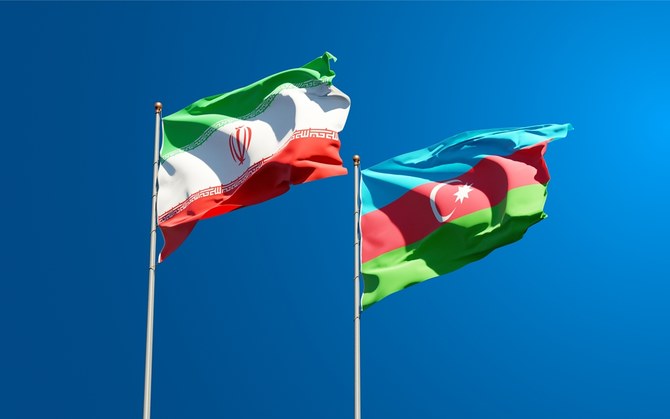
TEHRAN, Iran: Iran’s army put its wary neighbors on notice Thursday that it’s about to conduct a wide-ranging military exercise near its northwestern border amid long-simmering tensions with Azerbaijan.
The commander of the Iranian army’s ground forces, Gen. Kioumars Heidari, said the drill would test weapons, assess the combat readiness of troops and demonstrate the country’s military capabilities. It would involve drones, attack helicopters, tanks and artillery.
The state-run IRNA new agency’s report did not specify the exact area the exercise would cover. But the drill, which starts on Friday, is bound to put Iranian troops and weapons close to the tense border with Azerbaijan — a prospect that has already raised alarm in the ex-Soviet Caspian Sea nation.
Earlier this week, Azerbaijani President Ilham Aliyev said he was stunned by the planned drill in an interview with Turkey’s state-run Anadolu Agency.
“Every country can carry out any military drill on its own territory. It’s their sovereign right. But why now, and why on our border?” he said, noting it was the first time since the fall of the Soviet Union that Iran was intending to stage such a show of force so close to its border.
Iran long has been skeptical of Azerbaijan over its ties to the West and deep military cooperation with the Islamic Republic’s archrival, Israel.
Azerbaijan and Israel have strengthened their military alliance in recent months, with Israeli-supplied high-tech drones helping to tilt the conflict between Azerbaijan and Armenia over the Nagorno-Karabakh region in Baku’s favor last year.
Iran’s foreign ministry drew a direct connection between the country’s military drill and Azerbaijan’s ties to Israel in remarks earlier this week.
“It’s clear that the Islamic Republic of Iran will not tolerate the presence of the Zionist regime, even demonstratively, near its borders and in this regard it will take any action it deems necessary for its national security,” Foreign Ministry spokesman Saeed Khatibzadeh was quoted as saying by Iran’s semi-official ISNA news agency.
The tensions with Azerbaijan have also complicated a vital border passage that trucks use to ferry fuel and other goods from Iran to Armenia. Azerbaijani authorities have detained two Iranian truck drivers in recent weeks for trying to take the route, angering Iran.
The drill comes as the region remains on edge over Iran’s escalating nuclear program. Talks in Vienna to revive Tehran’s now-tattered 2015 accord with world powers stalled since June, with no date set for their resumption.

Iran’s army to hold drill near tense border with Azerbaijan
https://arab.news/65b4b
Iran’s army to hold drill near tense border with Azerbaijan
- The commander of the Iranian army's ground forces said the drill would test weapons, assess the combat readiness of troops and demonstrate the country's military capabilities
- The drill, which starts on Friday, is bound to put Iranian troops and weapons close to the tense border with Azerbaijan
Only 4% women on ballot as Bangladesh prepares for post-Hasina vote
- Women PMs have ruled Bangladesh for over half of its independent history
- For 2026 vote, only 20 out of 51 political parties nominated female candidates
DHAKA: As Bangladesh prepares for the first election since the ouster of its long-serving ex-prime minister Sheikh Hasina, only 4 percent of the registered candidates are women, as more than half of the political parties did not field female candidates.
The vote on Feb. 12 will bring in new leadership after an 18-month rule of the caretaker administration that took control following the student-led uprising that ended 15 years in power of Hasina’s Awami League party.
Nearly 128 million Bangladeshis will head to the polls, but while more than 62 million of them are women, the percentage of female candidates in the race is incomparably lower, despite last year’s consensus reached by political parties to have at least 5 percent women on their lists.
According to the Election Commission, among 1,981 candidates only 81 are women, in a country that in its 54 years of independence had for 32 years been led by women prime ministers — Hasina and her late rival Khaleda Zia.
According to Dr. Rasheda Rawnak Khan from the Department of Anthropology at Dhaka University, women’s political participation was neither reflected by the rule of Hasina nor Zia.
“Bangladesh has had women rulers, not women’s rule,” Khan told Arab News. “The structure of party politics in Bangladesh is deeply patriarchal.”
Only 20 out of 51 political parties nominated female candidates for the 2026 vote. Percentage-wise, the Bangladesh Socialist Party was leading with nine women, or 34 percent of its candidates.
The election’s main contender, the Bangladesh Nationalist Party, whose former leader Zia in 1991 became the second woman prime minister of a predominantly Muslim nation — after Pakistan’s Benazir Bhutto — was the party that last year put forward the 5 percent quota for women.
For the upcoming vote, however, it ended up nominating only 10 women, or 3.5 percent of its 288 candidates.
The second-largest party, Jamaat-e-Islami, has not nominated a single woman.
The 4 percent participation is lower than in the previous election in 2024, when it was slightly above 5 percent, but there was no decreasing trend. In 2019, the rate was 5.9 percent, and 4 percent in 2014.
“We have not seen any independent women’s political movement or institutional activities earlier, from where women could now participate in the election independently,” Khan said.
“Real political participation is different and difficult as well in this patriarchal society, where we need to establish internal party democracy, protection from political violence, ensure direct election, and cultural shifts around female leadership.”
While the 2024 student-led uprising featured a prominent presence of women activists, Election Commission data shows that this has not translated into their political participation, with very few women contesting the upcoming polls.
“In the student movement, women were recruited because they were useful, presentable for rallies and protests both on campus and in the field of political legitimacy. Women were kept at the forefront for exhibiting some sort of ‘inclusive’ images to the media and the people,” Khan said.
“To become a candidate in the general election, one needs to have a powerful mentor, money, muscle power, control over party people, activists, and locals. Within the male-dominated networks, it’s very difficult for women to get all these things.”


