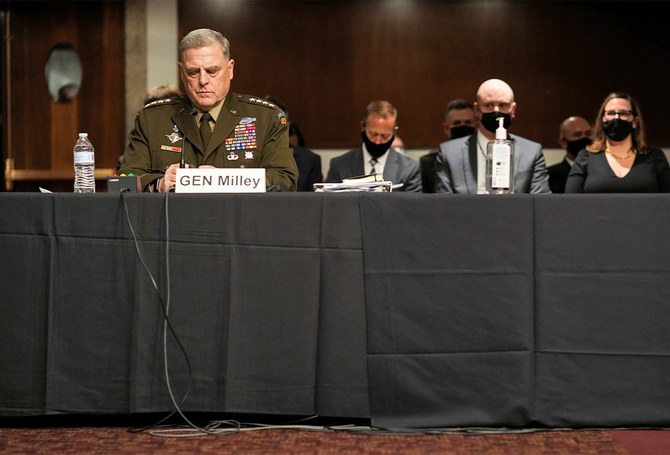
ISLAMABAD: US General Mark Milley, chairman of the Joint Chiefs of Staff, has said he had advised the US government that an “accelerated withdrawal” from Afghanistan would increase several risks, including to regional instability and the security of Pakistan and its nuclear arsenals.
He was speaking at his first public congressional testimony since the Taliban won the war in Afghanistan in August and the US concluded its troop withdrawal.
The general, 63, remained unshaken as Republicans called for his resignation during an already contentious hearing that was meant to focus on the chaotic US withdrawal.
“My job is to advise the President, Secretary of Defense, and National Security Council of various military options and associated costs, benefits, risk to force, and risk to mission,” Milley said, saying that in the fall of 2020, his analysis had been that an “accelerated withdrawal” without meeting necessary conditions risked losing the substantial gains made in Afghanistan, damaging US credibility, and a general collapse of the Afghan army and the Afghan government resulting in a complete Taliban takeover or a civil war.
“Additionally, we estimated an accelerated withdrawal would increase risks of regional instability, the security of Pakistan and its nuclear arsenals, a global rise in violent extremist organizations, our global credibility with allies and partners would suffer, and a narrative of abandoning the Afghans would become widespread,” the general said.
He also said there was a need to “fully examine the role of Pakistan sanctuary,” referring to accusations that Pakistan had provided safe havens to Afghan Taliban and allied militants over the years. Islamabad denies the charge.
Gen. Frank McKenzie, the leader of US Central Command, also spoke at the Senate Armed Services Committee, saying the relationship between Pakistan and the Taliban was likely to become more “complicated” in the future.
“I believe Pakistan’s relationship with the Taliban is going to become significantly more complicated as a result of the US withdrawal from Afghanistan,” McKenzie said, adding that the US was negotiating with Pakistan over the use of an air corridor to access Afghanistan.
“Over the last 20 years we’ve been able to use what we call the air boulevard to go in over western Pakistan and that’s become something that’s vital to us, as well as certain landlines of communication,” McKenzie said, “and we’ll be working with the Pakistanis in the days and weeks ahead to look at what that relationship is going to look like in the future.”


![]()

US general says had warned ‘accelerated’ Afghan withdrawal could risk security of Pakistan’s nukes
Short Url
https://arab.news/rym7e
US general says had warned ‘accelerated’ Afghan withdrawal could risk security of Pakistan’s nukes
- General Milley was speaking at his first public congressional testimony since the Taliban won the war in August
- CENTCOM leader General McKenzie says US negotiating with Pakistan over use of air corridor to access Afghanistan
Latest updates


© 2026 SAUDI RESEARCH & PUBLISHING COMPANY, All Rights Reserved And subject to Terms of Use Agreement.