

London’s Muslim mayor details stress of threats, police protection

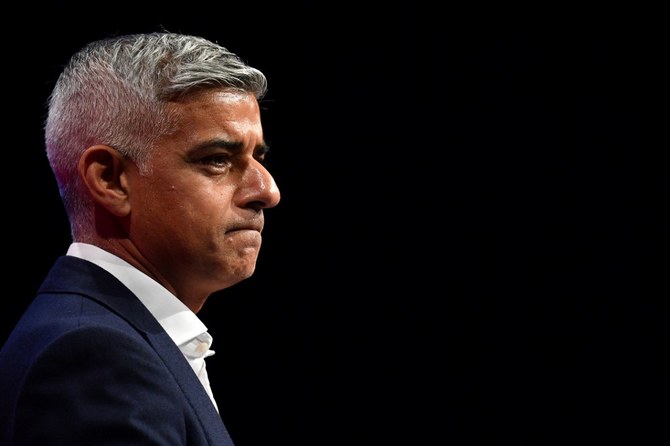
London Mayor Sadiq Khan told a gathering at the Labour Party conference in Brighton that being told by police that his family was at risk was a ‘game-changer.’ (AFP)
Short Url
Updated 29 September 2021
Follow

London’s Muslim mayor details stress of threats, police protection

  • Sadiq Khan outlines stringent security needs ‘because of the color of his skin and the God he worships’
  • Being told by police that his family was at risk was a ‘game-changer’

LONDON: London Mayor Sadiq Khan has described his “horrible” life of constant security after enduring years of threats over his race and Muslim faith.

“The mayor of the greatest city in the world needs protection 24 hours a day, seven days a week because of the color of his skin and the God he worships,” he said.

Khan told a gathering at the Labour Party conference in Brighton that being told by police that his family was at risk was a “game-changer,” and that adjusting to needing protection from 15 police officers was “tough.”

He added: “You can’t do anything spontaneously. Riding a bike to work, which I do often, is different for me than for you. Using the Tube, which I do, is different for me than for you. Going for a jog … it’s hard. Having sniffer dogs in your house is not fun. Not being able to answer your door is hard. To have to give your staff counseling because of the vitriol directed at me from letters, emails. It’s horrible.”

Khan said he had been reluctant to discuss the abuse and security risk he endures because he does not want to make others from minority backgrounds feel nervous about standing for political office. “It’s probably the first time I’ve talked about it. I might get emotional,” he told the audience.


EU assembly weighs freezing US trade deal over Trump’s Greenland threats

Updated 14 January 2026
Follow

EU assembly weighs freezing US trade deal over Trump’s Greenland threats

  • Signatories were mainly fellow members of Clausen’s Left Group, but also included center-left Social Democrats and Greens
  • Greens lawmaker Anna Cavazzini said the only argument in favor ⁠of the deal was to bring stability

BRUSSELS: The European Parliament is considering putting on hold the European Union’s implementation of the trade deal struck with the United States in protest over threats by US President Donald Trump to seize Greenland.
The European Parliament has been debating legislative proposals to remove many of the EU’s import duties on US goods — the bulk of the trade deal with the US — and to continue zero duties for US lobsters, initially agreed with Trump in 2020.
It was due to set its position in votes on January 26-27, which the MEPs said should now be postponed.
Leading members of the cross-parliamentary trade committee met to discuss the ⁠issue on Wednesday morning and decide whether to postpone the vote. In the end, they took no decision and settled on reconvening next week.
A parliamentary source said left-leaning and centrist groups favored taking action, such as a postponement.
A group of 23 lawmakers also urged the EU assembly’s president Roberta Metsola on Wednesday to freeze work on the agreement as long as ⁠the US administration continued its threats to take control of Greenland, an autonomous territory of Denmark.
“If we go through and approve a deal that Trump has seen as a personal victory, while he makes claims for Greenland and refuses to rule out any manner in which to achieve this, it will be easily seen as rewarding him and his actions,” the letter drafted by Danish lawmaker Per Clausen said.
Signatories were mainly fellow members of Clausen’s Left Group, but also included center-left Social Democrats and Greens.
Greens lawmaker Anna Cavazzini said the only argument in favor ⁠of the deal was to bring stability.
“Trump’s actions show again and again that chaos is his only offer,” she said.
French lawmaker Valerie Hayer, head of the centrist Renew Europe group, said on Tuesday the EU should consider holding off a vote if Trump’s threats continued.
Many lawmakers have complained that the US trade deal is lopsided, with the EU required to cut most import duties while the US sticks to a broad rate of 15 percent.
However, freezing the deal risks angering Trump, which could lead to higher US tariffs. The Trump administration has also ruled out any concessions, such as cutting tariffs on spirits or steel, until the deal is in place.