

PIF-backed Lucid to start deliveries of EVs with range exceeding Tesla’s in October

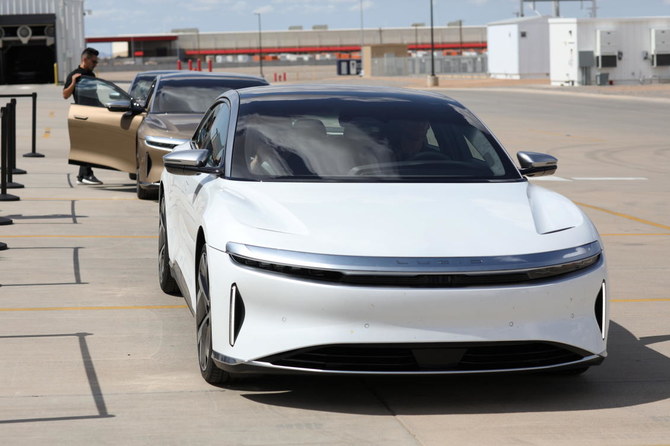
People test drive Dream Edition P and Dream Edition R electric vehicles at the Lucid Motors plant in Casa Grande, Arizona, US September 28, 2021. (Reuters)
Short Url
Updated 29 September 2021
Follow

PIF-backed Lucid to start deliveries of EVs with range exceeding Tesla’s in October

CASA GRANDE, Arizona: US startup Lucid Group Inc. said on Tuesday it will start delivering luxury electric sedans with a Tesla-beating driving range in late October, posing a major challenge to the market leader whose sales of premium models have stagnated.
The California-based Lucid began production of its long-delayed Lucid Air cars at its Arizona factory on Tuesday, and said it aims to ramp plant’s capacity up to 90,000 vehicles per annum in the next two years.
The top-end Lucid Air Dream Edition will be available in late October, followed by less expensive models: Grand Touring, Touring and Air Pure. The company said it has received more than 13,000 reservations for Lucid Air models, and it has increased the planned total production of the Lucid Air Dream Edition to 520 vehicles.
A version of the Lucid Air Dream Edition, priced at $169,000, received an official US government rating of a 520-mile (837 km) driving range, over 100 miles more than its closest rival, Tesla’s Model S, which is priced at $89,990. The higher range helped lead to a 23 percent jump in Lucid’s shares this month.
Speaking at the production site, Lucid Chief Executive Officer Peter Rawlinson, a former chief engineer on the Tesla Model S, said his company’s cars have an advantage in battery technology and costs over the Model S.
“We’ve ridden customers of the fear of range anxiety,” he said. “The next big obstacle is cost effectiveness of electric cars. We’ve got to get the cost down.”
He said the Air Pure, the least expensive version with a price tag of $77,400, will go into production late next year.

Execution challenge

The company, founded in 2007, received funding from Saudi Arabia’s Public Investment Fund in 2018 before going public via a shell company in July.
“(20)17 and (20)18 were brutal. The company was in a parlous state. And then I’ve got to say, we met a perfect partner,” he said.
Rawlinson, who left Tesla in 2012, faces tasks similar to those of Tesla in its early days, including how to address manufacturing challenges and scale up production.
“I think the big challenge for Lucid will be execution,” said Sam Abuelsamid, a principal analyst at Guidehouse Insights. “I think that they have a very good car. It’s very attractive.”
Tesla CEO Elon Musk said in June that Tesla has canceled its plan to launch a Model S Plaid+, with a target driving range of 520 miles, saying the Model S Plaid itself is “just so good.”
Musk reiterated this month that “production is hard.”
“Production with positive cash flow is extremely hard,” he said, citing carmakers’ razor-thin margins.
Tesla’s combined sales of Model S and Model X luxury models stood at only 1,890 in the second quarter of this year, down from 22,300 during the same period three years ago. Tesla does not break out figures for the two high-end models.
“The Model S doesn’t look fundamentally different from a Model S nine years ago,” Abuelsamid said. “In the premium market, customers are looking for the latest and greatest.”
Musk in October 2020 cut the price of its Model S, shortly after Lucid announced the pricing of its base model. “The gauntlet has been thrown down! The prophecy will be fulfilled,” he tweeted at that time.
Electric vehicle maker Rivian, backed by Amazon.com Inc. and now preparing for a public stock listing.
That move came ahead of similar expected moves by Tesla, General Motors Co. and Ford Motor Co.


PIF’s Humain invests $3bn in Elon Musk’s xAI prior to SpaceX acquisition

Updated 18 February 2026
Follow

PIF’s Humain invests $3bn in Elon Musk’s xAI prior to SpaceX acquisition

JEDDAH: Humain, an artificial intelligence company owned by Saudi Arabia’s Public Investment Fund, invested $3 billion in Elon Musk’s xAI shortly before the startup was acquired by SpaceX.

As part of xAI’s Series E round, Humain acquired a significant minority stake in the company, which was subsequently converted into shares of SpaceX, according to a press release.

The transaction reflects PIF’s broader push to position Saudi Arabia as a central hub in the global AI ecosystem, as part of its Vision 2030 diversification strategy.

Through Humain, the fund is seeking to combine capital deployment with infrastructure buildout, partnerships with leading technology firms, and domestic capacity development to reduce reliance on oil revenues and expand into advanced industries.

The $3 billion commitment offers potential for long-term capital gains while reinforcing the company’s role as a strategic, scaled investor in transformative technologies.

CEO Tareq Amin said: “This investment reflects Humain’s conviction in transformational AI and our ability to deploy meaningful capital behind exceptional opportunities where long-term vision, technical excellence, and execution converge, xAI’s trajectory, further strengthened by its acquisition by SpaceX, one of the largest technology mergers on record, represents the kind of high-impact platform we seek to support with significant capital.” 

The deal builds on a large-scale collaboration announced in November at the US-Saudi Investment Forum, where Humain and xAI committed to developing over 500 megawatts of next-generation AI data center and computing infrastructure, alongside deploying xAI’s “Grok” models in the Kingdom.

In a post on his X handle, Amin said: “I’m proud to share that Humain has invested $3 billion into xAI’s Series E round, just prior to its historic acquisition by SpaceX. Through this transaction, Humain became a significant minority shareholder in xAI.”

He added: “The investment builds on our previously announced 500MW AI infrastructure partnership with xAI in Saudi Arabia, reinforcing Humain’s role as both a strategic development partner and a scaled global investor in frontier AI.”

He noted that xAI’s trajectory, further strengthened by SpaceX’s acquisition, exemplifies the high-impact platforms Humain aims to support through strategic investments.

Earlier in February, SpaceX completed the acquisition of xAI, reflecting Elon Musk’s strategy to integrate AI with space exploration.

The combined entity, valued at $1.25 trillion, aims to build a vertically integrated innovation ecosystem spanning AI, space launch technology, and satellite internet, as well as direct-to-device communications and real-time information platforms, according to Bloomberg.

Humain, founded in August, consolidates Saudi Arabia’s AI initiatives under a single entity. From the outset, its vision has extended beyond domestic markets, participating across the global AI value chain from infrastructure to applications.

The company represents a strategic initiative by PIF to diversify the Kingdom’s economy and reduce oil dependence by investing in knowledge-based and advanced technologies.