

Saudi-backed Lucid breaks Tesla’s rating on electric car range

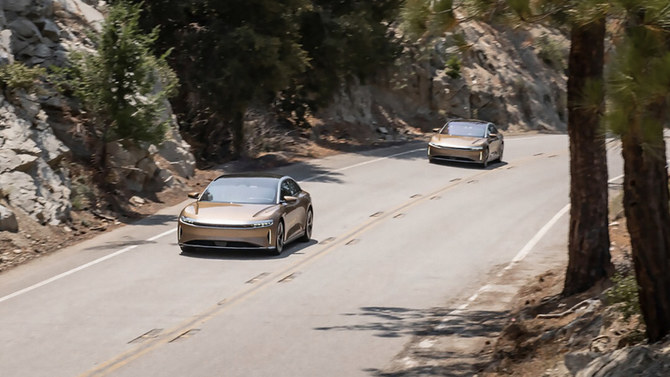
Lucid Air Dream Edition R is the longest-range electric car ever
Short Url
Updated 23 September 2021
Follow

Saudi-backed Lucid breaks Tesla’s rating on electric car range

  • Lucid's Air Dream model can go for 520 miles between charges
  • It beats Tesla's record

Saudi-backed electric car makers Lucid Motors are celebrating after one of its models smashed Tesla’s record for distance covered without needing a recharge.

The company’s Lucid Air Dream Edition R has been given a rating of 520 miles by the Environmental Protection Agency, making it the longest-range electric vehicle ever rated by the organisation.

The rating means the US-based company, which received $1 billion from Saudi Arabia's Public Investment Fund in April 2019, has beaten Tesla’s longest range vehicle by more than 100 miles.

Earlier this month it was announced that Lucia Motors will produce vehicles in Saudi Arabia by 2024, with the paperwork still being finalized.

Commenting on the EPA-rating, CEO Peter Rawlinson said: “I’m delighted that our Lucid Air Dream Edition Range has been officially accredited with a range of 520 miles by the EPA, a number I believe to be a new record for any EV. Crucially, this landmark has been achieved by Lucid’s world-leading, in-house EV technology, not by simply installing an oversize battery pack.

“Our race-proven 900V battery and BMS technology, our miniaturized drive units, coupled with our Wunderbox technology endow Lucid Air with ultra-high efficiency, enabling it to travel more miles from less battery energy. The next generation EV has truly arrived!”

In an exclusive drive with car review site MotorTrend, the Lucid Air Dream Edition R was taken from Los Angeles to San Francisco and back down to Lucid HQ in Newark — a 445-mile trip — with 72 miles to spare. 

Lucid Motors described this as “real-world testing, air conditioning on, pacing with the flow of traffic. The cruise control was set at a practical 67 mph”.

After the journey, MotorTrend’s Jonny Lieberman said: “Remember range anxiety? As with the internal combustion engine, it's a thing of the past.”

Lucid Motors — which is 67 percent owned by the Public Investment Fund — will be hoping the rating drums up pre-orders for their vehicles.

Its flagship Lucid Air model, priced at over $70,000, is due to launch early next year but has received only 11,000 orders to date.

That’s about half as many Teslas have been sold every month in the US alone this year, and just under 388,000 cars in total were sold in Saudi Arabia in 2020.


Saudi Arabia’s foreign reserves rise to a 6-year high of $475bn

Updated 22 February 2026
Follow

Saudi Arabia’s foreign reserves rise to a 6-year high of $475bn

RIYADH: Saudi Arabia’s foreign reserves climbed 3 percent month on month in January to SR1.78 trillion, up SR58.7 billion ($15.6 billion) from December and marking a six-year high.

On an annual basis, the Saudi Central Bank’s net foreign assets rose by 10 percent, equivalent to SR155.8 billion, according to data from the Saudi Central Bank, Argaam reported.

The reserve assets, a crucial indicator of economic stability and external financial strength, comprise several key components.

According to the central bank, also known as SAMA, the Kingdom’s reserves include foreign securities, foreign currency, and bank deposits, as well as its reserve position at the International Monetary Fund, Special Drawing Rights, and monetary gold.

The rise in reserves underscores the strength and liquidity of the Kingdom’s financial position and aligns with Saudi Arabia’s goal of strengthening its financial safety net as it advances economic diversification under Vision 2030.

The value of foreign currency reserves, which represent approximately 95 percent of the total holdings, increased by about 10 percent during January 2026 compared to the same month in 2025, reaching SR1.68 trillion.

The value of the reserve at the IMF increased by 9 percent to reach SR13.1 billion.

Meanwhile, SDRs rose by 5 percent during the period to reach SR80.5 billion.

The Kingdom’s gold reserves remained stable at SR1.62 billion, the same level it has maintained since January 2008.

Saudi Arabia’s foreign reserve assets saw a monthly rise of 5 percent in November, climbing to SR1.74 trillion, according to the Kingdom’s central bank.

Overall, the continued advancement in reserve assets highlights the strength of Saudi Arabia’s fiscal and monetary buffers. These resources support the national currency, help maintain financial system stability, and enhance the country’s ability to navigate global economic volatility.

The sustained accumulation of foreign reserves is a critical pillar of the Kingdom’s economic stability. It directly reinforces investor confidence in the riyal’s peg to the US dollar, a foundational monetary policy, by providing SAMA with ample resources to defend the currency if needed.

Furthermore, this financial buffer enhances the nation’s sovereign credit profile, lowers national borrowing costs, and provides essential fiscal space to navigate global economic volatility while continuing to fund its ambitious Vision 2030 transformation agenda.