Birth of Arabian leopard cub in Saudi Arabia hailed as important step in efforts to save species

1 / 2
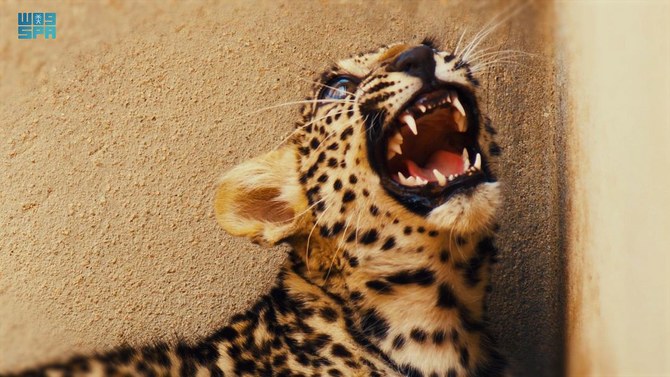
The International Union for Conservation of Nature classifies the Arabian leopard as critically endangered. (SPA)
2 / 2
The International Union for Conservation of Nature classifies the Arabian leopard as critically endangered. (SPA)
Short Url
Updated 30 September 2021
Follow

Birth of Arabian leopard cub in Saudi Arabia hailed as important step in efforts to save species

  • The cub is the latest of 16 born to date at the Arabian Leopard Breeding Center in the Prince Saud Al-Faisal Wildlife Research Center in Taif
  • The Arabian leopard is classified as “critically endangered;” numbers in the wild have declined to fewer than 200 because of poaching and loss of habitat

JEDDAH: A female Arabian leopard cub has been born in Saudi Arabia, authorities announced on Tuesday.

The Royal Commission for AlUla described the birth as an important step toward saving an endangered species and achieving the goal of rehabilitating local ecosystems.

The cub was born on April 23 at the Arabian Leopard Breeding Center in the Prince Saud Al-Faisal Wildlife Research Center in Taif, which is operated by the commission. She is the latest of 16 born as part of the captive-breeding program. The gender was determined when her first health check was carried out on July 13.

“This successful birth confirms that it is not too late to save the Arabian leopard,” said Amr Al-Madani, the CEO of the Royal Commission for AlUla. Efforts to save such endangered species from extinction are critical to the battle to protect the planet and restore the natural balance of ecosystems, which is a goal of the commission, he added.

The International Union for Conservation of Nature classifies the Arabian leopard as “critically endangered.” Its numbers in the wild have declined to fewer than 200 as a result of poaching and the loss of its natural habitat.

The commission’s efforts to save the species include a number of initiatives, including the expansion of the breeding program through the upcoming opening of an Arabian Leopard center at the Sharaan Nature Reserve in AlUla, and the establishment of the Arab Leopard Fund, to which the commission has allocated $25 million.


The International Union for Conservation of Nature classifies the Arabian leopard as critically endangered. (SPA)

The strategy is in line with the Saudi Green Initiative, which was launched this year, one of the aims of which is to establish 80 percent of AlUla — a UNESCO World Heritage site — as a nature reserve.

The program to save the Arabian leopard, and eventually reintroduce it to the wild in AlUla, also includes plans to reintroduce natural prey species such as the Nubian ibex and the mountain gazelle, along with the training of local people as park rangers to protect the reserves.

Images of Arabian leopards can be found among ancient rock art in several parts of AlUla, revealing the governorate’s rich natural environment throughout history.


14 sculptures go on display at public spaces in Riyadh

Updated 11 December 2025
Follow

14 sculptures go on display at public spaces in Riyadh

  • The works were chosen by Riyadh Art from its international Tuwaiq Sculpture symposium to reflect its ‘vision of weaving beauty and intellect into the city’s fabric’
  • Initiative aligns with efforts to make art a key part of city’s identity that improves quality of life and promotes the cultural economy, says Royal Commission for Riyadh City’s Khalid Al-Hazani

RIYADH: Fourteen sculptures selected from the annual international Tuwaiq Sculpture symposium, a Riyadh Art program, went on display on Wednesday at three prominent public spaces across the Saudi capital: ROSHN Front, the SEDRA residential community, and Sports Boulevard.

The project is part of Riyad Art’s efforts to showcase artworks in public spaces, and the addition of more works in other places is expected later.

Khalid Al-Hazani, the executive vice president of the lifestyle sector at the Royal Commission for Riyadh City, said: “This step reflects (Riyadh Art’s) vision of weaving beauty and intellect into the city’s fabric, and creating vibrant and culturally rich public spaces, allowing art to become an integral part of people’s daily lives.”

It is also in line with Riyadh Art’s broader strategy for transforming the city into an open-air art gallery, he added, thereby “turning art into a central element of the city’s identity and a key contributor to improving quality of life and promoting the cultural economy.” 

The Riyadh Art Program installed on Wednesday 14 sculptures selected from the Tuwaiq International Sculpture Symposium at prominent locations in Riyadh, including the ROSHN Front, SEDRA Residential Community, and Sports Boulevard. (Supplied)

The three chosen locations were considered perfect places to host the artworks because of their vibrancy, strong community connections and accessibility, Al-Hazani noted.

“This provides residents and visitors with the opportunity to engage with the sculptures in their everyday lives,” he said.

Seven of the sculptures have been installed at ROSHN Front, considered a key urban hub. The artworks on display there form a thought-provoking artistic landscape that encourages interaction, organizers said, and explores a number of themes including the values of urban transformation, community spirit, and creative curiosity.

Three sculptures are on display at the SEDRA residential community. Chosen to complement its serene character and nature-integrated urban planning, they blend in with their surroundings to reflect the values of environmental harmony, contemplation and renewal, organizers explained.

The remaining four sculptures are at Sports Boulevard, known for its open, green spaces. These works reflect several concepts, in particular ideas of nature, balance and public health.

All of the sculptures are part of Riyadh Art’s permanent collection, which includes works created by local and international artists during the Tuwaiq Sculpture symposium.