North Korea fires missile, accuses US of ‘double standards’

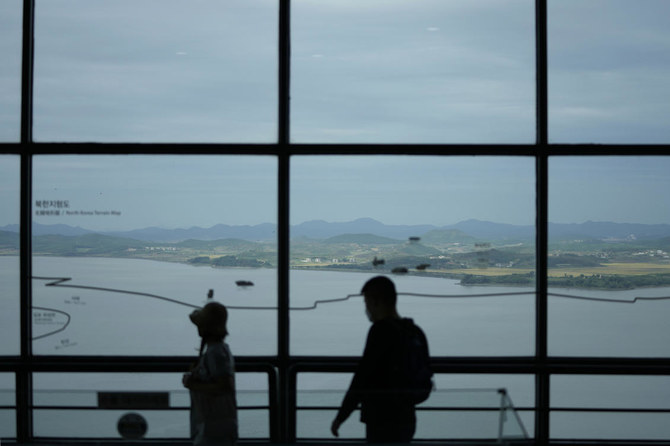
The latest weapon tests by North Korea that has raised questions about the sincerity of its recent offer for talks with South Korea. Above, North Korea’s Kaepoong town is seen as visitors tour to the unification observatory in Paju, South Korea. (AP)
Updated 28 September 2021
Follow

North Korea fires missile, accuses US of ‘double standards’

  • The missile was launched from the central north province of Jagang at around 6:40a.m.
  • The latest test underscored the steady development of North Korea’s weapons systems

SEOUL: North Korea fired a missile toward the sea off its east coast on Tuesday, South Korea’s military said, as Pyongyang called on the United States and South Korea to scrap their “double standards” on weapons programs to restart talks.
The missile was launched from the central north province of Jagang at around 6:40a.m., the South’s Joint Chiefs of Staff said. Japan’s defense ministry said it appeared to be a ballistic missile, without elaborating.
The latest test underscored the steady development of North Korea’s weapons systems, raising the stakes for stalled talks aimed at dismantling its nuclear and ballistic missile arsenals in return for US sanctions relief.
The launch came just before North Korea’s ambassador to the United Nations urged the United States to give up its hostile policy toward Pyongyang and said no one could deny his country’s right to self-defense and to test weapons.
South Korea’s President Moon Jae-in ordered aides to conduct a detailed analysis of the North’s recent moves.
“We regret that the missile was fired at a time when it was very important to stabilize the situation of the Korean peninsula,” defense ministry spokesman Boo Seung-chan told a briefing.
The US Indo-Pacific Command said the launch highlighted “the destabilizing impact” of the North’s illicit weapons programs, while the US State Department also condemned the test.
At the UN General Assembly, North Korea’s UN envoy, Kim Song, said the country was shoring up its self-defense and if the United States dropped its hostile policy and “double standards,” it would respond “willingly at any time” to offers to talks.
“But it is our judgment that there is no prospect at the present stage for the US to really withdraw its hostile policy,” Kim said.
Referring to a call by Moon last week for a formal end to the 1950-53 Korean War, Kim said Washington needed to permanently stop joint military exercises with South Korea and remove “all kinds of strategic weapons” on and around the peninsula.
The United States stations various cutting edge military assets including nuclear bombers and fighter jets in South Korea, Guam and Japan as part of efforts to keep not only North Korea but also an increasingly assertive China in check.
Kim’s speech was in line with Pyongyang’s recent criticism that Seoul and Washington denounce its weapons development while continuing their own military activities.
Kim Yo Jong, the powerful sister of North Korean leader Kim Jong Un, has said the North is willing to improve inter-Korean ties and consider another summit if Seoul abandons its double standards and hostile policy toward Pyongyang.
“The conditions she suggested were essentially to demand that the North be accepted as a nuclear weapons state,” said Shin Beom-chul, a senior fellow at the Korea Research Institute for National Strategy in Seoul.
“Their goal is to achieve that prestige and drive a wedge between Seoul and Washington, taking advantage of Moon’s craving for diplomatic legacy as his term is running out.”
Moon, a liberal who has prioritized inter-Korean ties, sees declaring an end to the Korean War, even without a peace treaty to replace an armistice, as a way to revive denuclearization negotiations between the North and the United States.
However, Moon, who has been in office for a single term, faces sagging popularity ahead of a presidential election in March.
Hopes for ending the war were raised after a historic summit between Kim Jong Un and then US President Donald Trump in Singapore in 2018. But that possibility, and the momentum for talks came to nothing, with talks stalled since 2019.


Ukraine hosts talks with security allies in Kyiv

Updated 11 sec ago
Follow

Ukraine hosts talks with security allies in Kyiv

KYIV: Ukraine is hosting security advisers for crunch talks on Saturday as Kyiv insists negotiations are zeroing in on a deal, while Russia claims a deadly New Year strike torpedoed the efforts.
Ukrainian President Volodymyr Zelensky said around 15 countries would attend the talks, along with representatives from the European Union and NATO, with a US delegation joining via video link.
Leaders from the so-called coalition of the willing are expected to convene in France next week after Saturday’s talks.
The latest peace push comes after Zelensky announced in his New Year’s Eve address that the US-brokered plan was “90 percent” ready, but cautioned that important territorial issues remain.
Russia occupies around a fifth of Ukraine and has hit its smaller neighbor with an almost daily barrage of missiles and drones that have killed thousands of civilians and displaced millions.
Kyiv has repeatedly said Russia is not interested in peace and is deliberately trying to sabotage diplomatic efforts in order to seize more Ukrainian territory.
Russia captured the most Ukrainian land last year since launching its all-out invasion in 2022, an AFP analysis showed.
Moscow has meanwhile accused Ukraine of carrying out a “terrorist attack” and “deliberately torpedoing” a peaceful resolution after a strike on a hotel in Kherson killed 28 people celebrating the New Year.
Moscow warned of “consequences,” but Ukraine said the attack targeted a military gathering that was closed to civilians.
AFP was not able to verify either account.

- Concessions -

After US special envoy Steve Witkoff boasted about putting peace efforts back on track in the New Year, Ukraine ordered the evacuation of more than 3,000 children and their parents from frontline settlements in the Zaporizhzhia and Dnipropetrovsk regions, where Russian troops have been advancing.
More than 150,000 people have been evacuated from front-line areas since June 1, according to Ukrainian Restoration Minister Oleksiy Kuleba.
Underlining the risks for civilians, authorities in Kharkiv reported on Saturday morning that another body had been pulled from the rubble after an aerial barrage reduced multi-story buildings to smoldering heaps.
At least two people, including a three-year-old, were killed and another 19 people wounded, local officials said.
Under the current US-backed blueprint for ending the war, Ukraine would cede parts of the eastern Donbas region and agree not to join NATO.
Zelensky said last week that Ukraine has been able to wrest some concessions, notably removing the provision that land seized by Moscow’s army would be recognized as Russian.
The Russian army captured more than 5,600 square kilometers (2,160 square miles), or 0.94 percent, of Ukrainian territory in 2025, according to an analysis of data from the Institute for the Study of War, which works with the Critical Threats Project.
This includes areas that Kyiv and military analysts say are controlled by Russia, as well as those claimed by Moscow’s army.
That is more land than the previous two years combined, though far short of the more than 60,000 square kilometers it took in the first year of its invasion.
Russia made its biggest advance in 2025 in November — 701 square kilometers — whereas the 244 square kilometers it gained in December was the smallest since March, the data showed.
Russian President Vladimir Putin has consistently told his citizens that the military intends to seize the rest of the Ukrainian land he has proclaimed as Russian if talks fail.

- New cabinet appointees -

Zelensky has shuffled his cabinet ahead of the January 6 summit in France.
He announced on Friday that he offered the defense ministry to his 34-year-old minister of digital transformation, Mikhailo Fedorov.
Without explaining his decision to replace Denys Shmygal, the Ukrainian leader said he had proposed the incumbent “head another area of government work that is no less important for our stability.”
Zelensky also recently named Ukrainian military intelligence chief Kyrylo Budanov to head his presidential office.
Budanov will succeed Zelensky’s most important ally, Andriy Yermak, who resigned in November after investigators raided his house as part of a sweeping corruption probe.
“At this time, Ukraine needs greater focus on security issues, the development of the Defense and Security Forces of Ukraine, as well as on the diplomatic track of negotiations,” Zelensky said.
“Kyrylo has specialized experience in these areas and sufficient strength to deliver results.”
Budanov said he had accepted the nomination and would “continue to serve Ukraine.”