South Korea to vaccinate 12 to 17 year-olds, give boosters to elderly

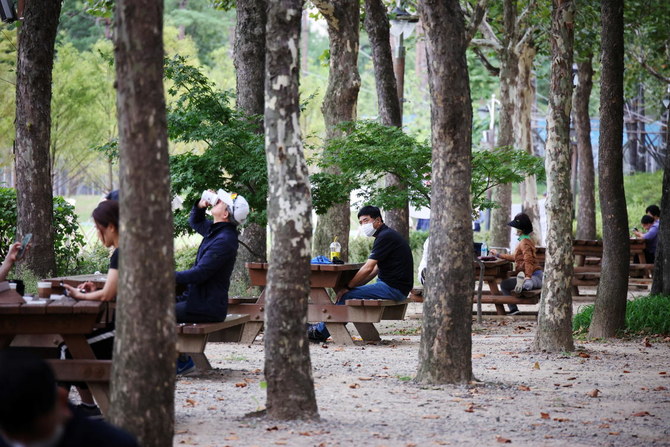
People rest as they keep social distancing to avoid the spread of the coronavirus disease at a park in Seoul, South Korea on Sept. 27, 2021. (Reuters)
Short Url
Updated 27 September 2021
Follow

South Korea to vaccinate 12 to 17 year-olds, give boosters to elderly

  • South Korea scrambled over the weekend to contain a surge in COVID-19 cases
  • Over 91 percent of the people aged 60 and above have so far received at least one dose

SEOUL: South Korea said on Monday it would begin inoculations next month for children aged 12 to 17 and offer COVID-19 vaccine booster shots to those 75 years and above as the country starts to transition to normalcy by the end of October.
South Korea, which has been battling a fourth wave of infections since early July, scrambled over the weekend to contain a surge in cases. Infections topped 3,000 for the first time fueled by last week’s public holidays.
The vaccination advisory committee of the Korea Disease Control and Prevention Agency (KDCA) has ruled that the benefits outweigh the risks in vaccinating children. However, parents who have healthy children, such as those who do not have underlying conditions, are advised to weigh the relative benefits in making their decision, KDCA Director Jeong Eun-kyeong told a news conference on Monday.
While approving vaccinations for 12 to 17 year-olds, who will be given Pfizer shots, the panel and the government had not mandated that all children should take the shot.
The United States had by August vaccinated 50 percent of 12-17 year-olds and some European and Asian countries, including Germany and the Philippines have also been recommending vaccines for the age group.
Jeong said the initial booster doses from Pfizer/BioNTech and Moderna will go to those with weakened immune systems or deemed to be at high risk — the elderly, nursing home patients and staff.
The country aims to boost vaccination and fully immunize 90 percent of those aged 60 and older, and 80 percent of 18 to 59 years-old by the end of October.
Over 91 percent of the people aged 60 and above have so far received at least one dose, and vaccinations are under way for those 18 and above, 86.3 percent of whom have already had the first shot.
South Korea has reported 2,383 new coronavirus cases for Sunday, bringing total infections to 303,553, with 2,456 deaths.
Despite the high daily case numbers, the country has kept its mortality rate and severe COVID-19 cases relatively low and steady at 0.81 percent and 319, respectively, as of Sunday.
Some 74.2 percent of its 52 million population have had at least one dose of a vaccine through Sunday, and more than 45 percent are fully vaccinated.


Geoeconomic confrontation tops global risks in 2026: WEF report

Updated 14 January 2026
Follow

Geoeconomic confrontation tops global risks in 2026: WEF report

  • Also armed conflict, extreme climate, public polarization, AI
  • None ‘a foregone conclusion,’ says WEF’s MD Saadia Zahidi

DUBAI: Geoeconomic confrontation has emerged as the top global risk this year, followed by state-based armed conflict, according to a new World Economic Forum report.

The Global Risks Report 2026, released on Wednesday, found that both risks climbed eight places year-on-year, underscoring a sharp deterioration in the global outlook amid increased international competition.

The top five risks are geoeconomic confrontation (18 percent of respondents), state-based armed conflict (14 percent), extreme weather events (8 percent), societal polarization (7 percent) and misinformation and disinformation (7 percent).

The WEF’s Managing Director Saadia Zahidi said the report “offers an early warning system as the age of competition compounds global risks — from geoeconomic confrontation to unchecked technology to rising debt — and changes our collective capacity to address them.

“But none of these risks are a foregone conclusion.”

The report assesses risks across three timeframes: immediate (2026); short-to-medium term (next two years); and long term (next 10 years).

Economic risks show the largest overall increase in the two-year outlook, with both economic downturn and inflation jumping eight positions.

Misinformation and disinformation rank fifth this year but rise to second place in the two-year outlook and fourth over the 10-year horizon.

The report suggests this reflects growing anxiety around the rapid adoption of artificial intelligence, with adverse outcomes linked to AI surging from 30th place in the two-year timeframe to fifth in the 10-year outlook.

Uncertainty dominates the global risk outlook, according to the report.

Surveyed leaders and experts view both the short- and long-term outlook negatively, with 50 percent expecting a turbulent or stormy global environment over the next two years, rising to 57 percent over the next decade.

A further 40 percent and 32 percent, respectively, describe the outlook as unsettled across the two- and 10-year timeframes, while just 1 percent anticipate a calm global outlook in either period.

Environmental risks ease slightly in the short-term rankings. Extreme weather fell from second to fourth place and pollution from sixth to ninth. Meanwhile, critical changes to Earth systems and biodiversity loss dropped seven and five positions, respectively.

However, over the next decade, environmental threats re-emerge as the most severe, with extreme weather, biodiversity loss, and critical changes to Earth systems topping the global risk rankings.

Looking ahead over the next decade, around 75 percent of respondents anticipate a turbulent or stormy environmental outlook, making it the most pessimistic assessment across all risk categories.

Zahidi said that “the challenges highlighted in the report underscore both the scale of the potential perils we face and our shared responsibility to shape what comes next.”

Despite the gloomy outlook, Zahidi signaled a positive shift in global cooperation.

 “It is also clear that new forms of global cooperation are already unfolding even amid competition, and the global economy is demonstrating resilience in the face of uncertainty.”

Now in its 21st year, the Global Risks Report highlights a core message: global risks cannot be managed without cooperation.

As competition intensifies, rebuilding trust and new forms of collaboration will be critical, with the report stressing that today’s decisions will shape future outcomes.

The report was released ahead of WEF’s annual meeting, which will be held in Davos from Jan. 19 to 23.