

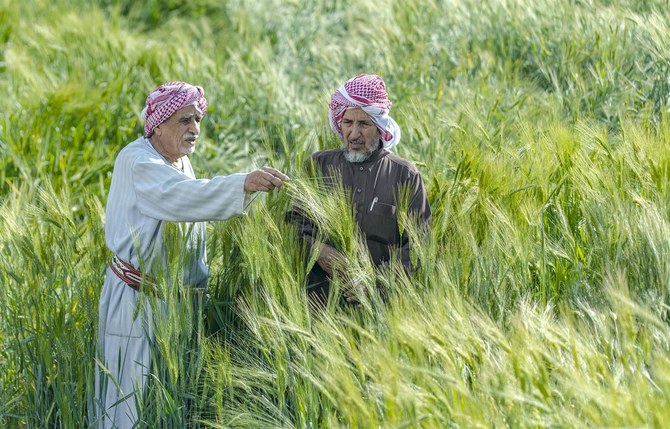
Saudi agriculture fund finances projects worth $480m

Short Url
Updated 26 September 2021
Follow

Saudi agriculture fund finances projects worth $480m

RIYADH: Saudi Arabia’s Agricultural Development Fund approved funds worth SR1.8 billion ($480 million) to support different agricultural projects in the Kingdom since the beginning of the year, Argaam reported citing an official statement.
At a recent G20 meeting in Italy, Saudi Minister of Environment, Water and Agriculture Abdul Rahman Al-Fadhli said the Kingdom has allocated SR12 billion to support small farmers.
The minister noted that agricultural investments in Saudi Arabia, funded by the Agricultural Development Fund, have grown over the past four years by about 400 percent, which has contributed to building a resilient and sustainable food system.
The Kingdom has turned to modern technical methods in the field of agricultural extension, with the aim of reaching the largest segment of farmers in a faster and more efficient manner, the minister said.


Maersk latest shipping firm to halt Gulf cargo bookings as Iran conflict pushes up insurance costs 

Updated 15 sec ago
Follow

Maersk latest shipping firm to halt Gulf cargo bookings as Iran conflict pushes up insurance costs 

JEDDAH: Danish shipping giant Maersk has suspended cargo bookings to and from several Gulf markets in light of the war in Iran, becoming the latest logistics company to reassess its operations in the region.

The firm has halted new business related to the UAE, Kuwait, and Qatar, as well as Iraq, Bahrain, parts of Saudi Arabia and most ports in Oman “until further notice” after a fresh risk assessment.  

In a statement, Maersk added that “exceptions will be made for critical foodstuff, medicine and other essential goods,” and the measure does not apply to Jordan and Lebanon. Two of its vessels are currently in the Gulf.

This comes as Iran’s Revolutionary Guards said on March 5 that passage through the critical transit passage of the Strait of Hormuz would remain under Iranian control during wartime and claimed a US tanker had been hit in the northern Gulf, though there was no immediate independent confirmation of the incident. 

The strait is a critical transit route for roughly 20 percent of global crude oil shipments and significant volumes of liquefied natural gas. 

Khaled Ramadan, an economist and head of the International Center for Strategic Studies in Cairo, said oil and gas transit through Hormuz could fall by as much as 80 percent if tensions intensify, driving up prices and creating shortages. 

“This crisis will also hamper global trade by escalating freight and insurance costs, forcing vessel rerouting, and causing widespread supply chain delays, particularly for oil-dependent economies,” he told Arab News. 

Hapag-Lloyd said on March 5 it would implement contingency procedures for cargo already in transit to and from the Upper Gulf after suspending all shipments to and from the area. 

The company said vessels may be diverted to contingency ports or held in safe waters for shipments linked to the UAE, Saudi Arabia, and Kuwait, as well as Qatar, Bahrain, Iraq, Oman and Yemen. 

Chinese shipping line COSCO Shipping has halted new container bookings to multiple Gulf ports following traffic restrictions in the Strait of Hormuz, while Mediterranean Shipping Co. has announced the end of a voyage. 

In a statement on March 3, MSC said: “In light of the ongoing situation in the Middle East, MSC regrets to inform you that it is compelled to declare an End of Voyage for all shipments currently under MSC’s custody and care, whether located ashore or at sea, and destined for ports in the Arabian Gulf.” 

It added that all shipments already en route will be diverted to the nearest safe port, with a mandatory $800 surcharge per container to cover deviation costs. 

MSC later said Gulf-bound cargo would be offloaded at the closest safe seaport amid ongoing hostilities following US and Israeli attacks on Iran. 

CMA CGM has also introduced emergency measures for Gulf-bound vessels, prioritizing the safety of crews, ships, and cargo. 

APM Terminals Bahrain declared force majeure at Khalifa Bin Salman Port, saying regional security conditions were disrupting port operations and that the duration of the disruption remained uncertain. 

Insurance providers have also reduced Gulf exposure. Reuters reported that Angus Blayney of Gallagher said London insurers were still offering cover, but at sharply higher premiums depending on cargo, vessel type and route. 

Separately, the agency reported that insurance broker Marsh McLennan said it had met US officials to explore ways to restore maritime trade as escalating fighting threatens energy shipments through the Strait of Hormuz.