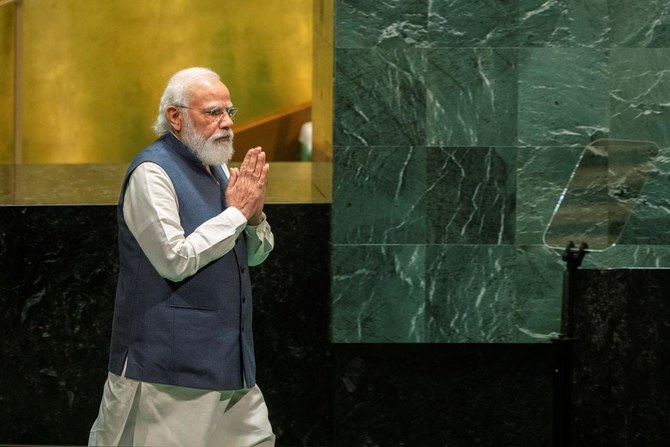
NEW YORK: Indian Prime Minister Narendra Modi didn’t directly mention Pakistan or China in his Saturday speech to the United Nations General Assembly, but the targets of his address were clear.
He called upon the international community to help the women, children and minorities of Afghanistan and said that it was imperative the country not be used as a base from which to spread terror.
“We also need to be alert and ensure that no country tries to take advantage of the delicate situation there, and use it as a tool for its own selfish interests,” he said in an apparent reference to Pakistan, wedged in between Afghanistan and India.
Modi also highlighted what he called the need to protect oceans from “the race for expansion and exclusion.” India and China have long competed for influence in the Indian Ocean.
On the heels of waves of coronavirus surges that have ravaged India, Modi made no mention of his own country’s death toll. But he reaffirmed last week’s announcement that India would restart exporting vaccines next month.
“Deeply conscious of its responsibility toward mankind, India has resumed the process of providing vaccines to those who need it in the world,” Modi said, also inviting vaccine manufacturers to come to India.
Modi said it was incumbent on the United Nations itself to strengthen its own effectiveness and boost its credibility.
“Today, all kinds of questions have been raised about the UN,” he said. “We have seen such questions being raised related to the climate crisis. And we also saw that during COVID, the proxy war going on in many parts of the world, terrorism, and the recent Afghan crisis have further highlighted the seriousness of these questions.”

India’s Modi targets neighbors at UN, but not by name
Short Url
https://arab.news/49pkx
India’s Modi targets neighbors at UN, but not by name
- Modi called upon the international community to help the women, children and minorities of Afghanistan
- He made no mention of India’s death toll but reaffirmed announcement that it would restart exporting vaccines
Afghans mourn villagers killed in Pakistani strikes
- Afghans gathered around a mass grave Sunday to bury villagers killed in overnight air strikes by Pakistan, which said its military targeted militants
BIHSUD: Afghans gathered around a mass grave Sunday to bury villagers killed in overnight air strikes by Pakistan, which said its military targeted militants.
The overnight attacks killed at least 18 people and were the most extensive since border clashes in October, which left more than 70 dead on both sides and wounded hundreds.
“The house was completely destroyed. My children and family members were there. My father and my sons were there. All of them were killed,” said Nezakat, a 35-year-old farmer in Bihsud district, who only gave one name.
Islamabad said it hit seven sites along the border region targeting Afghanistan-based militant groups, in response to suicide bombings in Pakistan.
The military targeted the Pakistani Taliban and its associates, as well as an affiliate of the Daesh group, a statement by the Ministry of Information and Broadcasting said.
Afghan government spokesperson Zabihullah Mujahid said “people’s homes have been destroyed, they have targeted civilians, they have committed this criminal act” with the bombardment of Nangarhar and Paktika provinces.
Residents from around the remote Bihsud district in Nangarhar joined searchers to look for bodies under the rubble, an AFP journalist said, using shovels and a digger.
“People here are ordinary people. The residents of this village are our relatives. When the bombing happened, one person who survived was shouting for help,” said neighbor Amin Gul Amin, 37.
Nangarhar police told AFP the bombardment started at around midnight and hit three districts, with those killed all in a civilian’s house.
“Twenty-three members of his family were buried under the rubble, of whom 18 were killed and five wounded,” said police spokesperson Sayed Tayeeb Hammad.
Strikes elsewhere in Nangarhar wounded two others, while in Paktika an AFP journalist saw a destroyed guesthouse but there were no immediate reports of casualties.
- ‘Calculated response’ -
Afghanistan’s defense ministry said it will “deliver an appropriate and calculated response” to the Pakistani strikes.
The two countries have been locked in an increasingly bitter dispute since the Taliban authorities retook control of Afghanistan in 2021.
Pakistani military action killed 70 Afghan civilians between October and December, according to the UN mission in Afghanistan.
Several rounds of negotiations followed an initial ceasefire brokered by Qatar and Turkiye, but they have failed to produce a lasting agreement.
Saudi Arabia intervened this month, mediating the release of three Pakistani soldiers captured by Afghanistan in October.
The deteriorating relationship has hit people in both countries, with the land border largely shut for months.
Pakistan said Sunday that despite repeated urging by Islamabad, the Taliban authorities have failed to act against militant groups using Afghan territory to carry out attacks in Pakistan.
The Afghan government has denied harboring militants.
Islamabad launched the strikes after a suicide blast at a Shiite mosque in Islamabad two weeks ago and other such attacks more recently in northwestern Pakistan.
The Daesh group had claimed responsibility for the mosque bombing, which killed at least 40 people and wounded more than 160 in the deadliest attack in Islamabad since 2008.
The militant group’s regional chapter, Islamic State-Khorasan, also claimed a deadly suicide bombing at a Kabul restaurant last month.
The overnight attacks killed at least 18 people and were the most extensive since border clashes in October, which left more than 70 dead on both sides and wounded hundreds.
“The house was completely destroyed. My children and family members were there. My father and my sons were there. All of them were killed,” said Nezakat, a 35-year-old farmer in Bihsud district, who only gave one name.
Islamabad said it hit seven sites along the border region targeting Afghanistan-based militant groups, in response to suicide bombings in Pakistan.
The military targeted the Pakistani Taliban and its associates, as well as an affiliate of the Daesh group, a statement by the Ministry of Information and Broadcasting said.
Afghan government spokesperson Zabihullah Mujahid said “people’s homes have been destroyed, they have targeted civilians, they have committed this criminal act” with the bombardment of Nangarhar and Paktika provinces.
Residents from around the remote Bihsud district in Nangarhar joined searchers to look for bodies under the rubble, an AFP journalist said, using shovels and a digger.
“People here are ordinary people. The residents of this village are our relatives. When the bombing happened, one person who survived was shouting for help,” said neighbor Amin Gul Amin, 37.
Nangarhar police told AFP the bombardment started at around midnight and hit three districts, with those killed all in a civilian’s house.
“Twenty-three members of his family were buried under the rubble, of whom 18 were killed and five wounded,” said police spokesperson Sayed Tayeeb Hammad.
Strikes elsewhere in Nangarhar wounded two others, while in Paktika an AFP journalist saw a destroyed guesthouse but there were no immediate reports of casualties.
- ‘Calculated response’ -
Afghanistan’s defense ministry said it will “deliver an appropriate and calculated response” to the Pakistani strikes.
The two countries have been locked in an increasingly bitter dispute since the Taliban authorities retook control of Afghanistan in 2021.
Pakistani military action killed 70 Afghan civilians between October and December, according to the UN mission in Afghanistan.
Several rounds of negotiations followed an initial ceasefire brokered by Qatar and Turkiye, but they have failed to produce a lasting agreement.
Saudi Arabia intervened this month, mediating the release of three Pakistani soldiers captured by Afghanistan in October.
The deteriorating relationship has hit people in both countries, with the land border largely shut for months.
Pakistan said Sunday that despite repeated urging by Islamabad, the Taliban authorities have failed to act against militant groups using Afghan territory to carry out attacks in Pakistan.
The Afghan government has denied harboring militants.
Islamabad launched the strikes after a suicide blast at a Shiite mosque in Islamabad two weeks ago and other such attacks more recently in northwestern Pakistan.
The Daesh group had claimed responsibility for the mosque bombing, which killed at least 40 people and wounded more than 160 in the deadliest attack in Islamabad since 2008.
The militant group’s regional chapter, Islamic State-Khorasan, also claimed a deadly suicide bombing at a Kabul restaurant last month.
© 2026 SAUDI RESEARCH & PUBLISHING COMPANY, All Rights Reserved And subject to Terms of Use Agreement.


