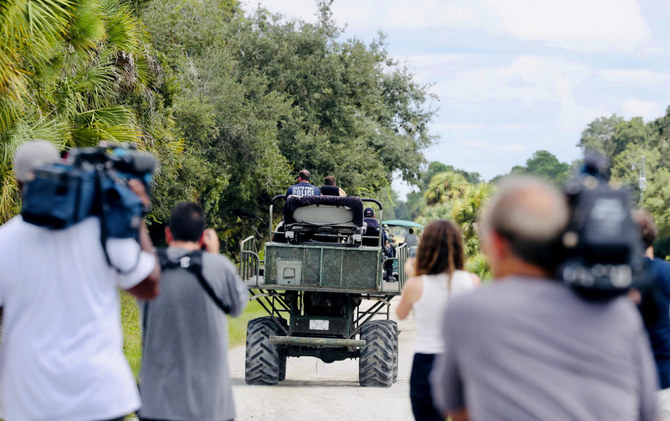
The exhaustive search for slain travel blogger Gabby Petito’s fiancé in a vast Florida wilderness entered a sixth day on Thursday as the mystery deepened around a case that has engrossed Americans.
A team of divers joined police and FBI agents using boats and helicopters looking for Brian Laundrie, 23, in the alligator-infested Carlton Reserve on Wednesday, but a spokesman said at nightfall that they had found “nothing” to show for their efforts.
Authorities have not said why they are convinced Laundrie, whom police call a “person of interest” in the case, may still be somewhere inside the more than 9,700-hectare wilderness preserve near his home in North Port, Florida, more than a week after he told family members he was headed there to hike alone.
North Port police say Laundrie’s parents did not report him missing until Sept. 14, three days after the family last saw him. The Carlton Reserve has more than 128 km of hiking trails but is dominated by swampy water.
Many Americans have closely followed the case since Petito, 22, was reported missing on Sept. 11. Ten days earlier, Laundrie had returned home to North Port without her from a cross-country road trip the couple chronicled in social media posts.
Petito’s body was discovered on Sunday in a remote corner of the Bridger-Teton National Forest in western Wyoming, less than 300m from where, on the evening of Aug. 27, another pair of travel bloggers caught video images of the couple’s white Ford Transit parked on a dirt road.
In identifying her remains, Teton County medical examiners ruled Petito’s death a homicide, but did not make the cause of her death public.
Petito and Laundrie left her home state of New York in July, heading west on what they called a “van life” trip. They posted photos to social media as they traveled through Kansas, Colorado and Utah.
Witnesses last saw Petito on Aug. 24 as she left a Salt Lake City hotel. She posted her final photo the next day.
Petito’s family believes she was headed to Grand Teton National Park when they last heard from her. Her body was found at the edge of that park near the Spread River.
Investigators searched the Laundrie family home in North Port last week and were seen loading cardboard boxes into a van and towing away a silver Ford Mustang.
In seeking search warrants, investigators cited text messages from Petito’s phone to her mother, Nicole Schmidt, that struck Schmidt as suspicious.
The final text from Petito’s phone came on Aug. 30 and read only: “No service in Yosemite,” a national park in California that she and Laundrie are not believed to have visited during their trip.
On Aug. 12, a 911 caller reported to emergency dispatchers that Laundrie was slapping and hitting Petito in front of the Moonflower Community Cooperative in Moab, Utah.
Moab police pulled the couple over in their van on a highway near Arches National Park. Body camera footage of that encounter shows Petito sobbing as she describes a fight between the couple that she said escalated into her slapping Laundrie as he drove the van.
The officers did not detain Petito or Laundrie but told them to spend the night apart.

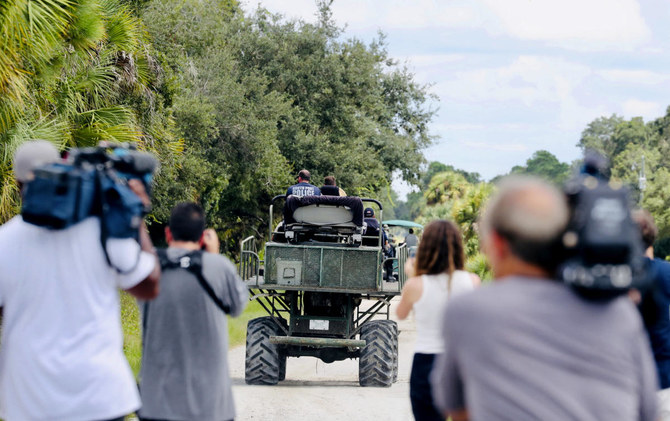
Search for Gabby Petito’s fiancé in Florida wilderness enters sixth day
https://arab.news/5zzvt
Search for Gabby Petito’s fiancé in Florida wilderness enters sixth day
- Mystery deepens around a case that has engrossed Americans
- Many Americans have closely followed the case since Petito as reported missing on September 11
House Republicans barely defeat Venezuela war powers resolution to check Trump’s military actions
WASHINGTON: The House rejected a Democratic-backed resolution Thursday that would have prevented President Donald Trump from sending US military forces to Venezuela after a tied vote on the legislation fell just short of the majority needed for passage.
The tied vote was the latest sign of Republican House Speaker Mike Johnson’s tenuous hold on the majority, as well as some of the growing pushback in the GOP-controlled Congress to Trump’s aggressions in the Western Hemisphere. A Senate vote on a similar resolution was also tied last week until Vice President JD Vance broke the deadlock.
To defeat the resolution Thursday, Republican leaders had to hold the vote open for more than 20 minutes while Republican Rep. Wesley Hunt, who had been out of Washington all week campaigning for a Senate seat in Texas, rushed back to Capitol Hill to cast the decisive vote.
On the House floor, Democrats responded with shouts that Republican leaders were violating the chamber’s procedural rules. Two Republicans — Reps. Don Bacon of Nebraska and Thomas Massie of Kentucky — voted with all Democrats for the legislation.
The war powers resolution would have directed Trump to remove US troops from Venezuela. The Trump administration told senators last week that there are no US troops on the ground in the South American nation and committed to getting congressional approval before launching major military operations there.
But Democrats argued that the resolution is necessary after the US raid to capture Venezuelan leader Nicolás Maduro and since Trump has stated plans to control the country’s oil industry for years to come.
The response to Trump’s foreign policy
Thursday’s vote was the latest test in Congress of how much leeway Republicans will give a president who campaigned on removing the US from foreign entanglements but has increasingly reached for military options to impose his will in the Western Hemisphere. So far, almost all Republicans have declined to put checks on Trump through the war powers votes.
Rep. Brian Mast, the Republican chair of the House Armed Services Committee, accused Democrats of bringing the war powers resolution to a vote out of “spite” for Trump.
“It’s about the fact that you don’t want President Trump to arrest Maduro, and you will condemn him no matter what he does, even though he brought Maduro to justice with possibly the most successful law enforcement operation in history,” Mast added.
Still, Democrats stridently argued that Congress needs to assert its role in determining when the president can use wartime powers. They have been able to force a series of votes in both the House and Senate as Trump, in recent months, ramped up his campaign against Maduro and set his sights on other conflicts overseas.
“Donald Trump is reducing the United States to a regional bully with fewer allies and more enemies,” Rep. Gregory Meeks, the top Democrat on the House Foreign Affairs Committee, said during a floor debate. “This isn’t making America great again. It’s making us isolated and weak.”
Last week, Senate Republicans were only able to narrowly dismiss the Venezuela war powers resolution after the Trump administration persuaded two Republicans to back away from their earlier support. As part of that effort, Secretary of State Marco Rubio committed to a briefing next week before the Senate Foreign Relations Committee.
Yet Trump’s insistence that the US will possess Greenland over the objections of Denmark, a NATO ally, has alarmed some Republicans on Capitol Hill. They have mounted some of the most outspoken objections to almost anything the president has done since taking office.
Trump this week backed away from military and tariff threats against European allies as he announced that his administration was working with NATO on a “framework of a future deal” on Arctic security.
But Bacon still expressed frustration with Trump’s aggressive foreign policy and voted for the war powers resolution even though it only applies to Venezuela.
“I’m tired of all the threats,” he said.
Trump’s recent military actions — and threats to do more — have reignited a decades-old debate in Congress over the War Powers Act, a law passed in the early 1970s by lawmakers looking to claw back their authority over military actions.
The war powers debate
The War Powers Resolution was passed in the Vietnam War era as the US sent troops to conflicts throughout Asia. It attempted to force presidents to work with Congress to deploy troops if there hasn’t already been a formal declaration of war.
Under the legislation, lawmakers can also force votes on legislation that directs the president to remove US forces from hostilities.
Presidents have long tested the limits of those parameters, and Democrats argue that Trump in his second term has pushed those limits farther than ever.
The Trump administration left Congress in the dark ahead of the surprise raid to capture Maduro. It has also used an evolving set of legal justifications to blow up alleged drug boats and seize sanctioned oil tankers near Venezuela.
Democrats question who gets to benefit from Venezuelan oil licenses
As the Trump administration oversees the sale of Venezuela’s petroleum worldwide, Senate Democrats are also questioning who is benefiting from the contracts.
In one of the first transactions, the US granted Vitol, the world’s largest independent oil broker, a license worth roughly $250 million. A senior partner at Vitol, John Addison, gave roughly $6 million to Trump-aligned political action committees during the presidential election, according to donation records compiled by OpenSecrets.
“Congress and the American people deserve full transparency regarding any financial commitments, promises, deals, or other arrangements related to Venezuela that could favor donors to the President’s campaign and political operation,” 13 Democratic senators wrote to White House Chief of Staff Susie Wiles Thursday in a letter led by Democratic Sen. Adam Schiff of California.
The White House has said it is safeguarding the South American country’s oil for the benefit of both the people of Venezuela and the US