

Afghan girls school ban is ‘not Islamic,’ Pakistani PM says

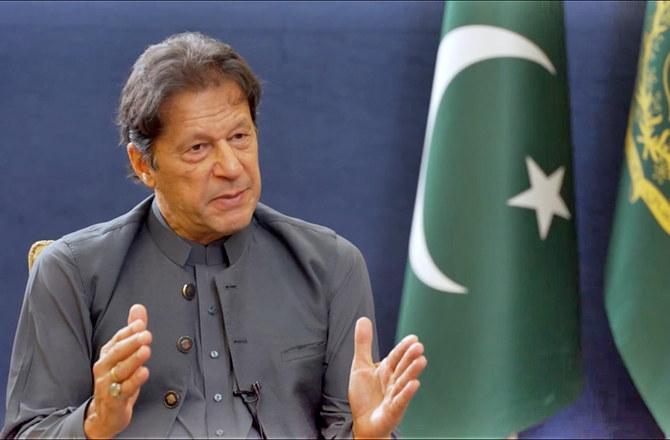
Pakistan Prime Minister, Imran Khan gestures during his interview to BBC in Islamabad, Pakistan, on September 21, 2021. (Screen grab from BBC interview video)
Short Url
Updated 22 September 2021
Follow

Afghan girls school ban is ‘not Islamic,’ Pakistani PM says

  • Says believes Taliban will allow women right to education
  • Calls on international community to give Taliban more time

ISLAMABAD: Pakistani Prime Minister Imran Khan has said preventing women from accessing education in neighboring Afghanistan would be un-Islamic.
In an interview with the BBC broadcast on Tuesday, Khan laid out the conditions that would need to be met for Pakistan to formally recognize the new Taliban government, which included an inclusive government and respect for human rights.
He also said Afghanistan should not be used to house ‘terrorists’ who could threaten Pakistan’s security.
Last week, the Taliban excluded girls from secondary schools with only boys and male teachers allowed back. But Pakistan’s leader said he believed girls would soon be able to attend.
“The statements they have made since they came to power have been very encouraging,” he told the BBC’s John Simpson. “I think they will allow women to go to schools … The idea that women should not be educated is just not Islamic. It has nothing to do with religion.”
Since the Taliban took control of Afghanistan in August, fears have grown over a return to the regime of the 1990s when the hard-line group severely restricted women’s rights.
Its leadership maintains that the rights of women will be respected “within the framework of Islamic law.”
The decision to exclude girls from returning to school last week prompted an international outcry, with a Taliban spokesman later saying they would return to the classroom “as soon as possible.”

But it is not yet clear when girls will be able to return or what form of education will be provided if they do.
When pressed on whether the Taliban would realistically meet his criteria for formal recognition, Khan repeatedly called on the international community to give the group more time.
“It’s just too early to say anything,” he said, adding that he expected Afghan women to eventually “assert their rights.”
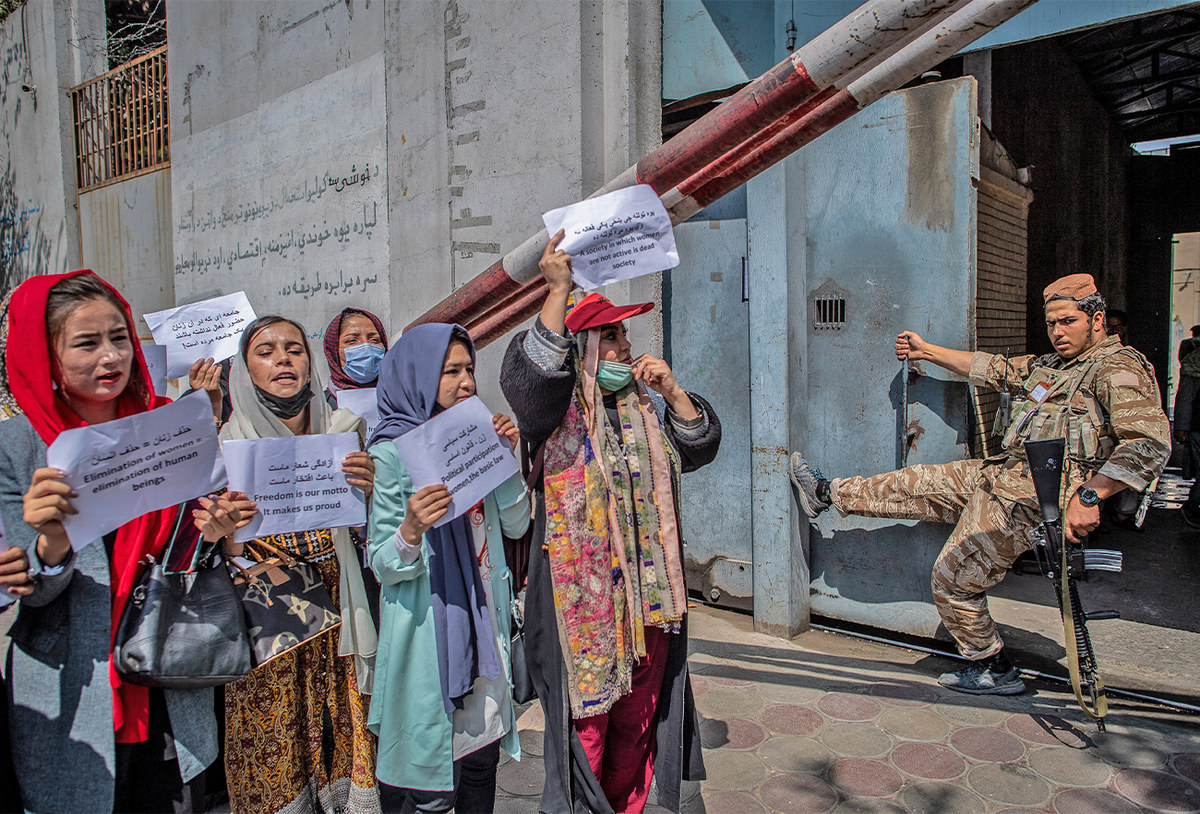


A Taliban fighter watches as Afghan women hold placards during a demonstration demanding better rights for women in front of the former Ministry of Women Affairs in Kabul on September 19, 2021. (AFp)

Khan said Pakistan would make a decision on whether to formally recognize the Taliban government alongside other neighboring states.
“All neighbors will get together and see how they progress,” he said. “Whether to recognize them or not will be a collective decision.”
He also called on the Taliban to form an inclusive government, warning that a failure to do so could see the country descend into civil war.
“If they do not include all the factions, sooner or later they will have a civil war,” he said. “That would mean an unstable, chaotic, Afghanistan and an ideal place for terrorists. That is a worry.”


Pakistan Army’s logistics firm to run national shipping corporation, confirm officials

Updated 4 sec ago
Follow

Pakistan Army’s logistics firm to run national shipping corporation, confirm officials

  • Government to transfer 30 percent shares in Pakistan National Shipping Corporation, management control to NLC firm, say officials
  • Officials say the move will increase PNSC’s shipping fleet from 10 to 54, save $6 billion Islamabad pays in foreign freight annually

KARACHI: The government has decided to transfer the state-run Pakistan National Shipping Corporation’s (PNSC) management to the military-run National Logistics Corporation (NLC), officials confirmed on Thursday, saying the move is expected to save $6 billion that Islamabad currently pays in foreign freight annually. 

A week earlier, Prime Minister Shehbaz Sharif’s government sold 75 percent of its shareholding in the national flag carrier Pakistan International Airlines (PIA) to a business consortium led by Arif Habib Group for Rs135 billion ($482 million).

The government’s current drive to privatize state-owned enterprises (SOEs) is a key requirement of the International Monetary Fund’s (IMF) $7 billion loan program. The global lender wants Islamabad to privatize its loss-making state assets to save valuable revenue. 

PNSC reported a 34 percent decline in its profit, which reduced to Rs3.71 billion ($13.2 million) in the July-September quarter this year. Its revenues from shipping business fell by 2 percent to Rs9.32 billion ($33 million) in the same period, according to the company’s filing to the Pakistan Stock Exchange (PSX) seen by Arab News. The PNSC’s profits remained almost stagnant at Rs20 billion ($73 million) in FY25 while its shipping income shrank 18 percent to Rs33.7 billion ($120.3 million).

“We received a letter about one month ago in which the government asked us to sort out things before Dec. 30,” a PNSC official told Arab News on condition of anonymity as he was not authorized to speak to media. “The management control will go to the NLC.”

An NLC official confirmed the same. 

“Yes, this is happening,” an NLC official told Arab News on condition of anonymity. He said details will be shared in due course.

Muhammad Arshad, a spokesman at Pakistan’s Maritime Affairs Ministry, and PNSC Spokesperson Muhammad Farooq Nizami both declined to comment on the matter.

“We can’t say anything about this development until we get an official notification,” Nizami told Arab News. 

Officials said that as per the PNSC Revitalization and Improvement Plan, the government would sell about 30 percent of its PNSC shareholding to NLC, which would then have a controlling share in the corporation’s management.

As of Jun. 30, the government holds 87.56 percent shares in PNSC, whose 198.1 million shares are listed on the PSX with a market capital of Rs109 billion ($389 million). 

The NLC will be required to increase the PNSC’s shipping fleet, which currently comprises only 10 ships, to 54 over the next five years, the shipping company’s official said.

This would help Pakistan’s government save about $6 billion in freight costs as the PNSC’s current 10 ships are only able to handle 11 percent of the country’s commercial cargo, he added.

“As a result, Pakistan has to pay approximately $6 billion annually in foreign exchange to foreign shipping companies as freight charges,” he said. 

Among other objectives, the military-led company is also expected to rid PNSC of its aging fleet, as many vessels are nearing the end of their operational life and won’t be able to sail profitably beyond 2030.

“This initiative will ensure 100 percent replacement of all old PNSC vessels along with the induction of new ships,” the PNSC official said. 

News reports of the transfer of management have led to a rise in the PNSC’s shares at the PSX, which gained by around 21 percent in the last two trading sessions. The stocks traded at Rs548.89 ($1.9) per share on Thursday morning, taking its year-to-date gains to 17 percent.

Pakistan’s government has been cautious in spending its $16 billion foreign exchange reserves as it aims to keep its current account balance in check. 

Pakistan’s current account reported a $812 million deficit in the July-November period from a $503 million surplus last year, according to data shared by the central bank. 

The PNSC official said the increase in the company’s shipping fleet will enhance its share in global maritime freight from $162 million to $1.79 billion. 

“Despite significant growth potential in the shipping industry, the absence of private operators is hindering market dynamism and efficiency,” he said. 

“World-class financial and legal advisers will be appointed for institutional restructuring, transforming PNSC into a modern, agile, and professionally managed organization.”