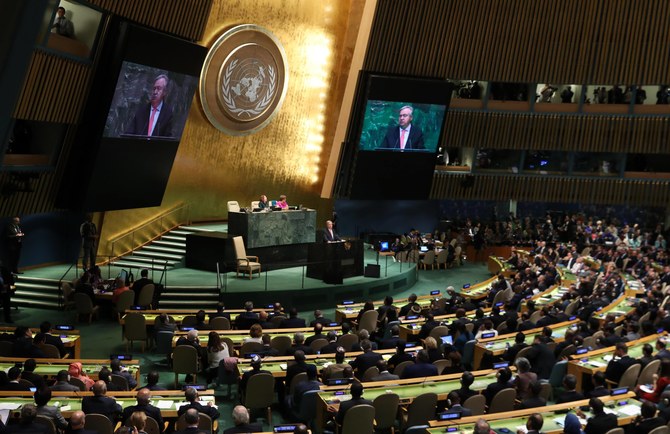
NEW YORK: In person and on screen, world leaders return to the United Nations foremost gathering for the first time in two years on Tuesday with a formidable, diplomacy-packed agenda of escalating crises to tackle, including the still-raging COVID-19 pandemic and a relentlessly warming planet.
Other pressing issues include rising US-China tensions, Afghanistan’s unsettled future under its new Taliban rulers and ongoing conflicts in Yemen, Syria and Ethiopia’s embattled Tigray region.
Last year, no leaders came to the UN because the coronavirus was sweeping the globe, so all addresses were pre-recorded. This year, the General Assembly offered leaders a choice — come to New York or remain online. More than 100 decided to appear in person in the General Assembly hall.
UN Secretary-General Antonio Gutteres, who opens the weeklong event, “will pull no punches in expressing his concern about the state of the world, and he will lay out a vision to bridge the numerous divides that stand in the way of progress,” UN spokesman Stephane Dujarric said. Guterres has already demonstrated that in pointed pre-meeting remarks about the virus and climate change.
By tradition, the first country to speak is Brazil, whose president, Jair Bolsonaro, isn’t vaccinated. He reiterated last Thursday that he doesn’t plan to get the shot any time soon, justifying his refusal by saying he had COVID-19 and therefore has a high level of antibodies.
A key issue ahead of the meetings has been COVID-19 entry requirements for leaders to the United States — and to the UN headquarters itself. The US requires a vaccination or a recent COVID-19 test, and the UN will operate on an honor system whereby anyone entering the complex attests that they do not have symptoms and have not tested positive in the last 10 days.
The three most closely watched speakers on Tuesday morning are expected to be US President Joe Biden, appearing at the UN for the first time since his defeat of Donald Trump in the US election last November; Chinese President Xi Jinping, who in a surprise move will deliver a video address; and Iran’s recently elected hard-line President Ebrahim Raisi.
Ahead of the opening of the General Assembly’s annual General Debate, Guterres issued a dire warning that the world could be plunged into a new and probably more dangerous Cold War unless the United States and China repair their “totally dysfunctional” relationship.
The UN chief said in an interview this weekend with The Associated Press that Washington and Beijing should be cooperating on the climate crisis and negotiating on trade and technology, but “unfortunately, today we only have confrontation” including over human rights and geostrategic problems mainly in the South China Sea.
Speaking last week about Biden’s speech, Richard Gowan, UN director of the International Crisis Group, said “the really significant question is exactly how he frames relations with China.” He predicted that Biden “won’t be as forthright in criticism of China as Trump was, especially in 2019 and 2020,” but rather will “try and cast China as a country that is challenging the rules-based world order and a country that should not be trusted with leadership of the international system.”
On the latest speakers list released earlier this month, China’s speech was supposed to be delivered on Friday by a deputy prime minister. But the UN confirmed Monday that Xi will give the country’s video address instead. His speech and any comments about the US rivalry are certain to be closely watched and analyzed: China’s presence in the world, and its relationship with the United States, affect most every corner of the planet.
Other leaders scheduled to speak in person during the meeting, which ends Sept. 27, include King Abdullah II of Jordan, the president of Venezuela, and the prime ministers of Japan, India and the United Kingdom along with Israel’s new Prime Minister Naftali Bennett and Palestinian President Mahmoud Abbas.
Leaders delivering prerecorded statements this year include the presidents of Egypt, Indonesia, South Africa and Zimbabwe. French President Emmanuel Macron was supposed to deliver a pre-recorded statement on Tuesday, but the government said Foreign Minister Jean-Yves Le Drian will now deliver the country’s address virtually on the final day.
France and China have reacted angrily to the surprise announcement by Biden, alongside the leaders of Australia and Britain, of a deal to provide Australia with at least eight nuclear-powered submarines. Australia had signed a contract worth at least $66 billion for a dozen French conventional diesel-electric submarines and their construction was already under way.
Le Drian told a news conference Monday that there is a “crisis of trust” between the United States and its oldest ally, France, as well as Europe, which has been excluded from the new US-UK-Australia alliance focused on the Indo-Pacific and aimed at confrontation with China. He said Europeans “should not be left behind,” and need to define their own strategic interests.


![]()

World leaders return to UN and face many escalating crises
Short Url
https://arab.news/cfy9k
World leaders return to UN and face many escalating crises


Latest updates


© 2026 SAUDI RESEARCH & PUBLISHING COMPANY, All Rights Reserved And subject to Terms of Use Agreement.