

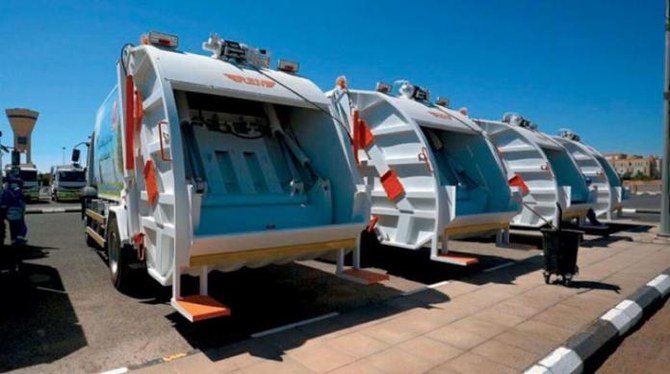
Saudi looks to greener pastures as it boosts recycling investment

Short Url
Updated 07 April 2022
Follow

Saudi looks to greener pastures as it boosts recycling investment

  • Saudi Arabia will look to invest almost SR24 billion ($6.4bn) in waste recycling by 2035
  • SIRC is keen to attract foreign direct investments worth SR6 billion, create 23,000 jobs, and contribute an amount of SR37 billion to the national GDP

Saudi Arabia will look to invest almost SR24 billion ($6.4bn) in waste recycling by 2035 as the country attempts to move to a more sustainable waste management system.

It will invest around SR1.3 billion ($346.6 million) in construction and demolition waste, and about SR900 million in industrial waste, while investments in municipal solid waste will exceed SR20 billion, and investments in other waste will exceed SR1.6 billion, Saudi Investment Recycling Company (SIRC) CEO, Ziyad Al-Shiha said.

Saudi Arabia had 5 percent of its total waste recycled from the beginning of 2020 until the first half of this year 2021, including plastic, metal and paper, Al-Shiha said.

The PIF-owned company started investing in projects specifically designed to increase conversion rates and recycling operations by establishing alliances with private sector companies specialized in this field, he told Al Eqtisadiah.

He pointed out that there is cooperation with leading local companies such as SABIC and Aramco in the recycling of plastic waste, and Maaden in the recycling of mining waste, and several companies in the building materials sector in the field using waste to produce alternative fuels, as well as a group of companies in the field of metal recycling and electronics.

"The company is also working with legislators and regulators to separate waste from the source by placing dedicated containers, organizing transportation and waste collection operations, building sorting and treatment stations, as well as making use of non-recyclable waste to produce alternative fuels and energy, and converting organic waste into organic fertilizers for agriculture," Al-Shiha said.

"This enhances the added value and reduces the cost of environmental degradation, which is estimated at SR86 billion annually," he said.

He stated that the company is keen to attract foreign direct investments worth SR6 billion, create 23,000 jobs, and contribute an amount of SR37 billion to the national GDP.


He pointed out that the share of foreign investment in the field of recycling at the present time is relatively "low", compared to other sectors, especially that the recycling market in Saudi Arabia is still nascent, and the number of local specialized companies in this field is still limited.

SIRC seeks within its strategic objectives to divert 85 percent of hazardous industrial waste from landfills, and 100 percent of solid waste from landfills and 60 percent of construction and demolition waste from landfills by 2035, Al-Shiha said.

Accordingly, the company is working on several promising projects to invest in the circular economy, through global and local partnerships to improve value chains, he said.

Al-Shiha pointed out that SIRC is also working to promote the Green Saudi Initiative goals by shifting from landfills by 94 percent..


"More than 40 percent of the recyclable materials in the Kingdom, amounting to about 56 million tons annually, are concentrated in Riyadh, Jeddah and Dammam, where 85 percent of them can be recycled and utilized for the purpose of obtaining a source of alternative energy and raw materials that enter into Manufacturing processes," Al-Shiha said.


The Kingdom recycles only about 10 percent of recyclable materials, while 90 percent of materials are disposed of by landfill, which causes harm to the environment and limits the use of recyclable materials, he explained.


He pointed out that one of the biggest challenges facing the sector at the present time is the lack of awareness of the importance of recycling, especially with the absence of a waste sorting system from the source. 

SIRC cooperates with the relevant government agencies to raise awareness, community participation, and disseminate awareness campaigns in the coming years, he said.


G7 countries to release oil reserves as IEA agrees to largest ever market intervention

Updated 11 March 2026
Follow

G7 countries to release oil reserves as IEA agrees to largest ever market intervention

  • IEA recommends release of 400 million barrels

RIYADH: Germany, Japan and Austria will release part of their oil reserves after the International Energy Agency recommended the release of 400 million barrels of oil ‌from stockpiles, the largest ‌such move in IEA ​history.

In a statement, IEA Executive Director Fatih Birol said the flow of oil, gas and other commodities through the Strait of Hormuz have all but stopped, leading global energy supply to fall by around 20 percent.

Ahead of the confirmation of the move — a larger intervention than the 182.7 million barrels that were released in 2022 by in response to Russia’s invasion of Ukraine — several countries began setting out plans to bring their reserves into play as countries grapple with ​soaring crude prices amid ​the US-Israeli war with Iran. 

Birol said: “I can now announce that IEA countries have decided to launch the largest ever release of emergency oil stocks in our agency's history. 

“IEA countries will be making 400 million barrels of oil available to the market to offset the supply lost through the effective closure of the strait.

“This is a major action aiming to alleviate the immediate impacts of the disruption in markets.”

Germany’s Economy ⁠Minister ​Katherina Reiche ⁠confirmed on Wednesday her government plans to limit petrol price increases at filling stations to once a day and to introduce more stringent antitrust regulation of the sector.

She did not ⁠give an exact timing for ‌those measures, but added that ‌the US and ​Japan would be the ‌largest contributors to the release of the ‌oil reserves.

The US has not confirmed it would do so, but its Interior Secretary Doug Burgum told Fox News on Wednesday that “these are the kinds of moments that these reserves are used for.”

The announcements did not stop oil prices rising, with Brent crude up 3.26 percent to $90.66 a barrel at 4:29 p.m Saudi time, and West Texas Intermediate up 3.12 percent to $86.05. Both were some way below the $119 a barrel seen earlier in the week.

“The situation regarding oil supplies is tense, as the Strait of Hormuz is currently virtually impassable,” Germany’s Reiche said.

“We will comply with this request and ‌contribute our share, because Germany stands behind the IEA’s most important principle: mutual ⁠solidarity,” Reiche ⁠said about the IEA’s request.

According to a statement by Reiche’s ministry, Germany will contribute 2.64 million tonnes of oil. This corresponds to 19.51 million barrels.

Reiche stressed there was no supply shortage in the country, which has a legally mandated reserve of oil and oil products intended to cover 90 days’ demand.

South Korea will release 22.46 million ​barrels of oil, which represents 5.6 percent of the total IEA ask, the ⁠country's industry ministry said.

“The government will consult with the IEA ⁠secretariat on details, such ‌as ‌the ​timing ‌and amount, from ‌the perspective of national interests in accordance with domestic conditions,” ‌the ministry said in a statement.

The ⁠ministry ⁠said it would continue to coordinate closely with major countries in responding to high oil prices to minimise any domestic ​impact.

Austrian Economy Minister Wolfgang Hattmannsdorfer said his country was releasing part of the emergency oil reserve and extending the national strategic gas reserve, adding: “One thing is clear: in a crisis, there must be no crisis winners at the expense of commuters and businesses.”

Acting ahead of the IEA move, G7 ​member Japan announced plans to release 15 days' worth of ‌private-sector oil reserves and one month's worth of state oil reserves.

“Rather than wait for formal IEA approval ‌of a coordinated international reserve release, Japan will act first to ease global energy market supply and demand, releasing reserves as early as the 16th of this month,” Prime Minister Sanae Takaichi said in a broadcast statement.

Following a meeting with the IEA on Wednesday, G7 energy ministers said: “In principle, we support the implementation of proactive measures to address the situation, including the use of strategic reserves.”

All IEA member countries are required to keep 90 days’ worth of their nation’s oil use in reserve in case of global disruption.