SAMOS, Greece: Greece on Monday began moving asylum seekers to the first of several new EU-funded “closed” camps on its islands, despite activists complaining that controls on access are too harsh.
A double barbed-wire fence surrounds the camp on Samos island, a facility for 3,000 people that also has surveillance cameras, X-ray scanners and magnetic doors.
During the migrant crisis in 2015 and 2016, the previous camp on Samos sheltered nearly 7,000 asylum seekers despite being built to take just 680, and campaigners had long denounced conditions as deplorable.
“Today is a historic day... a day of joy for us,” Manos Logothetis of the Greek migration ministry told state TV ERT on Samos.
Logothetis told AFP that out of some 400 people at the current Vathy camp at Samos, 270 have said they want to move to the new Zervou facility.
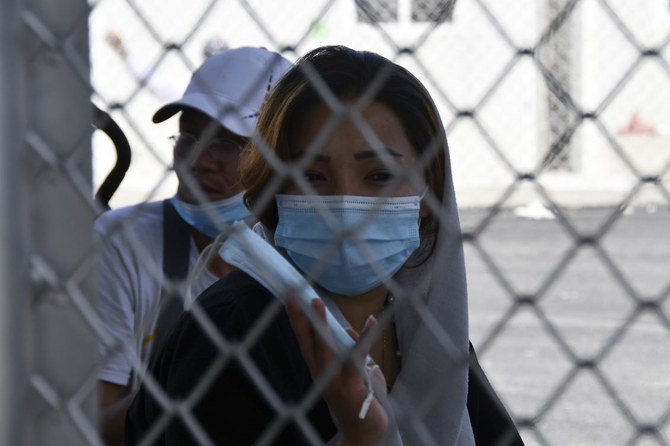
At the entrance of the new camp, police lined up the residents, checking them for weapons or dangerous objects, an AFP reporter said. Asylum personnel handed out clean bedsheets and showed the migrants how to use the gate’s magnetic entry cards.
Some of the asylum seekers carried boxes containing stray cats from the old camp, where rats were an ever-present menace.
“People are just angry for what will happen in the new camp, they think that it’s prison, but I don’t think it,” said Didier Tcakonmer, a 28-year-old Cameroonian who has spent more than two years in Samos.
“It will be better than here, no mosquitos, no rats.”
The ministry is prepared to register up to 200 people today and the remainder on Tuesday, Logothetis said.
The Samos camp, which will serve as a pilot for the other so-called closed and controlled access facilities, can only be entered via fingerprint scans and electronic badges.
Gates will remain closed at night and disciplinary measures await those who return after 8:00 pm.
Late on Sunday, a fire broke out in an abandoned part of the Vathy camp — though the ministry said nobody was hurt.
Logothetis told ERT it was common for asylum seekers to sort through their belongings ahead of a camp move and burn anything they did not intend to bring with them.
According to the ministry, all the asylum seekers had been evacuated on Sunday to an empty space near the entrance of the camp as firefighters tackled the blaze.
The new Samos facility is the first of several such camps on five Greek islands created with EU funds.
The EU has committed 276 million euros ($326 million) for the new camps on Greece’s five Aegean islands — Lesbos, Chios, Samos, Leros and Kos — that receive most of the migrant arrivals by sea from neighboring Turkey.
The Leros and Kos camps will open in November, the government said Monday.
Logothetis said the new restricted-access Samos camp offers “safety and humanitarian values,” but rights groups say the measures are too restrictive.
The Samos community, which had for years demanded the relocation of all the migrants to mainland Greece and Europe, has also opposed the construction of the new Zervou camp.
On the nearby island of Lesbos, the similarly overcrowded camp of Moria was destroyed in two fires that left 13,000 without shelter for several days.

Greece begins moving migrants to new ‘closed’ camp
https://arab.news/v5dsr
Greece begins moving migrants to new ‘closed’ camp
- The Samos camp, which will serve as a pilot for the other so-called closed and controlled access facilities, can only be entered via fingerprint scans and electronic badges
- The EU has committed €276 million for the new camps on Greece’s five Aegean islands — Lesbos, Chios, Samos, Leros and Kos — that receive most of the migrant arrivals
As India claims fourth-largest economy spot, what it means on the ground
- Indian government review says economy grew to $4.19 billion, overtaking Japan
- Claim still needs IMF review as only organized sector counted, economist says
NEW DELHI: When Ramesh Chandra Biswal left his job as a space scientist in the US, he returned to eastern India and ran an agriculture startup on a promise of his country’s rapid economic growth.
Nine years on, as India positions itself as the world’s fourth largest economy, he is still waiting for the promise to come true.
India’s economy was the sixth largest in the world, valued at about $2.6 trillion in 2017, when Biswal launched his Villamart project in his home village in Odisha.
According to calculations in the Indian government’s end-of-year economic review, it has now grown to $4.19 trillion, overtaking Japan’s economy in terms of nominal Gross Domestic Product.
The review also projects that India will overtake Germany to become the world’s third-largest economy within the next three years, trailing only the US and China in economic weight.
But on the ground, Biswal was not sure what the projections meant because they had no impact on his life or business.
“The hype around India becoming the fourth largest economy is not grounded. People cannot relate to that,” he said.
“The number of people here in India is much more than Japan ... We have to improve the per capita income instead of telling the story of being the fourth largest economy.”
Over the years that he has been running his company, Biswal has not noticed much change, but hoped that the news of the country’s growth would at least create a positive hype and motivate everyone.
“People are trying. As an entrepreneur, we are also trying, struggling every day, trying to do something new,” he said.
“I’m getting some respect in society. That way, it is giving me the driving force.”
But not everyone was immediately optimistic. For Sarvesh Sau, a fruit seller in Delhi, it has been increasingly difficult to keep his family afloat.
“Rich people are getting rich, those who have resources ... but a low-income group person like me finds it difficult to manage a decent living despite putting in more than 12 hours of work every day.
“We are a big nation, and we will look big compared to others. Are we able to match Japan?”
The world’s most populous nation, India has about 1.46 billion people and a GDP per capita estimated by the World Bank to be about $2,700. It is about 12 times lower than Japan’s.
Yogendra Kumar, a plumber in Noida, said his income has been rising, but it is consistently outpaced by the cost of living, leaving him feeling poorer over time.
“I have heard that India has become the fourth largest economy, but I don’t know how to react to that. It does not make any difference to our lives. It sounds good that India is growing, but the matter of fact is that for people like me the struggle for survival is more acute now than before,” he said.
“Today I earn more but the inflation takes away all the money, and it makes it difficult to have a comfortable life,” he told Arab News. “Mustard oil was 50 rupees 10 years ago. It is now 200 rupees. A cooking gas cylinder used to cost 500 rupees — now it costs more than double. Everything is so expensive.”
While India’s claim of being the fourth-largest economy is still awaiting review by the International Monetary Fund, Prof. Arun Kumar, a development economist, does not expect it to be confirmed.
“Our GDP data, as the IMF has said, is suspect because it doesn’t include the informal sector ... According to my estimate, we are still the seventh largest economy, just ahead of Italy,” he told Arab News, also estimating India’s actual growth to be much lower than the government’s projection.
“Even though official data shows a 7 percent to 8 percent rate of growth, people realize that it’s not growing so well,” Prof. Kumar said.
“The rate of growth is only of the organized sector, not of the unorganized sector ... The unorganized sector is declining and that is where 94 percent of the employment is.”


