

Same expectations as West from new Afghan government, Pakistani NSA says 

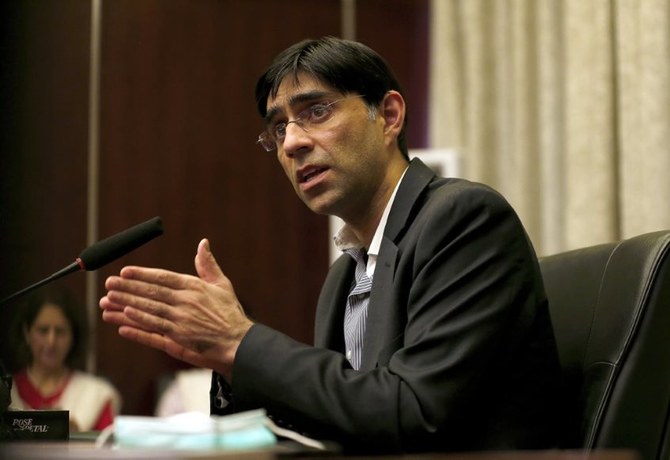
Pakistan's National Security Advisor Moeed Yusuf gives a news conference, in Islamabad, Pakistan, Wednesday, Sept. 15, 2021. (AP Photo)
Short Url
Updated 19 September 2021
Follow

Same expectations as West from new Afghan government, Pakistani NSA says 

  • National Security Adviser Yusuf urges the Taliban to safeguard all Afghan rights 
  • Reiterates calls for inclusivity by PM Khan, who has initiated a ‘dialogue’ with Afghanistan’s new rulers 

ISLAMABAD: Pakistan’s National Security Adviser Moeed Yusuf has said that Islamabad’s expectations from the Taliban are “identical to the West,” urging Afghanistan’s new rulers to protect everyone’s rights. 

In the past few weeks, the United Nations and other rights groups voiced concern over a reported surge in human rights violations in Afghanistan after the Taliban took control of the country last month. 

In an opinion piece published in ‘The Independent’ on Saturday, Yusuf said: “Pakistan’s expectations of the new government are identical to those of the west.” 

He added that Islamabad had repeatedly called for a “government that caters to and protects the rights of all Afghans while ensuring that Afghanistan’s territory is not used for terrorism against any country.” 

“This is a goal we share in full with the international community,” Yusuf said. 

Ethnic diversity has been at the center of politics and conflicts in Afghanistan, with no single group enjoying a decisive majority in the country of 38 million people. 

The Taliban swept into the Afghan capital, Kabul, on August 15, cementing their return to power two decades after being ousted in a US-led invasion in 2001. 

Earlier this month, Taliban spokesperson Zabihullah Mujahid announced an all-male interim government, facing intense criticism for not including women or ethnic groups in the setup. 

Islamabad has for long been persuading the Taliban to include representatives from its Pashtun, Hazara, Tajik, Uzbek and other ethnic groups in its new regime. 

On Friday, at the 20th Shanghai Cooperation Organization Council of Heads of State (SCO-CHS) summit in Dushanbe, Prime Minister Imran Khan said that the Taliban must fulfill its pledges “for an inclusive political structure; where all ethnic groups are represented.” 

“This is vital for Afghanistan’s stability. Also, it is important to ensure respect for the rights of all Afghans and ensure that Afghanistan is never again a safe haven for terrorists,” Khan said. 

Later, on Saturday, PM Khan said he had “initiated a dialogue” with the Taliban for an inclusive Afghan government to represent the country’s ethnic and religious minorities. 

Yusuf said that Afghanistan’s new rulers had also expressed their intention to engage with the world, “even asking western countries not to close down their embassies.” 

“This opens up space for the international community to engage constructively with Afghanistan,” he said. 

The top security official explained that an “abonnement of Afghanistan” has consequences that the world, especially Pakistan, has “lived through for the past four decades.” 

“It is the international community’s collective responsibility to avert a humanitarian crisis in Afghanistan, and to ensure that the threat to all of us from terrorism is ended once and for all,” Yusuf wrote, adding that this required “constructive engagement with the new political reality in Afghanistan.” 


Pakistan, Oman navies discuss maritime security, ink agreement to share shipping data

Updated 24 December 2025
Follow

Pakistan, Oman navies discuss maritime security, ink agreement to share shipping data

  • Visiting Oman royal navy commander calls on Pakistan Naval Chief Admiral Naveed Ashraf in Islamabad
  • White shipping agreement refers to exchange of prior information on movement of commercial ships

ISLAMABAD: The naval commanders of Pakistan and Oman discussed regional maritime security on Wednesday and signed an agreement to share shipping information with each other, the Pakistan Navy said in a statement.

The press release followed a meeting between Pakistan Naval Chief Admiral Naveed Ashraf and the visiting Oman Royal Navy Commander Rear Admiral Saif Bin Nasser Bin Mohsin Al Rahbi at Naval Headquarters in Islamabad.

Both navies maintain close professional relations, reflected in expert-level staff talks, joint training, bilateral exercises, and participation in multilateral exercises between the Pakistan Navy and the Royal Navy of Oman.

“During the meeting, matters of mutual interest, regional maritime security and bilateral naval cooperation were discussed,” the Pakistan Navy said.

The MoU was signed by both sides at a ceremony at the Naval Headquarters, the navy’s media wing confirmed. 

“The MoU is aimed at establishing of guidelines and procedures for information sharing in order to enhance mutual awareness of white shipping,” the Pakistan Navy said in a statement. 

White shipping agreement refers to the exchange of prior information on the movement and identity of commercial non-military merchant vessels.

Information regarding the identity of vessels helps countries tackle potential threats from sea routes. This particularly helps in the development of a proper regional maritime domain awareness

The statement said Al Rahbi lauded Pakistan Navy’s professionalism and acknowledged its ongoing contributions to maritime security and regional stability.

Pakistan and Oman share geographical proximity and common maritime boundaries. Bilateral relations between the two brotherly countries span a wide range of areas, including economic cooperation, people-to-people contacts and strong defense ties.

In December, a Royal Navy flotilla from Oman visited Karachi to take part in the annual bilateral Thamar Al Tayyib (TAT) 2025 exercise. 

Pakistan Navy and the Royal Navy of Oman have been conducting the TAT series of exercises regularly since 1980.