RAWALPINDI: The Gandharan city of Taxila, with its 25 square miles of archeological sites, is widely known as one of Pakistan’s top tourist destinations.
The vestiges of Buddhist monasteries, Greek settlements and spectacular pieces of Gandhara statuary that blend Buddhist imagery with Hellenistic styles have been found by archeologists working in the area since the mid-nineteenth century when the ruins were first discovered in Pakistan.
But the area is also home to another distinctly Pakistani treasure: the disco leopard.
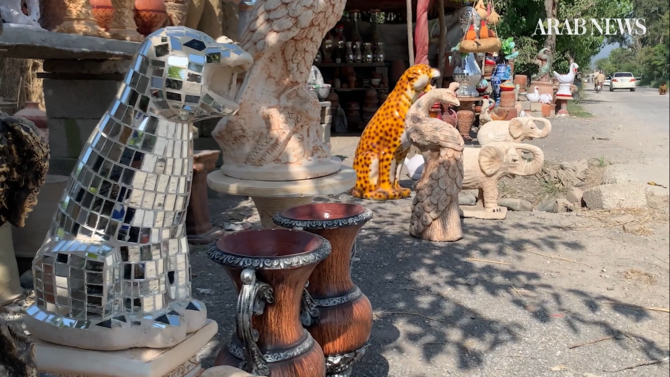
Not far from the ruins of Taxila off the historic Grand Trunk Road, pottery decorated with tiny mirrors, giving it the look of gaudy 70s disco balls, is sold in open air shops. Glass-encased leopards that have come to be called "disco leopards" are the top selling item here, shopkeepers said, especially among expats and diplomats.
Indeed, it was “the tradition of the gora (foreigner),” development specialist Chris Minch from Ireland said, to buy the leopards while in Pakistan and take them back to their home countries or to new stations where life and work took them.
“It was in every home of every foreigner living in Islamabad and it felt like this quintessential Pakistani item to buy,” Minch told Arab News in a telephone interview. “Everyone I know, literally everyone, has this leopard.”
Minch, who lived in Pakistan between 2017 and 2019, owns two of the pieces.
The disco leopard is believed to have debuted in Taxila about 20 years ago when an artisan, Malik Ashfaq, turned a lifelong hobby into a profession.
“I always enjoyed doing this and one day decided to buy locally made sculptures to decorate them for business purposes,” he told Arab News at his shop in Taxila as he pasted tiny mirrors onto a three-foot-tall leopard. “The artistic creation became popular with foreigners who drove down this road, making other shopkeepers in the market order them as well.”
“Now these leopards are everywhere in the world – from the United Arab Emirates to the United States – and it gives me great pride,” he added, saying it could take him up to three days to work on a large sized leopard, which required a ten-foot-long piece of mirror.
Asked why the leopards were so popular among foreigners, Ashfaq beamed and said: “Because this is Taxila and this is what we make with our own hands. They cannot get it anywhere else in the world and they understand the value of that.”
Aryan Malik, who has been selling decoration items in Taxila for three years, said it was “impossible” to put a number on how many disco leopards he had sold at his shop.
“Majority of our orders come from foreigners,” he said. “Even when tourism slowed down after the [coronavirus] pandemic, we continued to receive these requests. We even shipped the leopards to our customers, many of whom live abroad.”
Much like Ashfaq, Malik agreed that the magic of the disco leopards was that they were exclusively produced in Taxila.
But Ella Sakes, a World Health Organization official who lived in Pakistan from 2016 to 2018, told Arab News she bought the product because it reminded her of the "softer side" of Pakistan.
“I bought it because it’s beautiful but also the work we [expats] were doing out there [in Pakistan] can be so sad,” she said. “This happy little leopard reminds me a lot of the joy and silliness that is in Pakistan that people do not talk about enough.”
Sakes now lives in Amman, Jordan, where her disco leopard is displayed on the mantle in the living room:
“It really does take me back to some of the best times I have had on a country assignment.”
“They’re fabulous, they also remind me of all my friends in Pakistan,” John Montgomery, a development special, said in a video message emailed to Arab News.
“Some of my favourite days are from spending time in Taxila,” said Jocelyn Murphy, a development specialist, who lived in Pakistan for three years.
“Every time I look at him [disco leopard], I do see and remember all of the amazing experiences I had in Pakistan,” said consultant Thomas Chapman as he held up his leopard, lovingly named Howard.
The trend has also caught on among locals.
Music director Aisha Linea purchased disco leopards for a recent video shoot and decided to keep one at her home.
“The sun rises and the light hits it every day and it’s a disco morning, every morning,” she said, laughing. “These leopards are criminally underrated.”
Others said they had bought the leopards to support the local industry.
“It is an amazing and unique part of our local sculpture scene, and we should be supporting it,” said consultant Ghulam Hussain Soomro, who works in Islamabad. “I also like how in mythology cats are depicted as guardians, and so I also wanted the disco leopards keeping me safe.”


From DC to Dubai, expats’ homes decorated with distinctly Pakistani treasure: the disco leopard
https://arab.news/5qh4n
From DC to Dubai, expats’ homes decorated with distinctly Pakistani treasure: the disco leopard

- Glass-encased leopards made and sold in ancient city of Taxila are a top selling item among expats working in Pakistan
- Disco leopards debuted in Taxila about 20 years ago when artisan Malik Ashfaq turned a lifelong hobby into profession

At ECO meeting, Pakistan proposes ‘Regional Innovation Hub’ to curb natural disasters
- Pakistan hosts high-level 10th ECO Ministerial Meeting on Disaster Risk Reduction in Islamabad
- Innovation hub to focus on early warning technologies, risk informed infrastructure planning
ISLAMABAD: Pakistan has proposed to set up a “Regional Innovation Hub on Disaster Risk Reduction” that focuses on early warning technologies and risk informed infrastructure planning, the Press Information Department (PID) said on Wednesday, as Islamabad hosts a high-level meeting of the Economic Cooperation Organization (ECO).
The ECO’s 10th Ministerial Meeting on Disaster Risk Reduction (DRR) is being held from Jan. 21-22 at the headquarters of the National Disaster Management Authority (NDMA) in Pakistan’s capital.
The high-level regional forum brings together ministers, and senior officials from ECO member states, representatives of the ECO Secretariat and regional and international partner organizations. The event is aimed to strengthen collective efforts toward enhancing disaster resilience across the ECO region, the PID said.
“Key agenda items include regional cooperation on early warning systems, disaster risk information management, landslide hazard zoning, inclusive disaster preparedness initiatives, and Pakistan’s proposal to establish a Regional Innovation Hub on Disaster Risk Reduction, focusing on early warning technologies, satellite data utilization, and risk-informed infrastructure planning,” the statement said.
The meeting was attended by delegations from ECO member states including Pakistan, Türkiye, Azerbaijan, Iran, Kyrgyzstan, Tajikistan, Turkmenistan and Uzbekistan. Representatives of regional and international organizations and development partners were also in attendance.
Discussions focused on enhancing regional coordination, harmonizing disaster risk reduction frameworks, and strengthening collective preparedness against transboundary and climate-induced hazards impacting the ECO region, the PID said.
ECO members states such as Pakistan, Türkiye, Afghanistan and others have faced natural calamities such as floods and earthquakes in recent years that have killed tens of thousands of people.
Heavy rains triggered catastrophic floods in Pakistan in 2022 and 2025 that killed thousands of people and caused damages to critical infrastructure, inflicting losses worth billions of dollars.
Islamabad has since then called on regional countries to join hands to cooperate to avert future climate disasters and promote early warning systems to avoid calamities in future.


