



WARSAW: Two Pakistani scientists have published the results of a study that shows the decline in brain functions of dementia patients could be controlled, or slowed, with the use of virtual reality, offering new hope to sufferers of a neurological disorder that afflicts 55 million people worldwide.
Dementia, which is less a disease and more a group of related syndromes, manifests itself in a steep decline in brain functions. The condition destroys memories and personalities, robbing families of their loved ones and sapping patience and finances. With populations aging, the number of patients worldwide is projected to rise to 78 million by 2030 and 139 million by 2050, the World Health Organization said in a report this month.
There is no known cure for dementia and the focus of therapy has largely remained on slowing its progression. Now, in a study published in the Brain Sciences journal last month, Pakistani neuroscientist Dr. Ali Jawaid and computer scientist Dr. Suleman Shahid have demonstrated how virtual reality could help those living with dementia cope with their condition.
“Usually, dementia patients progressively deteriorate in cognitive functions, but what we assessed was that during the whole study, which was more than six months, there was no deterioration,” Jawaid told Arab News in a recent interview in Warsaw, Poland, where he leads neuropsychiatric disorders research at the BRAINCITY center at the Nencki Institute of Experimental Biology.
His collaborator Shahid directs the Computer Human Interaction and Social Experience Lab at the Lahore University of Management Sciences in Pakistan.
At the core of the two scientists’ latest work is using virtual reality for ‘environmental enrichment,’ a term used to describe changing a person’s surroundings to make them more complex, dynamic and challenging in order to stimulate the brain. Research on animals has variously found that environmental enrichment could aid the treatment and recovery of brain-related dysfunctions, including Alzheimer’s disease and others related to aging.
“In animals, we have discovered that environmental enrichment is one of the strongest protector factors against cognitive impairment induced by aging,” Jawaid said. “The challenge was how to bring this environmental enrichment to humans.”
Exercise and brain quizzes could work, he said, but were “stressful” and hardly ever engaging enough for dementia patients to do them regularly or for long periods of time.
What Jawaid and Shahid did instead was immerse their study’s participants, all with mild dementia, in virtual environments depicting real-world landmarks familiar to them. As all the study participants were Pakistani, the three environments used were the Great Wall of China, the Grand Mosque in Makkah, and the pyramids of Egypt.
In each of the virtual worlds, the patients had to perform tasks designed to stimulate different domains impaired in dementia, such as short-term memory, attention, navigation, motor coordination or decision making.
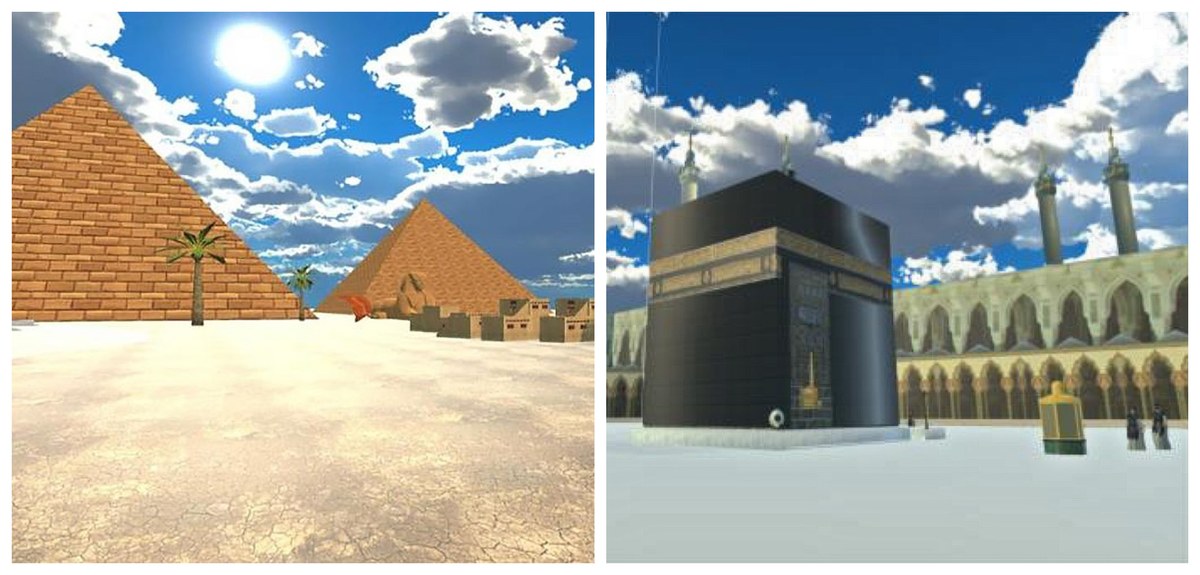
Virtual environments depicting real-world landmarks — the Kaaba in Makkah and the pyramids of Egypt — used in a study on VR-based therapy for dementia patients by Pakistani scientists Dr. Ali Jawaid and Dr. Suleman Shahid. (Photo courtesy: Ali Jawaid)
For example, in one scenario, a participant would see balloons in the sky as they “walked” along the Great Wall of China wearing a virtual reality headset. As the sight triggered a childhood memory of shooting balloons, a virtual pistol or a bow and arrow would appear. Once the participant shot the balloons, the next task would be presented.
“We were giving them all this cognitive training in the VR environment, and the results have been extremely encouraging,” Jawaid said.
“One of our patients was like ‘I miss playing golf.’ We arranged that he could play golf in the virtual reality environment. That was really motivating for him.”
The way the therapy is designed keeps the participants engaged much longer than most studies of this type, BRAINCITY vice president Dr. Ewelina Knapska said.
“What was done here was the development of a task that was attractive to older people,” she told Arab News.
The longer dementia patients are willing to be in therapy that increased brain activity, the more possible it is for them to remain independent. But the cost of such care and therapists is very high.
Dementia costs the world $1.3 trillion a year, this month’s WHO report said.
“It [dementia treatment] is very expensive,” Knapska said. “Such VR therapies are much cheaper and therefore much more accessible.”


