

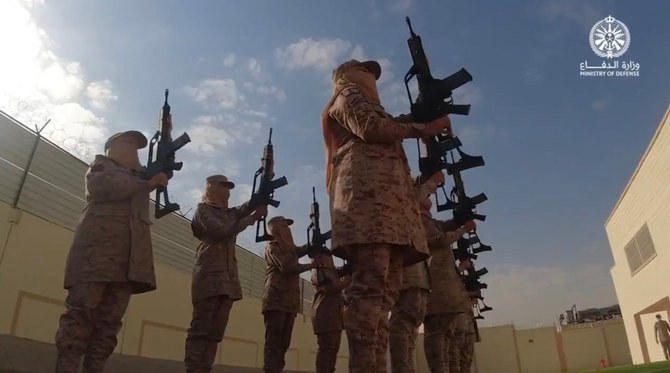

The head of Saudi Arabian Military Industries (SAMI) believes the state owned business could be run by a Saudi female engineer in the future as it seeks to attract top talent back to the Kingdom.
Speaking to Arab News at the DSEI trade fair in London, SAMI CEO Walid Abukhaled, argued that attracting the best and brightest to work in the industry was key to hitting the 50-percent goal, and that included tempting back female Saudis who are employed abroad.
Abukhaled was referring to the government’s goal to see 50 percent of all defense spending focused in the Kingdom by 2030.
Abukhaled said: “I’m convinced they will be the future leaders of the company.
“I absolutely believe we will have a female chief executive of SAMI in the future. Maybe not in the immediate future, but it will happen.
“There are Saudi female engineers working in Europe and the US who are gaining good experience and may want to come back to the Kingdom.
“You want to give top positions, like the CEO’s job, to the best, not because of gender, but because they are the best for the job and have the best experience. The Kingdom is very supportive of women.”
The defense company, a wholly owned subsidiary of the Public Investment Fund, launched in 2017 and is a key player in the Kingdom’s drive to reduce its reliance on foreign military products.
Joint venture deals have already been struck with French company Thales and Belgium based firm CMI Defence, and memorandums of understanding have been signed with US’s Boeing, and France’s Naval Group.
Female participation in the Saudi labor market, according to official public data, has risen dramatically in recent years, shooting up from 19.7 percent in 2018 to 33 percent by the end of 2020 - an increase of 64 percent in just two years.
Abukhaled said that in the defence sector women now make up 22 percent of the workforce, yet the jobs are mainly centered around human resources, finance, and legal.
Overseas Acquisitions
Speaking more broadly, Abukhaled said SAMI was looking to expand through overseas acquisitions but declined to comment on specific targets.
He said: “We first need to identify gaps in our capability, and then see where it can be filled. We should be clearer by next year in terms of a business case for where the gaps are and what we need to acquire.”
He added: “We want SAMI to be one of the top 25 companies in the world by 2030. We cannot do that all internally and we will have to acquire ability from both inside and outside the Kingdom.”
Abukhaled added he was also confident in delivering the Kingdom’s 50 percent localisation target.
He said: “We’re already over 50 percent in terms of a number of the contracts we have won. Some will be less of course, but overall I think the target will be achieved.”
Abukhaled said it was likely there would be more information on acquisitions and partnerships to coincide with next year’s World Defence Show which is due to take place in Riyadh in March 2022.
SAMI is the strategic partner for the event which promises to be the world’s biggest defence trade fair.
While praising what he called the ”transformation” of the Kingdom in recent years, Abukhaled, an engineer by training, admitted more needed to be done to create the localised skill base for the sector desired by the 2030 Vision program.
Abukhaled insisted that while he was confident that SAMI will achieve its target of employing a skilled workforce of 20,000 local staff by 2030, that depended on the training of more domestic technicians and engineers.
That concern was also flagged up by Ahmed bin Abdulaziz Al-Ohali, the governor of the Kingdom’s General Authority for Military Industries (GAMI) in a separate interview with Arab News.
Al-Ohali admitted the success of the 50 percent strategy depends heavily on creating a “healthy ecosystem” which includes research centers, universities, academic institutions, and public and private institutions.
GAMI has a vision to establish partnerships with academic institutions to close the local skills gap in areas like engineering and skilled craftsmanship, said Al-Ohali.


