Saudi Arabia sees R&D key to push military sector to create 100k jobs

1 / 4
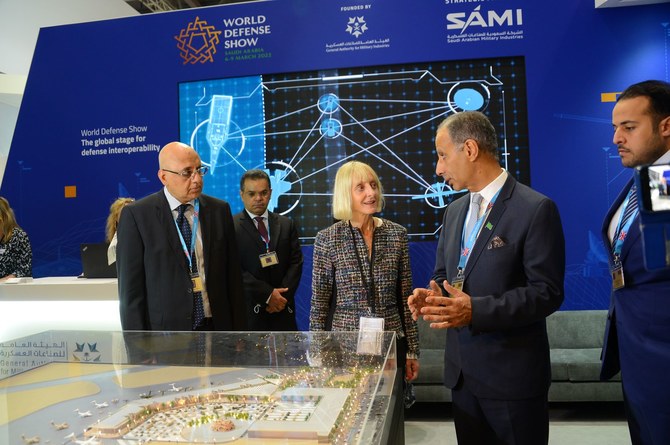
Ahmed bin Abdulaziz Al-Ohali, governor of the General Authority for Military Industries, at the Defense and Security Equipment International trade fair, in London on Tuesday. Arab News
2 / 4
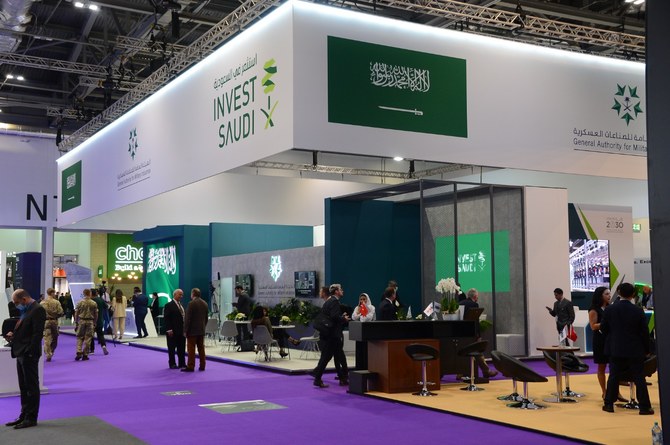
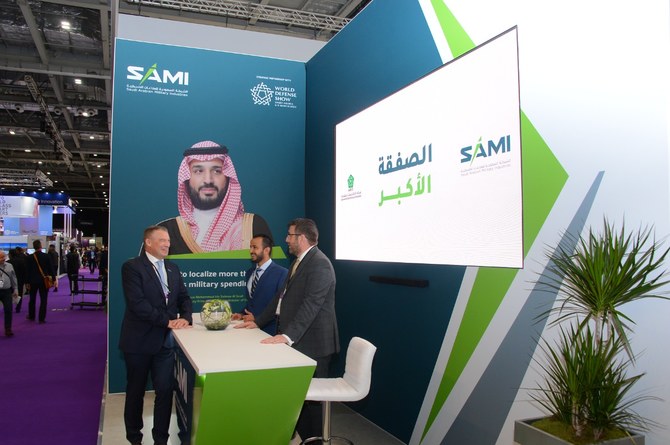
Saudi Arabia's pavilion at the Defense and Security Equipment International.
3 / 4
Saudi Arabia's pavilion at the Defense and Security Equipment International.
4 / 4
Ahmed bin Abdulaziz Al-Ohali, governor of the General Authority for Military Industries, at the Defense and Security Equipment International trade fair, in London on Tuesday. Arab News
Short Url
Updated 21 October 2021
Follow

Saudi Arabia sees R&D key to push military sector to create 100k jobs

  • The 50 percent localization goal is challenging but achievable, says GAMI chief


LONDON: Defense spending in Saudi Arabia is to focus on acquisitions as well as research and development (R&D) over the next decade to ensure that the local military industry will create around 100,000 jobs for Saudis, the governor of the Kingdom’s General Authority for Military Industries (GAMI) said.
Speaking in an exclusive interview at the Defense and Security Equipment International (DSEI) trade fair in London, Ahmed bin Abdulaziz Al-Ohali set out his vision for the future of domestic military spending, and talked up the importance of investing in the country’s R&D sectors.
Al-Ohali admitted that reaching the goal of domestic defense production accounting for 50 percent of the Kingdom’s military spending by 2030 was “challenging but doable,” as he argued that work undertaken to improve internal supply chains would soon see benefits.
He said: “In less than four years, we have doubled the localization rate from less than 4 percent to over 8 percent in 2020.”
“When we look at our licenses and license applications, we see great enthusiasm from local companies, which is encouraging,” he added. “The 50 percent localization goal is challenging but achievable, I would say.”

Saudi Arabia is investing heavily in its defense industries to reduce reliance on imported military hardware as well as add higher value jobs in the Kingdom.

The number of licensed companies in Saudi Arabia’s military sector rose sharply in the first half of the year, according to GAMI data.

It reported a 41 percent increase in licensed companies to reach a total of 99 — 85 percent of them local companies. More than half (55 percent) were granted to operating companies while military services providers accounted for 24 percent and product suppliers accounting for the rest.

Upskilling Saudis

Al-Ohali admitted that one of the areas that needs improvement in order to hit the 50 percent target is upskilling the domestic workforce.
“The defense industry is expected to create approximately 100,000 jobs by 2030; 40,000 of which will be directly created jobs,” he said, adding: “The success of our strategy will depend heavily on ensuring a sector that is sustainable.”
“To ensure sustainability, all our stakeholders will need to come together to form a healthy ecosystem, including research centers, universities, academic institutions, public and private institutions,” he said.
“We have a vision to establish partnerships with academic institutions to close the local skills gap in areas like engineering and skilled craftsmanship,” said Al-Ohali.

R&D spending

GAMI’s current plan sees R&D accounting for 4 percent of armaments expenditure by 2030, but Al-Ohali was relaxed about that figure growing as Saudi Arabia seeks to keep its place as “one of the top defense players in the world.”
“One of the most important aspects of R&D is that it helps nations achieve efficiency in spending,” he said. “We invest money and resources in R&D to be able to spend better.”
He added: “By enhancing a strong R&D ecosystem and utilizing our young, well-educated population, we will soon become a supplier to other nations.”

Foreign investors

Despite a desire to move 50 percent of defense spending inside the Kingdom’s borders, Al-Ohali is clear that working with other governments will help GAMI achieve its ambitions.

Last month, GAMI invited local and international companies to benefit from a number of military projects as well as launching a digital platform for investors to access local military industry.

The authority has identified 74 investment opportunities, across six domains of the military industries sector.

It has launched a digital platform called the Military Industry Marketplace (MIM) that links local industry projects with investors that are authorized and licensed by the authority.

While he was unable to give an “exact amount” of how much of the spending will be through joint ventures, he said: “The Kingdom is open to establishing strategic partnerships and joint ventures. More important is getting the right technologies.”  
“Foreign companies can now have 100 percent ownership of their investments and they will be treated with the same rights, duties, and obligations as the Saudi companies.”


The Real Estate Registry signs 10 agreements at forum in Riyhad

Updated 10 sec ago
Follow

The Real Estate Registry signs 10 agreements at forum in Riyhad

RIYADH: The Real Estate Registry concluded its participation in the Real Estate Future 2026, as a partner of the forum, with a distinguished presence that included the launch of its business portal, the signing of 10 agreements and memoranda of understanding with entities from the public and private sectors, the organization of specialized workshops, and the awarding of the Gold Award at the Real Estate Excellence Awards.

During his participation in the forum, the CEO of the firm, Mohammed Al-Sulaiman, reviewed the latest developments in real estate registration in the Kingdom in a keynote speech, highlighting the pivotal role of the Real Estate Registry in building a unified and reliable system for data. He also announced the launch of the national blockchain infrastructure, which aims to enable the microcoding of real estate assets, enhance transparency, expand investment opportunities, and support innovative ownership models within a reliable regulatory framework.

On the sidelines of the forum, Al-Sulaiman met with Nigeria’s Minister of Housing and Urban Development, Ahmed Dangiwa. During the meeting, they discussed areas of joint cooperation, exchanged experiences and advice on shaping the future of the real estate sector, and reviewed best practices in implementing real estate registration systems that enhance reliability and improve the efficiency of property registration.
efficiency of property registration systems.

The Real Estate Registry’s participation included organizing three specialized workshops that focused on the role of geospatial technologies in identifying ownership, enhancing transparency, and improving the quality of real estate data. 

The workshop “Empowering the Real Estate Registry for the Business Sector” reviewed digital solutions that enable the business sector to manage its real estate assets more efficiently and enhance governance and technical integration. The workshop “From Off-Plan Sales to Title Deed” focused on the journey of documenting real estate ownership and the role of the registry in linking the stages of development and documentation within an integrated digital system.

On the sidelines of the forum, the Real Estate Registry signed 10 agreements and memorandums of understanding, including a deal with Yasmina Information Technology Co. to utilize real estate data in developing smarter insurance solutions that support the real estate sector and enhance service reliability. 

Partnerships were also signed with Haseel, NewTech, and Sahl, as well as HissaTech and Droub, to develop innovative digital solutions in property ownership, fractional ownership, and asset tokenization, as well as real estate finance and investment within a trusted regulatory framework.

Further collaborations included an MoU with ROSHN Group, an agreement with the Saudi Water Authority to enable data integration and quality enhancement, an agreement with the Saudi National Bank, and a partnership with Saudi Post to link the national address with the property registry as a unified geospatial identifier supporting data accuracy and integration.

The registry’s participation was crowned with the Golden Award at the Real Estate Excellence Awards in the category of Excellence in Property Documentation, in recognition of its role in building a model based on transparency, accuracy, and speed, as well as advanced digital technologies and specialized legal expertise, contributing to rights protection and increasing the sector’s attractiveness.

The Real Estate Registry emphasized that its participation reflects its continued role as a key enabler of the real estate sector, a trusted data source, and an active partner in driving digital transformation, enhancing market efficiency, and building investor and financier confidence, in line with Saudi Arabia’s Vision 2030 objectives for a fully integrated and sustainable digital real estate ecosystem.