

As Merkel exits, Germans debate famed budget discipline

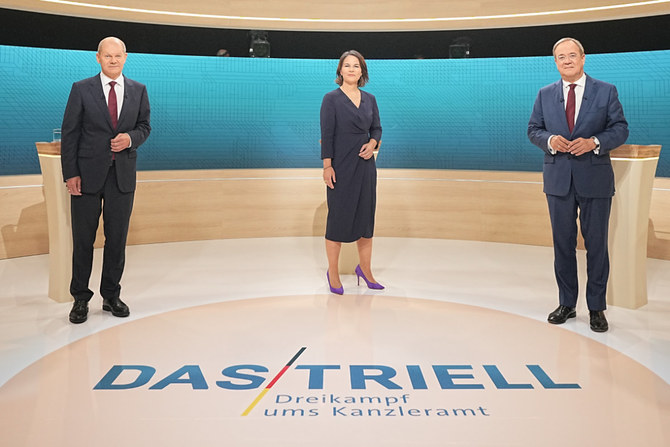
Political leaders Annalena Baerbock, Armin Laschet and Olaf Scholz join a televised debate of the candidates to succeed Angela Merkel as German chancellor on Sept. 12, 2021. (REUTERS/pool)
Short Url
Updated 16 September 2021
Follow

As Merkel exits, Germans debate famed budget discipline

  • European member states watching the election and hoping for a transformation of German debt attitudes may be disappointed

FRANKFURT: When Chancellor Angela Merkel’s government smashed its debt taboo and opened the money taps to help the German economy weather the pandemic crisis, it vowed to return to fiscal rigour as soon as possible.
But as the post-Merkel era beckons, voters may have other ideas.
In the closing stretch before September 26 polls that will see Merkel bow out after 16 years, surveys show her CDU-CSU alliance trailing the center-left Social Democrats (SPD).
Hoping to turn the tide, the conservatives have returned to their favored attack lines.
The SPD’s candidate for the top job, Finance Minister Olaf Scholz, would be a “debt chancellor,” warned CSU leader Markus Soeder.
Conservative millionaire Friedrich Merz, the CDU’s economic policy spokesperson, said taxpayers would end up footing the bill for an SPD-led government’s “free beer” policies.
Scholz himself has said he wants higher taxes for top earners and the reintroduction of a wealth tax to help fund much-needed investments in Europe’s biggest economy.
Whoever wins, any future German government will be presented with a “difficult choice” between “changing budgetary rules” to match the economic reality, or “sharply reducing the public deficit,” says Patrick Artus, chief economist at Natixis.
Germany’s cherished balanced finances have been turned upside down during the pandemic, with Merkel’s government taking on 370 billion euros ($438 billion) of new debt in 2020 and 2021.
Total public debt is expected to exceed 70 percent of gross domestic product (GDP) this year, up from 59.7 percent before the pandemic.

Merkel’s Germany is well-known for its budgetary discipline — and at times for enforcing it on fellow Europeans — but the pandemic spending forced it to suspend the “debt brake” written into the constitution in 2009.
The rule forbids the government from borrowing more than 0.35 percent of its GDP, other than in “exceptional circumstances” approved by parliament.
Between January and March this year, the public deficit exceeded 80 billion euros, equivalent to 4.7 percent of GDP.
It’s a long way from Germany’s vaunted “black zero” budget — the shorthand name given to the achievement of balancing the books and a target the country consistently met between 2014 and 2019.
The crisis also saw Merkel spearhead the European Union’s 800-billion-euro coronavirus recovery fund, which will be financed through joint borrowing for the first time — crossing a German red line on EU debt pooling.
But European member states watching the election and hoping for a transformation of German debt attitudes may be disappointed.
As a battle looms on whether to loosen the EU’s strict budget rules, Scholz ruled out any changes at a recent meeting of EU finance ministers.
The pandemic had shown that the bloc’s fiscal rules already had enough flexibility, he said.

By Merkel’s own admission, Germany will have to “spend gigantic sums of money in the coming years.”
The country’s biggest challenges — energy transition, climate protection and digital infrastructure — mean that “40 to 50 billion euros of public investment a year, between 1 and 1.5 percent of GDP, will be needed for the next 10 years,” said Marcel Fratzscher president of the economics think-tank DIW.
To solve this budgetary equation, it will be necessary to “reform” the debt brake to reflect EU norms, which tolerate deficits of up to three percent of GDP, Fratzscher said.
The catch: any change to the debt rule would have to be approved by a two-thirds super majority in the German parliament.

“The ruling parties will have to find another way to get around the rule,” Fratzscher said.
Much will depend on the balance of power between the parties in Germany’s next coalition.
Sticking to the debt brake will be “impossible without tax rises,” Fratzscher said — something the conservatives have ruled out.
The left-wing Greens, who fancy their chances of being part of the next government, want to adapt the debt brake to allow 50 billion euros of borrowing for investment annually until 2030.
The SPD are open to more public spending, but within the limited scope allowed by the constitutional brake.


What Bangladesh’s election means for India, China and Pakistan ties

Bangladesh Nationalist Party supporters gather for a rally ahead of the upcoming national election, in Sylhet on Jan. 22, 2026.
Updated 8 sec ago
Follow

What Bangladesh’s election means for India, China and Pakistan ties

  • Bangladeshis will vote on Feb. 12, almost two years after the 2024 student-led uprising
  • After nearly 2 years of tensions, experts expect a thaw with India under elected government

DHAKA: As Bangladesh prepares to hold its first elections since the 2024 ouster of Sheikh Hasina, its longest-serving prime minister, the outcome will define Dhaka’s relations with the most important regional powers — China, India, and Pakistan.

Nearly 128 million Bangladeshis will head to the polls on Feb. 12 to bring in new leadership after an 18-month rule of the current caretaker administration.

The interim government, led by Nobel laureate Muhammad Yunus, took control following a student-led uprising that ended 15 years in power of Hasina and her Awami League party.

The two main parties out of the 51 competing for power are the Bangladesh Nationalist Party and Jamaat-e-Islami. The Awami League, which for decades has had close ties with India, was excluded from the election ballot over its role in the deadly crackdown on the 2024 student-led protests, in which 1,400 people were killed.

While Bangladesh’s relationship India has deteriorated since the fall of Hasina, who has been in self-exile in New Delhi, the period of diplomatic strain is expected to ease when the new government takes office.

“Whoever comes to power in Bangladesh, due to domestic pressure in the country, relationships with India need a resetting,” Humayun Kabir, former ambassador to the US, told Arab News.

“It’s anticipated that India will also engage with the new government, but they will protect their interests, and we also have to do the same. It’s most likely that the India-Bangladesh relationship will be normalized under the new, elected, government.”

Since 2024, India has suspended key transshipment access that allowed Bangladeshi exports to go via Indian ports and airports. It also put on hold most normal visa services for Bangladeshis, who were among its largest groups of medical tourists.

From Hasina’s heavy pro-India orientation, the interim government has tried to rebalance Bangladesh’s foreign policy toward the two other key regional players — China and Pakistan — who at the same time are India’s main rivals. 

If New Delhi regains its importance, it should not deal a blow to the newly expanded relations with Pakistan, with whom Bangladesh has recently increased exchanges, especially economic, and last month resumed direct flights — after a 14-year gap.

Since the relations have been expanded under the caretaker government, Prof. Delwar Hossain from the International Relations Department at Dhaka University forecast that they would only further improve, no matter who comes to power, and there is no likelihood of a sudden change.

“For Pakistan, any political coalition — whether BNP or Jamaat — will be positive. The BNP has a long history of having good relations with Pakistan during their rule ... Jamaat also has a strong and very positive influence in Pakistan,” he said.

“For Pakistan, the new regime or new government is not the issue. The issue is what the (India) policy of the new government would be and to what extent it would actually support Pakistan’s view.”

Both the BNP and Jamaat have repeatedly said they wanted friendly relations with India, and Hossain expected that they would, at the same time, continue the balanced approach introduced by the caretaker administration.

“India is a reality as a neighbor. At the same time, India is also showing interest in mending relations or adopting a more cooperative approach after the vote, with the government that will be elected ... I think there will be pragmatism from both sides,” he said.

“I don’t see there is a long-term threat to Bangladesh-India relations ... When China and Pakistan were trying to create a trilateral cooperative system or some kind of coalition — China, Bangladesh and Pakistan — we have seen that Bangladesh opted out. It seems that Bangladesh is going to continue its policy of maintaining a balance among these great powers.”

Bangladesh’s relations with China have not changed since the ouster of Hasina, whose government signed several economic agreements with Beijing. Yunus’s administration has continued this cooperation, and China was among the very few countries he officially visited during his term.

During the visit, he secured about $2.1 billion in Chinese investments, loans and grants, including funding for infrastructure like Mongla Port and a special economic zone in Chattogram — Bangladesh’s largest port. China has also eased visa rules for Bangladeshi businesspeople, medical travelers and tourists.

According to Munshi Faiz Ahmed, Bangladesh’s former ambassador to Beijing, China’s importance for Bangladesh cannot be substituted by any other country, especially as over the past few years it has emerged not only as its key investor, but also the largest trade partner.

In the fiscal year 2024-25, Bangladesh’s trade with China was over $21.3 billion, according to National Board of Revenue data. With India, it was about $11.5 billion.

The trade — especially import — dependence on Beijing started long before the regime change. In terms of trade volume, China overtook India already in 2018.

“Even when people thought that we had very close relations with India, our relations with China continued to grow in terms of trade and commerce ... Our trade with China has surpassed India’s, and China is a much bigger investor in Bangladesh’s development projects,” Ahmed said.

“Bangladesh will continue to cooperate with China for a long time to come because what China can provide, no other country can.”