

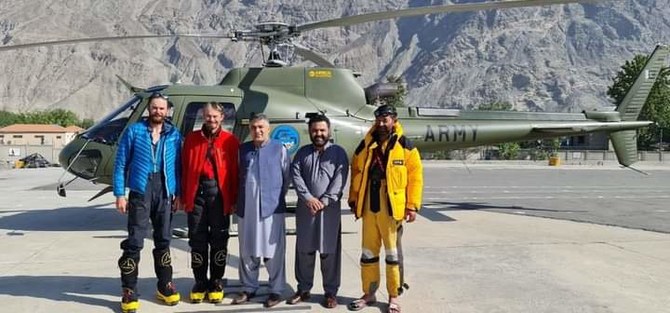
Three climbers stranded on Pakistani mountain during descent rescued

Czech climbers Jakub Vicek and Peter Macek (left) and Pakistani Wajidullah Nagri (right) standing in front of Pakistan Army's chopper in Hunza, Pakistan on September 15, 2021. (Photo courtesy: @DCNagarGB/ Twitter)
Short Url
Updated 16 September 2021
Follow

Three climbers stranded on Pakistani mountain during descent rescued

  • Czech climbers Jakub Vicek and Peter Macek and Pakistani Wajidullah Nagri stranded on Rakaposhi since September 8
  • One Czech climber had frostbites and was being treated, other Czech climber and Pakistani ‘fine,’ Alpine Club says

ISLAMABAD: Three climbers stranded on Pakistan’s Rakaposhi mountain while descending were rescued on Wednesday, the Alpine Club of Pakistan said.
Czech climbers Jakub Vicek and Peter Macek and Pakistani Wajidullah Nagri were stranded on Camp 3 on Rakaposhi at a height of 6,900 meters (22,640 feet) since September 8.
“Pakistan army aviation [helicopter] recused them today [Wednesday] and now they are in Gilgit,” Karrar Haidri, the secretary of the Alpine Club of Pakistan, told Arab News. “One of the Czech climber has some frostbites and is being treated, while other Czech climber and Pakistani Wajidullah Nagri are fine.”
Rakaposhi, the world’s 27th highest peak, is part of the Karakoram mountain range located in Pakistan’s Gilgit-Baltistan region.
The Pakistan army this week made several rescue attempts but could not succeed due to bad weather. On Tuesday, food supplies and ropes were dropped for the stranded climbers from the height.
Minister for tourism for the government of Gilgit Baltistan, Raja Nasir Ali Khan, said in a tweet this week the Czech mountaineers had started the ascent without government permission.
“We do expect from everyone going on to such expeditions to comply with laws and regulations for their own safety and wellbeing in the face of emergencies,” Khan’s tweet read.


In a separate tweet on Tuesday, the regional minister said repeated emergencies on high peaks during climbing seasons had produced the need to establish a high altitude rescue team.
“So, we’re going to create one, that’s trained, equipped with essential technologies and be timely deployed anywhere there’s a need,” Khan said.


Pakistan cabinet reviews private Hajj policy as mandatory pilgrim training enforced

Updated 10 sec ago
Follow

Pakistan cabinet reviews private Hajj policy as mandatory pilgrim training enforced

  • Cabinet sends draft Private Hajj Policy 2027–2030 to committee for further review
  • Religion minister warns pilgrims who skip mandatory training will be barred from Hajj

ISLAMABAD: Pakistan’s federal cabinet on Wednesday reviewed proposals for stricter oversight of private Hajj operators, as authorities separately warned that pilgrims who failed to complete mandatory training would be barred from performing Hajj next year.

The cabinet, chaired by Prime Minister Shehbaz Sharif, was briefed on a draft Private Hajj Policy for 2027–2030, which includes third-party registration and scrutiny of private Hajj operator companies, according to a statement from the Prime Minister’s Office.

“The Federal Cabinet directed that the draft Private Hajj Policy 2027–2030, presented by the Ministry of Religious Affairs and Interfaith Harmony regarding third-party registration and scrutiny of private Hajj operators’ companies, be referred to the Hajj Policy Committee for further deliberation in light of the views of Cabinet members,” the prime minister’s office said in a statement.

The development comes as Religious Affairs Minister Sardar Muhammad Yousaf said on Wednesday pilgrims who failed to attend both phases of mandatory Hajj training would not be allowed to perform the pilgrimage.

“Pilgrims who do not complete mandatory Hajj training will be barred from performing Hajj,” the ministry quoted Yousaf as saying during a training workshop in Islamabad.

Around 120,000 pilgrims are currently undergoing training at 200 locations nationwide, with the second phase scheduled to begin after Ramadan. The training aims to familiarize pilgrims with Saudi laws, Hajj rituals and safety protocols to prevent accidents in crowded areas.

Saudi Arabia has allocated 179,210 pilgrims to Pakistan for Hajj 2026, including about 118,000 seats under the government scheme, while the remainder will be handled by private tour operators.

Under Pakistan’s government Hajj package, the estimated cost ranges from Rs1.15 million to Rs1.25 million ($4,049.93 to $4,236), subject to final agreements with service providers.