


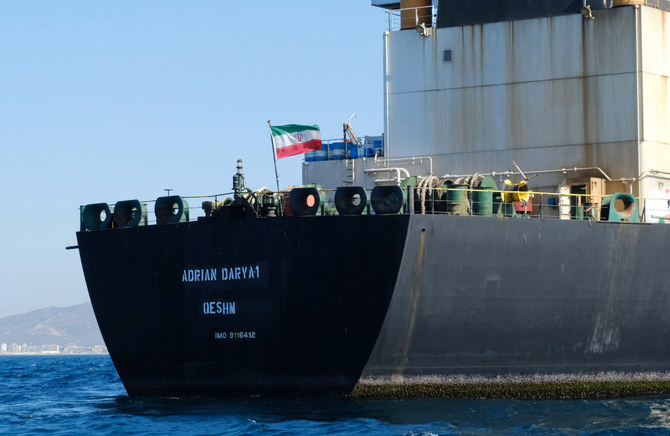

BEIRUT: Despite the threat of possible US sanctions, Hezbollah has arranged up to 80 oil tankers carrying Iranian diesel fuel to arrive in Lebanon via Syria on Thursday.
The tankers are destined for Baalbek, about 67 kilometers northeast of Beirut, where the fuel will be discharged into tankers owned by the Iran-backed Hezbollah. The group has also organized a ceremony to celebrate the shipment, which is expected to contain 3 million liters of fuel.
Sayyed Hassan Nasrallah, leader of the militant group, said in August that an Iranian fuel tanker will sail toward Lebanon “within hours,” warning Israel and the US not to intercept it. The move, Hezbollah said, was to help ease Lebanon’s crippling fuel shortage that has paralyzed the country for weeks.
Raymond Ghajar, Lebanon’s caretaker energy minister, said he “did not receive any request to approve fuel importation” undertaken by Hezbollah.
The delivery would violate US sanctions imposed on Tehran after former US President Donald Trump pulled out of a nuclear deal between Iran and other world powers three years ago. Hezbollah’s step is also likely to expose Lebanon to similar US sanctions.
Nasrallah said on Monday the Iranian ship docked on Sunday night in Syria’s Banias port and started to discharge diesel fuel in Syrian tankers that will arrive in Baalbek on Thursday.
“The vessel destined for Baalbek will arrive through Hermel,” Nasrallah said.
There are no legal border crossings in the region as Hezbollah allegedly uses the Hermel crossing for smuggling.
Al-Amana, a US-sanctioned company that belongs to Hezbollah, is expected to receive the transported Iranian fuel.
Nasrallah claimed he “spared Lebanon embarrassment by docking the ship in a Syrian port and not a Lebanese one.”
However, the arrival of diesel tankers in Lebanon will reveal the state’s vulnerability regarding the violation of its borders and the importation of fuel without its knowledge or approval. The US previously warned that any Iranian fuel ship that brings fuel for Lebanon would equate to “providing Hezbollah with funds.”
The US, the UK, and Germany are among a growing number of countries that recognize Hezbollah in its entirety as a terrorist organization.
Dorothy Shea, US ambassador to Lebanon, blocked the road for the Iranian initiative on Aug. 21 by informing Lebanon President Michel Aoun “of the US administration’s decision to help Lebanon obtain electricity from Jordan via Syria.” The plan would provide Egyptian natural gas to Jordan that can be transmitted to Lebanon via Syria.
She said: “Lebanon does not need Iranian ships,” and questioned whether “it was possible to count on Hezbollah to fairly distribute the fuel.”
According to Hezbollah, the Iranian diesel shipment “will be donated.” The group said it will aid “governmental hospitals, nursing homes, orphanages, municipalities that handle the task of pumping water, fire brigades and the Lebanese Red Cross.”
Opinion
This section contains relevant reference points, placed in (Opinion field)
Hezbollah called on the representatives of these bodies to attend Thursday’s ceremony in Baalbek.
“A second diesel ship that will arrive within five days,” said Nasrallah, who also claimed a third ship destined for Lebanon had started loading gasoline.
He said the goal is “not to compete with importing companies or to make profits but to serve the people.”
Nasrallah also announced that the group will open the door for individual purchases with the start of winter.
“The price will be announced on Thursday and the diesel will be priced in Lebanese pound,” Nasrallah said. “There is also the cost of transportation and the international price. We will sell at prices lower than the cost because we are not seeking to make profits or losses. We will bear a part of the cost, which will be a donation from our side and the Iranian state.”
Diana Kaissy, an energy expert and advisory board member at the Lebanese Oil and Gas Initiative, LOGI, an independent non-governmental organization based in Beirut, told Arab News: “A lot of opacity is prevailing on the Iranian diesel shipment.”
She said the 3 million liters is nothing compared to the market’s needs.
“But the problem is that the shipment did not obtain a permit from the energy ministry and the diesel will be sold at prices lower than the market price,” Kaissy said. “This means that there will be a competitor in the fuel market and therefore, a new cartel will emerge owning illegal weapons and selling fuel based on incorrect foundations.”
Hezbollah is trying to help the people with fuel but its execution is concerning.
“The situation is not clear,” Kaissy said. “Sales are made on the black market and there is a political party now openly creating a new black market under the pretext that the people need it and to put an end to monopoly. But who knows that this step will not create another monopoly?”


