

Iran backs down in standoff with UN nuclear inspectors

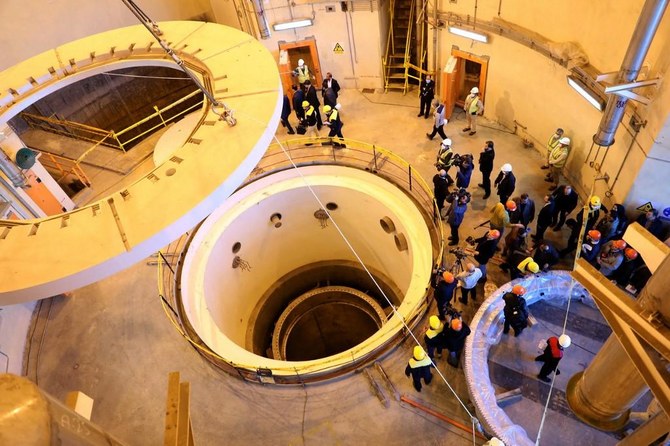
Above, the nuclear water reactor of Arak, south of capital Tehran, in a photo released by Iran’s Atomic Energy Organization on Dec. 23, 2019. (Atomic Energy Organization of Iran via AFP)
Short Url
Updated 13 September 2021
Follow

Iran backs down in standoff with UN nuclear inspectors

  • Tehran avoids embarrassing rebuke by allowing maintenance of monitoring cameras at atomic sites

JEDDAH: Iran on Sunday backed down in a standoff with the UN atomic watchdog and agreed to allow continued monitoring of its nuclear sites.

The move followed talks in Tehran between Rafael Grossi, director general of the International Atomic Energy Agency, and Iran’s nuclear research chief Mohammad Eslami, head of the Atomic Energy Organization of Iran.

International inspectors can now install new memory cards in surveillance cameras at Iran’s nuclear sites and continue filming there, averting a potentially embarrassing rebuke for Iran at an IAEA board meeting this week.

Tehran holds all recordings made at its sites as negotiations over the US and Iran returning to the 2015 nuclear deal remain stalled in Vienna. Iran is also enriching uranium close to weapons-grade purity and its stockpile continues to grow.

“I am glad to say that today were able to have a very constructive result, which has to do with the continuity of the operation of the agency’s equipment here," Grossi said after Sunday’s talks. The agreement was“indispensable for us to provide the necessary guarantee and information to the IAEA and to the world that everything is in order,” he said.

Opinion

This section contains relevant reference points, placed in (Opinion field)

Sunday’s agreement buys time for Iran before the IAEA board meeting, with Western powers arguing for Tehran to be censured over its lack of cooperation with international inspectors. Eslami said Iran would take part in the meeting and its negotiations with the IAEA would continue there.

The IAEA told member states in its confidential quarterly report last week that its verification and monitoring activities had been “seriously undermined” since February by Iran’s refusal to let inspectors access their monitoring equipment.

The agency said monitoring and surveillance equipment could not be left for more than three months without being maintained. It was provided with access this month to four surveillance cameras installed at one site, but one of the cameras had been destroyed and a second had been severely damaged, it said.

In Israel, Prime Minister Naftali Bennett urged world powers not to “fall into the trap of Iranian deception that will lead to additional concessions” over the nuclear inspections deadlock.

“You must not give up on inspecting sites and the most important thing, the most important message, is that there must be a time limit,” Bennett said. Iran was “dragging on, we must set a clear-cut deadline that says: It stops here.

“The Iranian nuclear program is at the most advanced point ever. We must deal with this project.”


Iraq’s parliament delays presidential vote

Updated 8 sec ago
Follow

Iraq’s parliament delays presidential vote

  • Iraq’s two main Kurdish parties, who ususally put forward a candidate for president, asked to postpone the vote
  • Once elected, the president will then have 15 days to appoint a prime minister
BAGHDAD: Iraq’s parliament postponed the election of the country’s president on Tuesday to allow Kurdish rivals time to agree on a candidate.
The parliament delayed the session, the official INA press agency reported, without saying whether a new date had been agreed.
The agency reported earlier that speaker Haibat Al-Halbussi received requests from Iraq’s two main Kurdish parties, the Kurdistan Democratic Party (KDP) and the Patriotic Union of Kurdistan (PUK), to postpone the vote to “allow both parties more time” to reach a deal.
By convention, a Shiite Muslim holds the powerful post of prime minister, the parliament speaker is a Sunni and the largely ceremonial presidency goes to a Kurd.
Under a tacit agreement between the two main Kurdish parties, a PUK member holds the Iraqi presidency, while the president and regional premier of the semi-autonomous Kurdish region is selected from the KDP.
But this time the KDP named its own candidate for Iraq’s presidency: Iraqi Foreign Minister Fuad Hussein.
Once elected, the president will then have 15 days to appoint a prime minister, expected to be former premier Nouri Al-Maliki.
On Saturday, the Coordination Framework, an alliance of Shiite parties with varying ties to Iran that holds a parliamentary majority, endorsed Maliki.
But his nomination appeared to stoke concern in Washington.
The 75-year-old shrewd politician is Iraq’s only two-term premier (2006-2014) since the 2003 US invasion.
Seen as close to Iran, Al-Maliki left power in 2014 following heated pressure from Washington.
US Secretary of State Marco Rubio warned on Sunday against a pro-Iranian government in Iraq.
An Iraqi source close to the Coordination Framework told AFP that Washington had conveyed that it “holds a negative view of previous governments led by former prime minister Maliki.”
In a letter, US representatives said that while the selection of the prime minister is an Iraqi decision, “the United States will make its own sovereign decisions regarding the next government in line with American interests.”
Another Iraqi source confirmed the letter, adding that the Shiite alliance had still moved forward with its choice, confident that Al-Maliki could allay Washington’s concerns.
Iraq has long been a proxy battleground between the US and Iran, with successive governments negotiating a delicate balance between the two foes.
Iraq’s new premier will be expected to address Washington’s longstanding demand that Baghdad disarm Tehran-backed factions, many of which are designated terrorist groups by the US.