Pakistan ready to hold next election based on 2023 census — planning minister

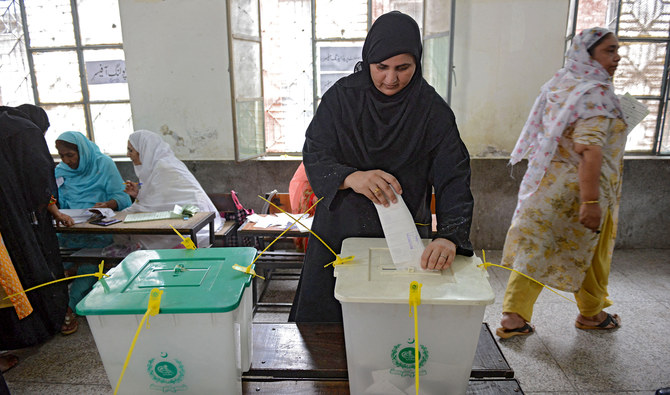
A woman casts her vote during Pakistan's general election at a polling station during the general election in Lahore on July 25, 2018. (AFP/File)
Short Url
Updated 11 September 2021
Follow

Pakistan ready to hold next election based on 2023 census — planning minister

  • In the 2023 census Pakistan will for the first time employ technology, including geo-tagging
  • General elections are scheduled to be held in Pakistan before Oct. 12, 2023

KARACHI: Constituencies for Pakistan's 2023 election will be demarcated on the basis of a new census, Planning Minister Asad Umar said on Saturday, as he expects the nosecount to be completed within the next 18 months.

General elections are scheduled to be held in Pakistan before Oct. 12, 2023, or less than 60 days from the dissolution of the National Assembly which will take place on Aug. 13, 2023.

"We have to complete this within 18 months. It will be completed by the beginning of 2023, new delimitation will be carried on the basis of fresh census," Umar said in a press conference in Karachi.

"A team of experts has completed their consultations and I have prepared a summary for next cabinet meeting."
 
He added that while until now all censuses have been done manually, the 2023 count is going to employ technology.

"This will be first time in Pakistan that technology will be used, it will a digitalized census, properly geo-tagging will be done."

Although the census is supposed to be held at 10-year intervals, the government has committed to holding the next population census before the 2023 election.

The results of the last census held in 2017 attracted much criticism, especially in Karachi and the whole of Sindh province, following reports that millions of the region's residents were not counted and not taken into account in the allocation and demarcation of constituencies in the 2018 general election.


Pakistan, seven Muslim nations back Palestinian technocratic body, stress Gaza-West Bank unity

Updated 15 January 2026
Follow

Pakistan, seven Muslim nations back Palestinian technocratic body, stress Gaza-West Bank unity

  • The National Committee for the Administration of the Gaza Strip was announced on January 14
  • Muslim nations call for consolidation of the ceasefire and unimpeded humanitarian aid into Gaza

ISLAMABAD: Pakistan and seven other Muslim-majority countries on Thursday welcomed the formation of a temporary Palestinian technocratic body to administer Gaza, stressing that it must manage daily civilian affairs while preserving the institutional and territorial link between the Gaza Strip and the West Bank amid the ongoing peace efforts.

In a joint statement, the foreign ministers of Pakistan, Egypt, Jordan, Saudi Arabia, Qatar, Türkiye, Indonesia and the United Arab Emirates said the newly announced National Committee for the Administration of the Gaza Strip would play a central role during the second phase of a broader peace plan aimed at ending the war and paving the way for Palestinian self-governance.

“The Ministers emphasize the importance of the National Committee commencing its duties in managing the day-to-day affairs of the people of Gaza, while preserving the institutional and territorial link between the West Bank and the Gaza Strip, ensuring the unity of Gaza, and rejecting any attempts to divide it,” the statement said.

The committee, announced on Jan. 14, is a temporary transitional body established under United Nations Security Council Resolution 2803 and is to operate in coordination with the Palestinian Authority, the ministers said.

The statement said the move forms part of the second phase of US President Donald Trump’s Comprehensive Peace Plan for Gaza, which the ministers said they supported, praising Trump’s efforts to end the war, ensure the withdrawal of Israeli forces and prevent the annexation of the occupied West Bank.

The top leaders of all eight Muslim countries attended a meeting with Trump in New York last September, shortly before he unveiled the Gaza peace plan.

The ministers also called for the consolidation of the ceasefire, unimpeded humanitarian aid into Gaza, early recovery and reconstruction and the eventual return of the Palestinian Authority to administer the territory, leading to a just and sustainable peace based on UN resolutions and a two-state solution on pre-1967 lines with East Jerusalem as the Palestinian capital.