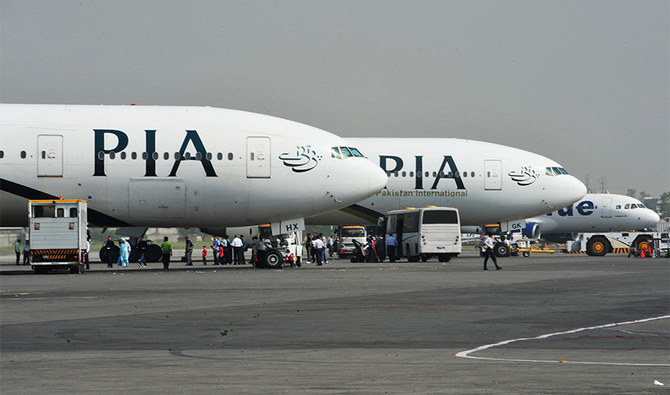
ISLAMABAD: Pakistan International Airlines (PIA) will resume flights from Islamabad to Kabul next week, a spokesman told AFP Saturday, becoming the first foreign commercial service since the Taliban seized power last month.
Kabul airport was severely damaged during a chaotic evacuation of over 120,000 people that ended with the withdrawal of US forces on August 30. The Taliban have been scrambling to get it operating again with Qatari technical assistance.
“We have got all technical clearances for flight operations,” PIA spokesman Abdullah Hafeez Khan told AFP.
“Our first commercial plane ... is scheduled to fly from Islamabad to Kabul on September 13.”
Khan said the service would depend on demand.
“We have received 73 requests which is very encouraging ... from humanitarian relief agencies and journalists,” he said.
In the last two days Qatar Airways has operated two charter flights out of Kabul, carrying mostly foreigners and Afghans who missed being taken out during the evacuation.
An Afghan airline resumed domestic flights last week.


Pakistan’s PIA to restart commercial flights to Kabul from Monday
https://arab.news/9q9bb
Pakistan’s PIA to restart commercial flights to Kabul from Monday

- An airline spokesperson says the frequency of commercial flights will depend on travel demand to the neighboring country
- The Taliban have been scrambling to get Kabul airport operational after it was damaged during last month’s chaotic evacuation

Historic Sikh prayer held at Lahore’s Aitchison College gurdwara after nearly 80 years
- Ceremony marks 140th anniversary of colonial-era institution
- Shrine had remained closed since Partition due to absence of Sikh students
ISLAMABAD: A Sikh worship service was held today, Friday, at the historic gurdwara inside Lahore’s Aitchison College, reopening the shrine for prayer nearly eight decades after it fell out of regular use following the 1947 Partition.
Founded in 1886 to educate the sons of royalty and prominent families of undivided Punjab, Aitchison College once served students from Muslim, Hindu and Sikh backgrounds. After Partition, which created Pakistan and India and triggered mass migration along religious lines, Sikh enrollment ended and the gurdwara ceased functioning as an active place of worship, though the college continued to maintain the building.
Friday’s ceremony took place as part of events marking the elite school’s 140th anniversary.
“A historic and emotional Sikh worship service was held at the Gurdwara on the campus of Aitchison College,” the institution said in a statement announcing the ceremony.
The gurdwara was designed by renowned Sikh architect Ram Singh of the then Mayo School of Arts, now the National College of Arts. Its foundation stone was laid in 1910 by Maharaja Bhupinder Singh of Patiala, a former Aitchison student who studied there from 1904 to 1908, and the Patiala royal family supported fundraising for its construction. Completed shortly afterward, it served as a daily prayer space for Sikh pupils attending the school.
About 15 Sikh alumni of Aitchison College are currently living in India and have recalled attending evening prayers at the gurdwara, describing its black-and-white marble flooring and castle-like interior architecture.
The campus also houses other pre-Partition places of worship, including a mosque built in 1900 by the Nawab of Bahawalpur and a Hindu temple whose foundation stone was laid in 1910 by the Maharaja of Darbhanga.
Over the decades, Aitchison College has educated prominent figures from across pre-Partition Punjab and modern South Asia, including former Pakistani prime ministers Imran Khan, Mir Zafarullah Khan Jamali and Feroz Khan Noon, as well as Indian cricket captain Iftikhar Ali Khan Pataudi and members of princely families such as the Maharaja of Patiala.


