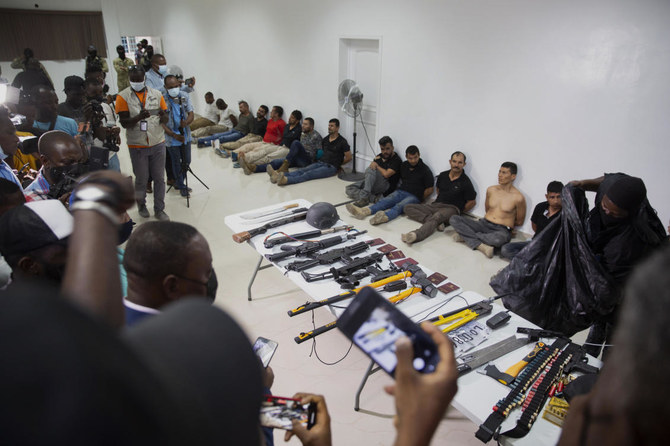
BOGOTÁ, Colombia: Former Colombian soldiers arrested in Haiti in the assassination of President Jovenel Moïse have accused local authorities of torture, saying they’ve been burned, stabbed and hit in the head with a hammer, among other things.
Details of the alleged torture are contained in a Sept. 6 letter addressed to Colombia’s president and other high-ranking officials as well as the Interamerican Court of Human Rights and the International Committee of the Red Cross. It was signed by the 18 former soldiers arrested in the slaying.
Relatives of the soldiers provided a copy of the letter to The Associated Press but asked not to be identified for their safety, saying only that they received the letter electronically.
In the letter, the soldiers accuse Haitian police officers of shooting at them with powerful weapons when they tried to turn themselves in with their hands raised just hours after Moïse was killed at his private home on July 7.
“We were deceived by people and companies in the United States and Haiti that seek to accuse us of acts for which we are not responsible. Don’t let an injustice be committed,” they wrote.
Several days after the killing, Colombian President Iván Duque said the majority of the former soldiers arrested were duped and thought they were traveling to Haiti for a legitimate mission to provide protection. He said only a small group of them knew it was a criminal operation.
In the letter, the ex-soldiers describe how police tortured and then executed one of their colleagues who was injured after being shot by Haitian officers while trying to turn himself over. He was one of three former Colombian soldiers killed. The letter also accuses police of kicking some ex-soldiers in the testicles and even burned one of them in their groin, allegedly while saying that human rights don’t exist in Haiti and that they could whatever they wanted.
The ex-soldiers alleged that other colleagues were thrown against walls, one had his foot burned with hot oil, another was kicked in the mouth and suffers from two broken teeth and that police released at least three of them to a crowd that attacked with machetes or stabbed them.
They also accused authorities of keeping all of them handcuffed for 24 days, and that they didn’t receive food or water in the first two days after their capture. They wrote that the bathrooms in the cell they were being held at in police headquarters weren’t working, so feces filled the area and caused their wounds to become infected.
The lack of timely medical attention also was denounced by the Colombian Ombudsman’s Office, a state entity in charge of ensuring human rights, after a July 26 visit with the ex-soldiers. In its report, the office warned that three of the detainees had considerable injuries and needed specialized medical treatment.
Once they were transferred to a penitentiary, the ex-soldiers said there were no bathrooms and no potable water, which they either have to buy or wait for a good Samaritan to bring them some. They noted that they get fed only once a day and that some of the ex-soldiers have lost up to 44 pounds (20 kilograms).
The United Nations and other organizations have long denounced prison conditions in Haiti, noting that they are severely overcrowded and that inmates are often ill-treated, sometimes tortured and can spend more than a decade behind bars without going to a single court hearing or being charged with anything.
In their letter, the ex-soldiers added they don’t have an attorney, don’t know what charges they face and that they’re barred from calling their families: “We find ourselves completely isolated.”
The ex-soldiers also said that Haitian authorities already had prepared written statements before interviewing them and ordered them to sign the documents drafted in a language they didn’t understand.
“Torture has been employed as a way to obtain statements,” they wrote.
The ex-soldiers said one of the main officials overseeing the case was responsible for the torture, calling him a “professional” in torturing humans. They did not identify him.
“We thank you in advance for your attention and prompt response to this cry for help and complaints,” they wrote.
Neither the office of Colombia’s president nor the foreign ministry immediately returned messages for comment. A spokeswoman for Haiti’s National Police did not immediately respond to a request for comment.
Haitian authorities have detained more than 40 suspects in the killing of Moïse during an attack in which his wife, Martine Moïse, was injured. Meanwhile, court clerks investigating the case have gone into hiding after being threatened with death if they didn’t change certain names and statements in their reports.
In addition, a Haitian judge assigned to oversee the investigation stepped down last month citing personal reasons. He left after one of his assistants died in unclear circumstances. A new judge has been assigned, but the former Colombian soldiers have yet to appear in court.


![]()


Colombian ex-soldiers in Haiti accuse police of torture
Short Url
https://arab.news/jz5jn
Colombian ex-soldiers in Haiti accuse police of torture


French police raid Arab World Institute in Paris as Epstein fallout widens
PARIS: French police searched the Arab World Institute in Paris on Monday as part of a probe into its former head, ex-culture minister Jack Lang, and his links to late convicted US sex offender Jeffrey Epstein, prosecutors said.
France’s National Financial Prosecutor (PNF) said in a statement that the Arab World Institute was among several locations being raided.
Prosecutors this month opened a preliminary investigation of Lang and his daughter Caroline on suspicion of tax fraud following the release of documents on Epstein in the US
Lang, who was culture minister under late Socialist president Francois Mitterrand, resigned this month from the Arab World Institute, which he had led since 2013.
He has said he was unaware of Epstein’s crimes despite corresponding with him between 2012 and 2019, 11 years after the financier was convicted of soliciting prostitution from an underage girl. Epstein died in prison by suicide in 2019.
The Institute, which is overseen by France’s foreign ministry, said it could not immediately comment on the police action.
Both Jack and Caroline Lang have repeatedly denied any wrongdoing and receiving financial benefits from Epstein. Their lawyer Laurent Merlet told French broadcaster BFMTV this month that “there was no movement of funds.”
Fallout from the release of millions of new documents related to Epstein has rippled through Europe.
On Saturday, Paris prosecutors set up a dedicated team to review the files, coordinating with the financial prosecutor and national police.
The office said it was analizing several potential cases stemming from the Epstein files.
One concerns French diplomat Fabrice Aidan, alleged to have transferred United Nations documents to Epstein.
Aidan, who worked at the UN from July 2006 to April 2013, has rejected the accusations through his lawyer.
France’s National Financial Prosecutor (PNF) said in a statement that the Arab World Institute was among several locations being raided.
Prosecutors this month opened a preliminary investigation of Lang and his daughter Caroline on suspicion of tax fraud following the release of documents on Epstein in the US
Lang, who was culture minister under late Socialist president Francois Mitterrand, resigned this month from the Arab World Institute, which he had led since 2013.
He has said he was unaware of Epstein’s crimes despite corresponding with him between 2012 and 2019, 11 years after the financier was convicted of soliciting prostitution from an underage girl. Epstein died in prison by suicide in 2019.
The Institute, which is overseen by France’s foreign ministry, said it could not immediately comment on the police action.
Both Jack and Caroline Lang have repeatedly denied any wrongdoing and receiving financial benefits from Epstein. Their lawyer Laurent Merlet told French broadcaster BFMTV this month that “there was no movement of funds.”
Fallout from the release of millions of new documents related to Epstein has rippled through Europe.
On Saturday, Paris prosecutors set up a dedicated team to review the files, coordinating with the financial prosecutor and national police.
The office said it was analizing several potential cases stemming from the Epstein files.
One concerns French diplomat Fabrice Aidan, alleged to have transferred United Nations documents to Epstein.
Aidan, who worked at the UN from July 2006 to April 2013, has rejected the accusations through his lawyer.
Latest updates


Recommended



© 2026 SAUDI RESEARCH & PUBLISHING COMPANY, All Rights Reserved And subject to Terms of Use Agreement.