

Senate body rejects using electronic voting in next Pakistan election as government adamant

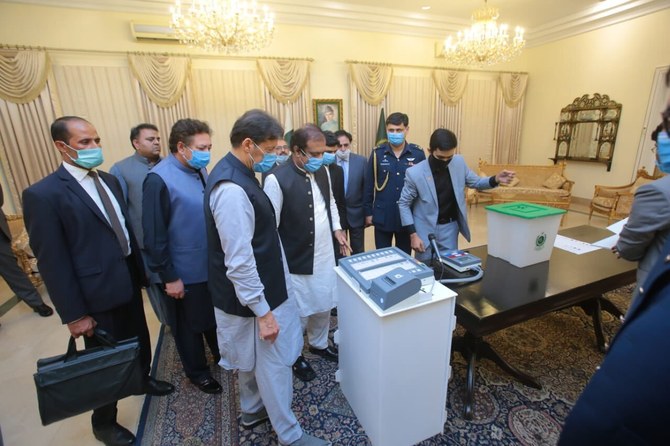
Pakistan PM Imran Khan over-looking the EVM machines in Islamabad, Pakistan on August 5, 2021. (Photo courtesy: Twitter/ @PTIOfficial)
Short Url
Updated 10 September 2021
Follow

Senate body rejects using electronic voting in next Pakistan election as government adamant

  • Election Commission earlier this week warned EMVs could jeopardize the “conduct of free, fair, credible and transparent elections”
  • Senate committee voted against the Election Act Amendment Bill after members of the ruling party walked out of the meeting

ISLAMABAD: The Pakistani senate parliamentary committee rejected on Friday a proposal by the government to use electronic voting machines (EVMs) in the next general elections.

The Election Commission of Pakistan (ECP) earlier this week submitted to the Senate Standing Committee on Parliamentary Affairs a list of 37 objections, warning that a hasty use of these devices could jeopardize the “conduct of free, fair, credible and transparent elections” in the country.

The ECP said a largescale deployment of EVMs was not possible in a short span of time, especially when they had not been properly tested and provided no ballot secrecy, voter anonymity and necessary transparency at various levels.

Despite the objections, Prime Minister Imran Khan’s special adviser on parliamentary affairs Senator Babar Awan said on Thursday the government was fully determined to do the required legislation to use these machines in the 2023 general elections.

“Prime Minister Imran Khan will not back down from e-voting and EVMs, nor will his government,” he told reporters.

During Friday’s Senate committee meeting, he accused the ECP of “shying away from fulfilling its national responsibility.”

The Senate body eventually voted against the Election Act Amendment Bill after Senate members from the ruling party walked out of the meeting to protest to the committee chairman’s refusal to hold the vote.



Pakistan, Saudi Arabia discuss regional situation, upcoming engagements

Updated 14 February 2026
Follow

Pakistan, Saudi Arabia discuss regional situation, upcoming engagements

  • Ishaq Dar and Prince Faisal bin Farhan agree to stay in contact amid Middle East tensions
  • The two officials speak ahead of Trump’s Feb. 19 Board of Peace meeting in Washington, DC

ISLAMABAD: Pakistan’s Deputy Prime Minister and Foreign Minister Ishaq Dar discussed regional developments and upcoming international engagements with Saudi Foreign Minister Prince Faisal bin Farhan in a phone call on Saturday, according to the foreign office in Islamabad.

The conversation took place against the backdrop of deepening strategic ties between Islamabad and Riyadh. In September last year, the two countries signed a bilateral defense agreement that formalized decades of military cooperation and included a commitment to view aggression against one as an attack on both countries.

“Deputy Prime Minister/Foreign Minister Mohammad Ishaq Dar held a telephonic conversation today with the Foreign Minister of Saudi Arabia, Faisal bin Farhan Al Saud,” Pakistan’s foreign ministry said in a statement.

“The two leaders discussed the evolving regional situation, forthcoming international engagements, and agreed to remain in close contact,” it added.

The two officials spoke at a time of heightened tensions in the Middle East, with the conflict in Gaza far from resolution amid ongoing ceasefire violations by Israel.

The region has also been on edge as the United States pursues nuclear negotiations with Iran, prompting regional states to call for diplomacy rather than new military flare-ups.

Both Pakistan and Saudi Arabia are participants in US President Donald Trump’s Board of Peace, which is scheduled to meet on Feb. 19 in Washington.

Islamabad and Riyadh have consistently coordinated positions over regional and global issues.

The foreign ministry did not provide further details of the discussion.