23 percent Pakistani children suffering because schools closed, lack online devices — UNICEF 

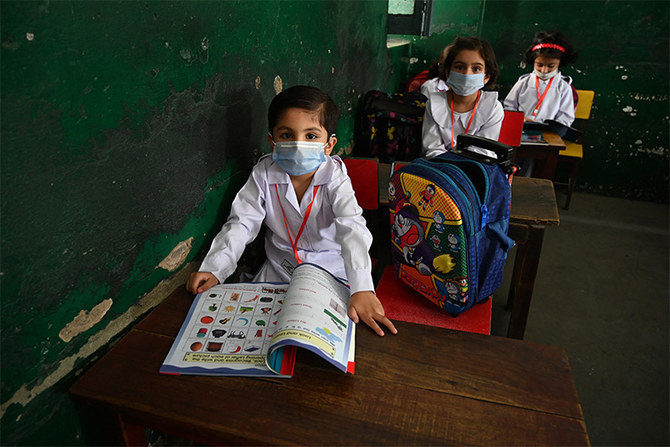
Students attend their class at a school in Rawalpindi, Pakistan, on June 7, 2021. (AFP)
Short Url
Updated 10 September 2021
Follow

23 percent Pakistani children suffering because schools closed, lack online devices — UNICEF 

  • A UNICEF study found students learnt significantly less compared to pre-pandemic levels 
  • The UN agency has urged authorities to prioritize safe reopening of schools 

ISLAMABAD: Pakistan was among the South Asian countries where closure of schools due to COVID-19 had led to alarming inequities in learning opportunities for children, the United Nations Children’s Fund said on Thursday, with 23 percent Pakistani children not having access to remote learning devices. 

The research conducted in Pakistan, India, Sri Lanka and the Maldives noted that school closures in South Asia had interrupted learning of 434 million children. 

The UN agency urged authorities to prioritize safe reopening of schools, noting that almost 60 percent of children in the region were unable to read and understand a simple text by the age of 10 even before the pandemic. 

“In Pakistan, 23 percent children didn’t have access to any device that could support remote learning,” it said. “Children from poor and disadvantaged households were the worst-hit, with many families struggling to afford even a single device.” 

Even when devices were available, the study said they would often be underutilized and that children’s access to them was limited. Among Pakistani children with access to such devices, only about 24 percent could use them whenever they wanted to. 

A large number of students and their parents reported that students learnt significantly less compared to pre-pandemic levels, according to the study. Despite significant efforts from governments, low connectivity and access to digital devices had severely hampered efforts to roll out remote learning. 

It found that student-teacher engagement, when regular and reciprocal, was a strong predictor of success in children’s learning. However, most students had little or no contact with their teachers after the closure of schools. 


Islamabad rebuts claims of Pakistan being used as base for possible US strike on Iran

Updated 6 sec ago
Follow

Islamabad rebuts claims of Pakistan being used as base for possible US strike on Iran

  • Pakistan information ministry attributes the ‘reckless’ claims to ‘Afghanistan and Indian X accounts’
  • ’Blame-pushing narrative tries to drag Pakistan into a US-Iran conflict without any evidence,’ it adds

ISLAMABAD: Pakistan on Monday refuted reports claiming that its territory could be used as a base for a possible US military strike on Iran, calling the claims a “reckless” attempt to drag Pakistani into a US-Iran conflict.

The Pakistan information ministry’s fact check account on X attributed the claims to “propaganda machineries Afghanistan and Indian X accounts,” identifying handles that claimed the US has moved aerial refueling (KC-135R) and surveillance aircraft to Pakistan.

The ministry said X accounts, @KHoorasanM_U1, @RealBababanaras and @AFGDefense, claimed these US aircraft are conducting unusual flights toward or into Iranian airspace and that Pakistan is being used as a base to support US stealth fighters (F-35/F-22) in a possible military strike on Iran.

Citing Reuters and Washington Post, the information ministry noted that while US refueling aircraft movements have been reported, but they were mostly linked to Europe, and there is no credible proof of any US aircraft based in Pakistan or any operational flights to Iran for a possible strike.

“This is a reckless, blame-pushing narrative that tries to drag Pakistan into a US-Iran conflict without any verifiable evidence,” the information ministry said on its fact check account on X, urging people not to share sensational military stories from “propaganda pages.”

“For national security and defense matters, rely only on ISPR (Inter-Services Public Relations), MoIB (Ministry of Information and Broadcasting), MoFA (Ministry of Foreign Affairs), and reputable defense outlets.”

The development comes amid weeks of public unrest in Iran over worsening economic conditions and a government crackdown on protesters.

The US-based Human Rights Activists News Agency said at least 572 people have been killed, including 503 protesters and 69 members of security forces. It said more than 10,600 people have been detained over the two weeks of protests.

The group relies on supporters in Iran cross-checking information, AP reported.

With the Internet down in Iran and phone lines cut off, gauging the demonstrations from abroad has grown more difficult. Iran’s government has not offered overall casualty figures.

US President Donald Trump last week threatened to intervene militarily if Tehran continued to kill protesters. He said late Sunday his administration was in talks to set up a meeting with Tehran but cautioned that he may have to act before then as reports of deaths mount and the government continues to arrest protesters.

“Iran called, they want to negotiate,” Trump told reporters on Air Force One.

Iran did not acknowledge Trump’s comments immediately. It has previously warned the US military and Israel would be “legitimate targets” if America uses force to protect demonstrators.

Separately, China said it opposes foreign “interference” in other countries.

“We always oppose interference in other countries’ internal affairs,” foreign ministry spokeswoman Mao Ning told a regular news conference on Monday, when asked about Trump’s comments. “We call on all parties to do more things conducive to peace and stability in the Middle East.”