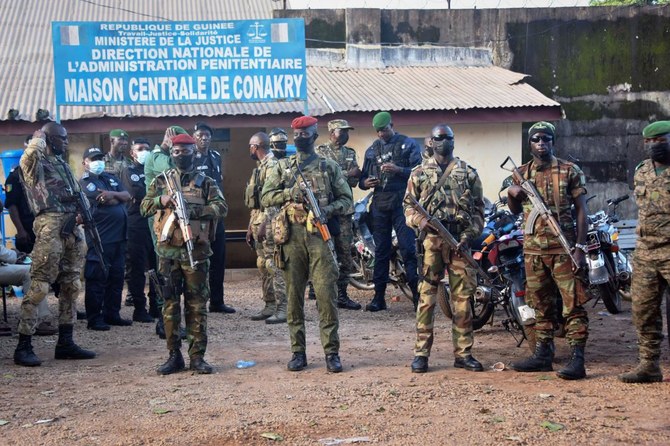
CONAKRY: Guinean putschists were awaiting decisions from the West Africa bloc ECOWAS on Wednesday, with regional leaders convening a crisis meeting on the coup that toppled president Alpha Conde at the weekend.
Special forces led by Lt. Col. Mamady Doumbouya seized power in the mineral-rich but impoverished West African country on Sunday and arrested the president, sparking international condemnation.
Conde, 83, had come under increasing fire for perceived authoritarianism, with dozens of opposition activists arrested after a violently disputed election last year.
But the putsch in Guinea has sparked fears of democratic backsliding across West Africa — where military strongmen are an increasingly familiar sight.
It has drawn parallels with its neighbor Mali: the Sahel state has suffered two coups since August last year led by Col. Assimi Goita, who was also a special forces commander.
West African leaders were to hold an extraordinary virtual crisis summit convened by the Economic Community of West African States (ECOWAS).
When faced with a similar discussion on Mali last year, ECOWAS imposed economic sanctions on the country, but lifted them after Mali’s ruling military committed to restoring civilian rule.
Doumbouya, hours after taking power in Conakry, appeared on television and accused the Conde government of “endemic corruption” and of “trampling on citizens’ rights.”
He has pledged to open talks on forming a new government, but it is not yet clear when, or under what form, these may take place.
“The government to be installed will be that of national unity and will ensure this political transition,” Doumbouya tweeted on Tuesday.
The same day, the military released about 80 political opponents of Conde who had been detained under his rule.
Ismael Conde, one of the detainees, told AFP upon his release that he was praying for a “new era for Guinea.”
The opposition activist had once been a member of Conde’s political party, but he defected and was then jailed for suggesting that the president had to be driven out by force.
“We are leaving invigorated to continue the struggle for a free and democratic Guinea,” Ismael Conde said.
Public discontent in Guinea had been brewing for months over a flatlining Covid-hit economy and the leadership of Conde, who became the first democratically elected president in 2010 and was re-elected in 2015.
But last year, Conde pushed through a new constitution that allowed him to run for a third term in October 2020.
The move sparked mass demonstrations in which dozens of protesters were killed. Conde won the election but the political opposition maintained that the poll was a sham.
No deaths have been officially reported in the putsch, although reports in Guinean media have suggested that between a dozen and 20 people were killed.
AFP was unable to independently confirm the reports.
The military coup was met with jubilation in some parts of Conakry, where hundreds residents turned out on the streets to applaud passing soldiers.
Cellou Dalein Diallo, the country’s main opposition leader, has backed the military regime — although he called for the army to uphold the rule of law.
In Bambeto, an opposition stronghold in Conakry, resident Abdoul Gadiri Diallo told AFP on Tuesday that he supports Doumbouya.
“He is going to straighten out this country very well, we are counting on him,” he said.
Doumbouya is in his early forties and was trained at France’s Ecole de Guerre military academy. He was also a member of the French Foreign Legion.
Guinea has spent decades under authoritarian rule since its independence from France in 1958. The latest coup is the third in the country’s history.

West African bloc holds crisis meeting after Guinea coup
https://arab.news/bsr2r
West African bloc holds crisis meeting after Guinea coup
- When faced with a similar discussion on Mali last year, ECOWAS imposed economic sanctions
- Guinea has spent decades under authoritarian rule since its independence from France in 1958
Ex-CNN journalist Don Lemon pleads not guilty to Minnesota protest charges
- A magistrate judge ordered Lemon released to await trial, after a night in custody following his arrest late on Thursday by the FBI
LOS ANGELES: Former CNN news anchor Don Lemon entered a not guilty plea on Friday to federal charges over his role covering a protest at a Minnesota church against President Donald Trump’s immigration crackdown, the Republican administration’s latest move against a critic.
Lemon, now an independent journalist, livestreamed a protest against Trump’s deployment of thousands of armed immigration agents into Democratic-governed Minnesota’s biggest cities. The protest disrupted a January 18 service at Cities Church in St. Paul.
A magistrate judge ordered Lemon released to await trial, after a night in custody following his arrest late on Thursday by the FBI.
Dressed in a cream-colored double-breasted suit, Lemon spoke only to say “yes, your honor” when asked if he understood the proceedings. One of his attorneys said that he pleaded not guilty.
“He is committed to fighting this. He’s not going anywhere,” said Lemon attorney Marilyn Bednarski.
“I have spent my entire career covering the news. I will not stop now,” Lemon told reporters after the hearing. “I will not be silenced. I look forward to my day in court.”
A grand jury indictment charged Lemon, who is Black, with conspiring to deprive others of their civil rights and violating a law that has been used to crack down on demonstrations at abortion clinics but also forbids obstructing access to houses of worship. Six other people who were at the protest, including another journalist, are facing the same charges.
Thousands of protesters took to the streets of Minneapolis and other US cities on Friday to denounce an immigration crackdown in which federal agents fatally shot two US citizens, sparking one of the most serious political crises Trump has faced.
PRESS ADVOCATES ALARMED
Free press advocates voiced alarm over the arrests. Actor and activist Jane Fonda went to show support for Lemon, telling journalists the president was violating the Constitution. “They arrested the wrong Don,” Fonda said.
Trump, who has castigated the protesters in Minnesota, blamed the Cities Church protest on “agitators and insurrectionists” who he said wanted to intimidate Christian worshippers.
Organizers told Lemon they focused on the church because they believed a pastor there was also a senior US Immigration and Customs Enforcement employee.
More than a week ago, the government arrested three people it said organized the protests. But the magistrate judge in St. Paul who approved those arrests ruled that, without a grand jury indictment, there was not probable cause to issue arrest warrants for Lemon and several others the Justice Department also wanted to prosecute.
“This unprecedented attack on the First Amendment and transparent attempt to distract attention from the many crises facing this administration will not stand,” Abbe Lowell, Lemon’s lawyer, said in a statement, invoking constitutional free speech protections.
In the livestream archived on his YouTube channel, Lemon can be seen meeting with and interviewing the activists before they go to the church, and later chronicling the disruption inside, interviewing congregants, protesters and a pastor, who asks Lemon and the protesters to leave.
Independent local journalist Georgia Fort and two others who had been at the church were also arrested and charged with the same crimes.
US Magistrate Judge Dulce Foster on Friday ordered Fort’s release, denying prosecutors’ request to hold her in custody, according to court documents.
TRUMP CRITICS TARGETED
The Justice Department over the past year has tried to prosecute a succession of Trump’s critics and perceived enemies. Its charges against former FBI Director James Comey and New York Attorney General Letitia James, who both led investigations into Trump, were thrown out by a judge.
Lemon spent 17 years at CNN, becoming one of its most recognizable personalities, and frequently criticizes Trump in his YouTube broadcasts. Lemon was fired by CNN in 2023 after making sexist on-air comments for which he later apologized.
Trump frequently lambastes journalists and news outlets, going further than his predecessors by sometimes suing them for damages or stripping them of access-granting credentials.
FBI agents with a search warrant seized laptops and other devices this month from the home of a Washington Post reporter who has covered Trump’s firing of federal workers, saying it was investigating leaks of government secrets.
Press advocates called the FBI search involving the Post reporter and the arrests of Lemon and Fort an escalation of attacks on press freedom.
“Reporting on protests isn’t a crime,” said Jameel Jaffer, executive director of Columbia University’s Knight First Amendment Institute. Jaffer called the arrests alarming, and said Trump sought “to tighten the vise around press freedom.”
Trump has said his attacks are because he is tired of “fake news” and hostile coverage.
Legal experts said they were unaware of any US precedent for journalists being arrested after the fact, or under the two laws used to charge Lemon and Fort. They include the Freedom of Access to Clinic Entrances Act, a 1994 measure that prevents obstructing access to abortion clinics and places of worship.


