BERLIN: German Chancellor Angela Merkel on Tuesday lauded her party’s candidate Armin Laschet as the best choice to succeed her, as polls showed the gaffe-prone Rhinelander still trailing badly ahead of this month’s election.
Laschet, the chancellor candidate for Merkel’s conservative CDU/CSU bloc, was long the favorite to be the next German leader, but his ratings have plummeted following a series of missteps.
The frontrunner is now Vice Chancellor and Finance Minister Olaf Scholz, whose center-left Social Democrats (SPD) are enjoying a late spurt in the final weeks before the Sept. 26 vote.
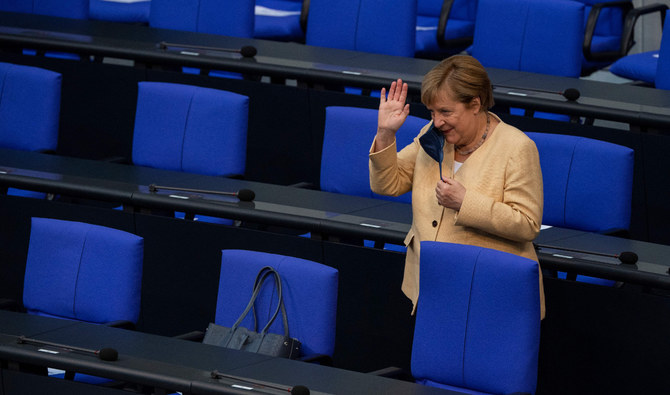
“It is a special election, not only because no incumbent chancellor is running for reelection for the first time since 1949,” the outgoing Merkel said in what was likely her last speech in parliament ahead of the vote.
“It is also a special election because it is a decision on the direction of our country in difficult times — and it is not irrelevant who governs this country,” she said.
“The best way for our country is a CDU/CSU-led federal government with Armin Laschet as chancellor, because his government would stand for stability, reliability, moderation and centrism.”
Merkel, who is retiring after 16 years in power, did not get involved in the race to pick a candidate from her party to run in the elections.
But with the Christian Democrats’ poll ratings plummeting to their lowest in the post-war period, the party is now encouraging as many joint appearances as possible between Merkel and Laschet.
A poll for the NTV broadcaster published on Tuesday showed the conservative alliance on just 19 percent, with the SPD out ahead on 25 percent and the Greens— an early favourite in the race — on 17 percent.
The CDU/CSU bloc won 33 percent at the last election in 2017 under Merkel, who remains immensely popular with the public.
Merkel appeared alongside Laschet at a digital summit on Monday, and also accompanied him at the weekend on a tour of two towns hit hard by deadly floods in July.
In North Rhine-Westphalia, where Laschet is the regional premier, Merkel told reporters he was “leading the largest state in Germany very successfully.”
Laschet’s reponse to the floods in his state was the beginning of a downward slide for the 60-year-old, after he was caught on camera joking with local officials during a tribute to flood victims.
If the alliance’s fortunes don’t improve soon, it could crash out of government in favour of an SPD-led alliance — most likely with the Greens and either the liberal FDP or the far-left Die Linke.
Scholz has been under pressure to rule out working with Die Linke, which refuses to recognize NATO and voted against the German army’s recent rescue effort in Afghanistan.
The SPD leader on Tuesday insisted that “we have to work for a strong sovereign Europe that is able to take its own affairs into its own hands”, which he said would “only be possible in the NATO alliance”.
But Laschet called on him to go further and reject collaborating with Die Linke, saying voters had a right to know whether he intended to “call these people into a potential federal government.”
The CDU-CSU would “do everything to ensure that there is no red-red-green alliance in Germany,” he said, referring to the colours of the SPD, Die Linke and the Greens.
Merkel also urged voters not to choose a left-wing coalition.
“Citizens will have the choice of either a government of the SPD and the Greens that accepts the support of the Linke party -- or at least does not rule it out -- or a federal government that leads our country into the future with moderation and balance,” she said.


![]()

Merkel goes all out for Laschet as party lags in polls
Short Url
https://arab.news/2dm3g
Merkel goes all out for Laschet as party lags in polls
Latest updates


© 2026 SAUDI RESEARCH & PUBLISHING COMPANY, All Rights Reserved And subject to Terms of Use Agreement.