

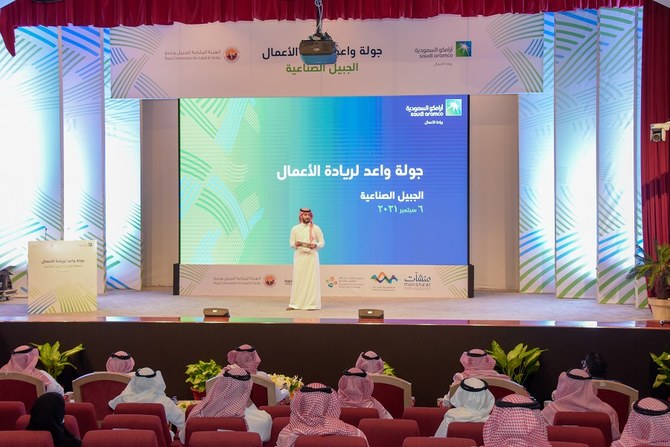
Aramco’s arm, Wa’ed, gives $2.71m to startups in 1st stop of Saudi roadshow

Wa’ed has helped drive growth of the Kingdom’s entrepreneurial ecosystem by deploying more than SR 400 million in venture capital investment, loans and incubation services into more than 100 Saudi-based startups. (Supplied)
Short Url
Updated 08 September 2021
Follow

Aramco’s arm, Wa’ed, gives $2.71m to startups in 1st stop of Saudi roadshow

  • The next Wa’ed Entrepreneurship Roadshow will be on Sept. 21 in Yanbu

JUBAIL: A total of SR10.2 million ($2.71 million) has been given in grants and loans to six local startups in the first of Wa’ed’s six stops on its nationwide roadshow. The first group of winners include a maker of radioisotopes, used in medical imaging technology, and a company that converts used cooking oil into biofuels for use in diesel cars.

Wa’ed, the entrepreneurship arm of Aramco, began a six-city national roadshow in Jubail on Monday to fund the Kingdom’s best new startups. The roadshows bring an element of Shark’s Tank TV show to Saudi Arabia with a top local TV personality bringing an air of excitement and competition to the selection of winning entrepreneurs.

Wa’ed roadshows will also be held this year in Yanbu, Jeddah, Riyadh, Madinah and Makkah. Wa’ed is selecting Saudi-based entrepreneurs for loans, incubation services and venture capital investment. The roadshows are being hosted by Mohammed Almousa, a Saudi entrepreneur and broadcast presenter for MBC television.

“The startups we recognize tonight in Jubail are part of a new wave of Saudi-based entrepreneurs who are driving economic growth and diversification in the Kingdom,” said Fahad Alidi, Wa’ed managing director. 

Created as a wholly owned venture of Aramco in 2011, Wa’ed has helped drive growth of the Kingdom’s entrepreneurial ecosystem by deploying more than SR 400 million in venture capital investment, loans and incubation services into more than 100 Saudi-based startups. 

The Jubail roadshow highlighted industrial manufacturing and services and drew entrepreneurs from a range of fields. The event was sponsored by The Royal Commission for Jubail & Yanbu, which oversees the Kingdom’s largest industrial zone. 

Future roadshows will focus on drones, security technology, reverse engineering, petrochemicals, environmental tech, fintech, supply chains, tourism and hospitality, among other sectors.

Entrepreneurs recommended for loans and incubation support must pass Wa’ed background checks. The next Wa’ed Entrepreneurship Roadshow will be on Sept. 21 in Yanbu.

Wa’ed Entrepreneurship Roadshow recommended loans be issued to:

  • Ahmad Alkhowaiter, the first Saudi producer of a ubiquitous oil and gas drilling compound;
  • Motlaq Almotairy, founder of Saudi’s first radioisotopes firm;
  • Abdullah Al Otaibi, the founder of a company that converts used cooking oils into biofuels. 

Wa’ed also recommended incubation seed funding grants to:

  • Nawaf Alabra, founder of a new-generation B2B platform;
  • Ahmed Abdulmohsen, founder of a business software maker that manages infrastructure, buildings and lighting;
  • Muhannad Alhamed, founder of a smart home automation solutions maker based on IoT.


First EU–Saudi roundtable on critical raw materials reflects shared policy commitment

Updated 16 January 2026
Follow

First EU–Saudi roundtable on critical raw materials reflects shared policy commitment

RIYADH: The EU–Saudi Arabia Business and Investment Dialogue on Advancing Critical Raw Materials Value Chains, held in Riyadh as part of the Future Minerals Forum, brought together senior policymakers, industry leaders, and investors to advance strategic cooperation across critical raw materials value chains.

Organized under a Team Europe approach by the EU–GCC Cooperation on Green Transition Project, in coordination with the EU Delegation to Saudi Arabia, the European Chamber of Commerce in the Kingdom and in close cooperation with FMF, the dialogue provided a high-level platform to explore European actions under the EU Critical Raw Materials Act and ResourceEU alongside the Kingdom’s aspirations for minerals, industrial, and investment priorities.

This is in line with Saudi Vision 2030 and broader regional ambitions across the GCC, MENA, and Africa.

ResourceEU is the EU’s new strategic action plan, launched in late 2025, to secure a reliable supply of critical raw materials like lithium, rare earths, and cobalt, reducing dependency on single suppliers, such as China, by boosting domestic extraction, processing, recycling, stockpiling, and strategic partnerships with resource-rich nations.

The first ever EU–Saudi roundtable on critical raw materials was opened by the bloc’s Ambassador to the Kingdom, Christophe Farnaud, together with Saudi Deputy Minister for Mining Development Turki Al-Babtain, turning policy alignment into concrete cooperation.

Farnaud underlined the central role of international cooperation in the implementation of the EU’s critical raw materials policy framework.

“As the European Union advances the implementation of its Critical Raw Materials policy, international cooperation is indispensable to building secure, diversified, and sustainable value chains. Saudi Arabia is a key partner in this effort. This dialogue reflects our shared commitment to translate policy alignment into concrete business and investment cooperation that supports the green and digital transitions,” said the ambassador.

Discussions focused on strengthening resilient, diversified, and responsible CRM supply chains that are essential to the green and digital transitions.

Participants explored concrete opportunities for EU–Saudi cooperation across the full value chain, including exploration, mining, and processing and refining, as well as recycling, downstream manufacturing, and the mobilization of private investment and sustainable finance, underpinned by high environmental, social, and governance standards.

From the Saudi side, the dialogue was framed as a key contribution to the Kingdom’s industrial transformation and long-term economic diversification agenda under Vision 2030, with a strong focus on responsible resource development and global market integration.

“Developing globally competitive mineral hubs and sustainable value chains is a central pillar of Saudi Vision 2030 and the Kingdom’s industrial transformation. Our engagement with the European Union through this dialogue to strengthen upstream and downstream integration, attract high-quality investment, and advance responsible mining and processing. Enhanced cooperation with the EU, capitalizing on the demand dynamics of the EU Critical Raw Materials Act, will be key to delivering long-term value for both sides,” said Al-Babtain.

Valere Moutarlier, deputy director-general for European industry decarbonization, and directorate-general for the internal market, industry, entrepreneurship and SMEs at European Commission, said the EU Critical Raw Materials Act and ResourceEU provided a clear framework to strengthen Europe’s resilience while deepening its cooperation with international partners.

“Cooperation with Saudi Arabia is essential to advancing secure, sustainable, and diversified critical raw materials value chains. Dialogues such as this play a key role in translating policy ambitions into concrete industrial and investment cooperation,” she added.