



DUBAI: Through a television screen slightly past 9 a.m. on the east coast of the US on a Tuesday morning, Americans received perhaps their greatest trauma. It was then that the second plane crashed through Twin Towers in New York City, a moment embedded in the public consciousness ever after, a moment that would shape culture in all its facets.
Through those television screens, other grim images that would be echoed in film and culture followed. There was the falling man, leaping from the building to escape the smoke and flames.

General view of the World Trade Center memorial in New York City on February 26, 2021. (File/AFP)
There were the falling towers themselves, collapsing in on themselves as if from grief. There was the billowing smoke and debris that pervaded lower Manhattan, the grey ashes that clung to everything — the streets, police cars, even the survivors themselves.
Part of the reason that these images linger so strongly, and part of the reason that those wounds have never fully healed, is the lack of reason, of resolution, of narrative embedded within them. No matter how many questions that the horrible events of 9/11 raised, there were no easy explanations to be found on that day, nor satisfying ones in the days after.

Kristina Hollywood and her daughter Allyson attend a candlelight vigil for 9/11 victims at a memorial site following the death of Osama bin Laden May 2, 2011. (File/AFP)
Answers were what Americans needed. Answers are what pop culture provided them. More than anything else, the key to success in the world of film and television is how well the work provided the right framework for thought, often the more comforting the better.
In the months following the attacks, the most popular films provided those answers most satisfyingly, if more generally. Audiences flocked to the opening screenings of “The Lord of the Rings: The Fellowship of the Ring,” finding solace in a world in which good and evil are clearly defined, at clear odds, and in which the purity of spirit of the good side can overcome all. They found that in the first Harry Potter film, too, “The Sorcerer’s Stone,” in which love and unity can overcome a malevolent, secretly invasive force.

The family of Flight 93 victim C.C. Lyle arrives at the premiere of "United 93" during the Fifth Annual Tribeca Film Festival at the Ziegfeld Theatre April 25, 2006 in New York City. (File/AFP)
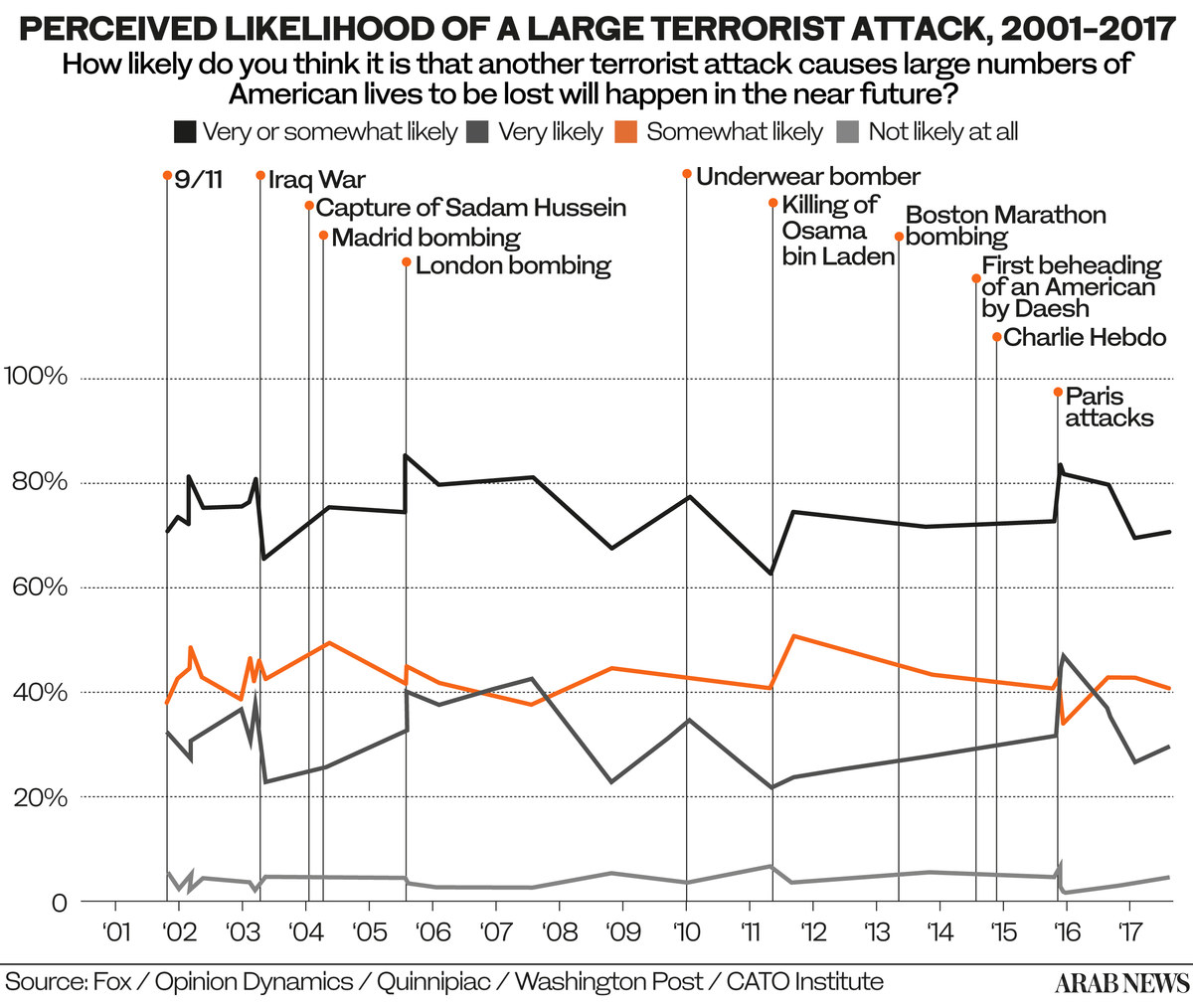
Applying that narrative back to the real world, however, is when America’s need for answers brought out its darkest impulses. Some in America, including those at the very top, quickly defined the true evil as the Arab and Muslim other, a narrative that was not born on the morning of 9/11, merely refocused and sharpened.
In the wake of that fateful day, across the country, Arabs were targeted in hate crimes and Islamophobia became practically acceptable mainstream discourse. America’s need for a real-world inspired villain on screen led the ascent of the Muslim terrorist, including in popular television shows such as “24” and “Homeland.”
Nuance and subjective perspective were stripped from most characters from the region, a trend that continues to this day across many films and TV, as “London Has Fallen” and the Jack Ryan films repeat the same tropes with only cosmetic enhancements.
For Arab actors, the post-9/11 world became a land of both opportunity and heartbreak. A sequence in the 2008 film “AmericanEast,” directed by Egyptian-American filmmaker Hesham Issawi, plainly portrayed that experience.
In the film, which depicts various Arab immigrants trying to assimilate into American culture, a character named Omar is finding nascent success as an actor. His most successful role to date was that of a Muslim extremist terrorizing the US, and his hopes that he can transform that success into a wide range of roles are quickly crushed.

Janice Ryan points as she finds her friend's name at the World Trade Center memorial in New York City on February 26, 2021. (File/AFP)
In one scene, Omar is cast for a leading role in a network TV drama as a doctor that incidentally happens to be Muslim. When he arrives on set, however, he finds the role has been cut, and he has been recast as a Muslim terrorist. When he tries to find the humanity in the character, the exasperated filmmakers tell him: “He’s a terrorist. He’s full of hate. That’s all you have to play.”
Unfairly, Omar is forced to choose between following his dream, and dehumanizing himself and his people, a choice many real actors made in more desperate circumstances. Worse still, Arabs both in the US and abroad have not found their faces reflected in the media, which continues to portray characters that lack values and basic three-dimensional humanity.

Members of the U.S. Coast Guard honor veterans killed in the attacks on September 11 at the memorial at Ground Zero on Veterans Day on November 11, 2020 in New York City. (File/AFP)
In those same years, the films that portrayed real events surrounding 9/11 and the wars that were started in its name were often met with disinterest. Even when a film about the war in Iraq won the Oscar for Best Picture in 2009, Kathryn Bigelow’s “The Hurt Locker,” it was the lowest-grossing film to ever receive that honor, signaling that even the film world’s most prestigious prize was not enough to imbue reflection on those events into the cultural psyche.
What the world needed was not more questions; it was crying out for answers. And if there is any truism that film fans can rely on, it is that a hero can provide all of the answers.
It was the idea of unbridled heroism that led Jack Bauer in “24” to become a cultural icon on television in the early 2000s, allowing people to enjoy a show that depicts events similar to those of 9/11 because at the center was a man who had it all figured out, knew why it was happening and how he would stop it.
More significantly, the post-9/11 film landscape saw the ascent of the superhero genre, which had failed to truly take hold in the past outside of Superman and Batman, but starting with 2002’s “Spider-Man,” became the dominant genre of the medium, a distinction it still holds.
Christopher Nolan’s “Dark Knight” films and Zack Snyder’s “Superman” films took the direct imagery of that tragic Tuesday morning — the smoke, the collapsing buildings, the falling men — and used that to make it feel as if these larger-than-life heroes were saving the world as it really was, the one we lived through, not the fantastical one we had seen in the past.
Then, dwarfing them all, the Marvel Cinematic Universe was born, and there the unresolved narrative needs of the American public were focused most greatly.
In “Captain America,” a yearning for a clear understanding of American good was fulfilled, an embodiment of innocence forced to contend with a darker age. In “Iron Man,” American ingenuity overcomes Muslim extremism.
FASTFACT
* Netflix is airing a 5-part series, Turning Point, which documents the 9/11 terrorist attacks, from Al-Qaeda’s roots in the 1980s to America’s response, both at home and abroad.
And in the “Avengers,” 9/11 itself was seemingly re-enacted by an alien force, the only solution to which was not the grass-roots unity of the American people toward a common goal, but the reliance on heroes to do that work for us.
America found real-life heroes to put on the screen too. US Navy SEAL sniper Chris Kyle was depicted in Clint Eastwood’s 2014 film “American Sniper,” which became the highest-grossing film of that year, and the highest-grossing war film of all time.
“American Sniper” got rid of the nuance that had plagued the “war on terror” films for over a decade and replaced it with a character who had the sure-headedness of a Marvel hero, the clear understanding that he was a good guy who was killing bad guys, who had never done an unjustifiable act.
It was intoxicating for many audiences, who chose to look past the fact that Kyle was not the “Captain America” one might have hoped but instead idolized the Marvel hero “The Punisher,” a monstrous vigilante whose iconography is popular among US special forces. Because of that, as the dust settled, the film has a more controversial legacy than its initial praise suggested.

A US flag hangs from Oculus at the World Trade Center Transportation Hub for the Memorial Day weekend in New York city on May 29, 2021. (File/AFP)
It is not all grim, of course. American cinema has been at its best when it extends its gaze internally more critically, and outside its borders with more compassion.
Arab and Muslim films and performers have gained prominence in award shows, and TV series such as “Ramy” have themselves depicted 9/11 from the perspective of Arab Americans who suddenly found themselves otherized.
The push and pull that existed in the creative community for the last two decades seems finally to be leaning more toward an answer that perhaps should have been found in the direct aftermath: That peace, coexistence, and a recognition of common humanity are what overcome acts of evil, and broadly labelling an enemy as an entire culture only creates more to contend with.
Twitter: @whmullally


