- Army statement coincides with media reports of Pakistan using drones to support Taliban in Afghanistan’s Panjshir valley
- Pakistani military spokesman says Pakistan has “nothing to with anything happening” in Panjshir or elsewhere
ISLAMABAD: Reports that Pakistan had supported the Afghan Taliban in a latest assault on Panjshir were “false and irrational propaganda,” a spokesperson for the military said on Monday about the fall of the last province in the north of Afghanistan that was not in the Taliban’s control since the insurgent group captured Kabul on August 15.
The Pakistan army’s statement coincided with the circulation on social media of a picture purportedly showing a Pakistan Air Force jet shot down by opposition fighters in Afghanistan’s Panjshir valley northeast of Kabul. A fact check by Pakistan’s Dawn newspaper said the picture was from 2018 in the United States.
Other reports suggested Pakistan had supported the Taliban in bombing Panjshir valley using unmanned aerial vehicles (UAV) or drones. On Monday, Iran's military spokesperson, while referring to the Panjshir battle, said Tehran was investigating 'foreign interference' in Afghanistan.
The Taliban have now declared victory over opposition forces in the Panjshir valley, declaring that it had completed the group's takeover of Afghanistan and promising to announce a new government soon.
“Whatever is happening inside Afghanistan, Pakistan has nothing to do with it,” the BBC said, quoting military spokesperson Major General Babar Iftikhar. “Be it Panjshir or anywhere else.”
Iftikhar described the reports of Pakistan’s involvement in the Panjshir strikes as “completely false and irrational propaganda.”
The BBC also quoted unnamed military officials as saying Pakistan did not have the drone technology to hit targets at a long distance.
In 2015, the BBC report said, Pakistan had announced for the first time that it had used drones to target militant hideouts in Shawwal valley in northwestern Pakistan.
Pakistan used its Burraq unmanned combat aerial vehicle in the Shawaal strike, which was developed and built by the National Engineering and Scientific Commission (NESCOM), a civil scientific research and development organization of Pakistan, along with the Pakistan Air Force. The drone uses a laser-guided missile to hit targets on the ground.
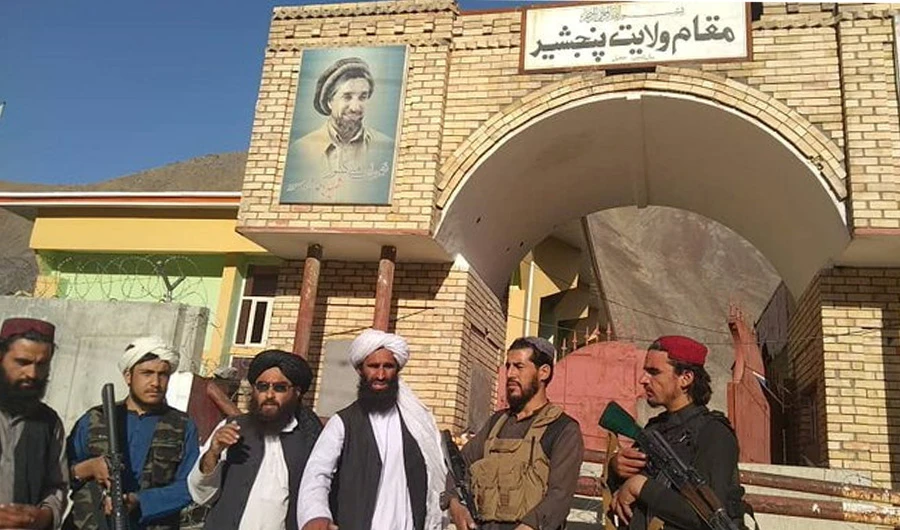
Pictures circulated on social media on Monday showed Taliban members standing in front of the gate of the Panjshir provincial governor’s compound after fighting over the weekend with the National Resistance Front of Afghanistan (NRFA), led by Panjshiri leader Ahmad Massoud.
The Taliban assured the people of Panjshir, who are ethnically distinct from the Pashtun-dominated Taliban and fought against the militants during their rule from 1996 to 2001, that there would be no “discriminatory act against them.”
“They are our brothers and would work together for a joint purpose and welfare of the country,” Taliban spokesman Zabihullah Mujahid told a news conference.
Massoud, who leads a force drawn from remnants of the regular Afghan army and special forces units as well as local militia fighters, said in a Twitter message he was safe but gave no details.