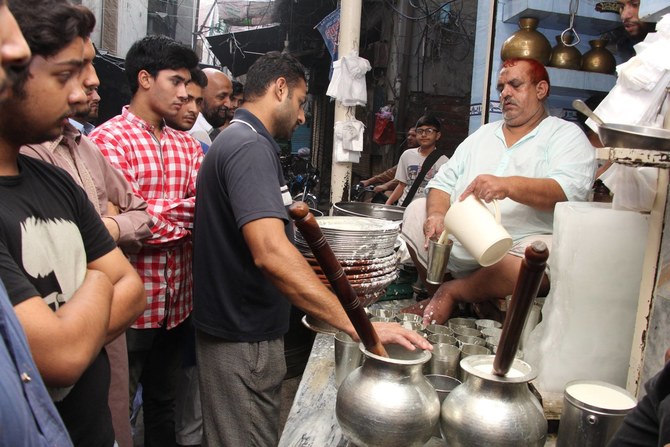

RAWALPINDI: Lassi, a tangy concoction made from yogurt and water, is possibly Pakistan’s most popular drink — year-round but especially during the torment of summer.
The cooling drink is usually made with sugar but those willing to experiment can use salt instead. Some mix in malai, or cream, while others spice it up with cardamom, top it with crushed pistachios, or prefer a concoction of yogurt and mango pulp. Whatever the ingredients, there is no doubt lassi has stood the test of time.
“It’s not surprising that lassi has remained so popular to this day: it’s an affordable, three-ingredient drink that is perfect for the summer,” Maryam Jillani, an international educator, food writer and founder of the award-winning blog Pakistan Eats, told Arab News.
The history of the drink is not well known but it is believed to have originated long ago in the Punjab region, where milk has always been an important staple drink. Before the advent of refrigerators, Punjabi farmers are said to have drunk milk cooled in a clay pot and mixed with curd and sugar stirred by a wooden stick.
Indeed, Jillani said, aside from its affordability and cooling properties, lassi’s enduring popularity in Pakistan spoke to Punjab’s “intimate relationship” with yogurt and dairy in general.
“Of course, the evolution of lassi to include other fruits, especially mangoes, has given it an additional boost and expanded lassi’s fan base,” she said, explaining that the addition of new ingredients had made the drink more marketable at expensive restaurants, rather than just roadside food stalls where it was a staple.
“For some, plain lassi’s flavor is too mild and so the inclusion of mango pulp helps give the drink some extra oomph, which personally, I don’t think it needs,” Jillani said, “but it has certainly helped bring it to more upscale restaurant menus.”
At Lahore’s Chacha Feeka Famous Lassi Peray Wali shop, sweet lassi acquires a unique taste with the addition of khoya, which is made by mixing together condensed milk and milk powder and adding ghee. The lassi is so thick customers are given a spoon so they can scoop up delicious chunks of khoya embedded with crystal sugar.
Feeka is an icon on Pakistan’s lassi landscape. The original owner, the eponymous Chacha Feeka, opened the shop before the creation of Pakistan in 1947, and it is run today by his nephews and grandsons who sell hundreds of glasses of lassi a day.
“This is our longtime family business,” Kashif Abbas, one of Feeka’s grandsons, told Arab News. “Our lassi, from when we started to now, is its own unique take on lassi. Nobody makes it like we do and that’s how we have stood here for so long. Just like we are run by generations, generations of people continue the tradition of drinking lassi from our shop.”
The Punjab Milk Shop in Islamabad is another popular spot, with its sweet lassi texturally closer to a smoothie – not too heavy or too light but retaining the signature yogurt taste that every great lassi drink is built on.
“Ordering lassi is serious business,” said Badar Hussain, a manager at the Punjab Milk Shop. “We pride ourselves on creating products that are super fresh and without preservatives.”
In Rawalpindi, another city in Pakistan’s Punjab province, the most highly recommended spot to grab a glass of lassi is Kashmir Milk Shop in the longstanding Kartarpura Food Street.
Mohammad Banaras, who runs the shop with other family members, said his cousin set up the store 20 years ago, selling everything from yogurt to milk and cream and, of course, lassi.
“We sell lassi 14 hours a day, from when we open to when we close, there is not a time where lassi is not being sold,” he told Arab News. “At our shop you find all types of lassis, anything you can think of ... what makes our shop so special is that we make it any way you want it … we accommodate every customer who walks in.”