

Dubai-based Pakistani wins hearts, and AED50,000, for saving pregnant cat from high-rise

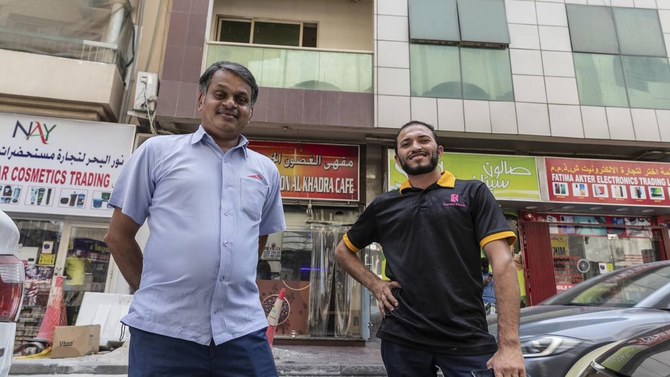
Pakistani Atif Mehmood (R), a salesman in Dubai poses in front of the residential building from which he saved a pregnant, cat stuck on the second floor balcony, on September 3, 2021. (AN Photo)
Short Url
Updated 06 September 2021
Follow

Dubai-based Pakistani wins hearts, and AED50,000, for saving pregnant cat from high-rise

  • ​​​​​​​Salesman Atif Mehmood and two other men saved a pregnant cat stuck in the balcony of a residential building last month
  • Footage of the incident caught the eye of the Dubai ruler who shared it on Twitter and asked people to help identify the rescuers

DUBAI: Pakistani Atif Mehmood, a salesman in Dubai, was on his way to work last month when he was stopped in his tracks by the distressed whimpers of what sounded like a cat.

When he looked up, he saw a pregnant cat stuck on the second floor balcony of a residential building in Deira, the commercial hub of Dubai.

What happened next has changed the life of the 24-year-old from Pakistan’s northwestern Lakki Marwat district, winning him fame, prayers and a monetary reward — that too from the prime minister of the United Arab Emirates and the ruler of Dubai, Sheikh Mohammed bin Rashid Al Maktoum.

“I saw that the cat was crying loudly and was afraid to jump off because of the height,” Mehmood told Arab News. “I decided that I could not just leave it there.”

The man picked up a box and held it up to the cat but it wouldn’t budge.

“I then asked for the help of an Indian and a Moroccan man, and also asked someone to give us a bedsheet,” he said.

As this was going on, Abdul Rashid, the Indian owner of a grocery store located just across the road, rushed over and started filming.

“I posted the video on my Instagram and shared it on my WhatsApp group, and within 15 minutes, it went viral,” Rashid told Arab News.

The video shows the three men holding up the bedsheet for the cat, who initially hesitates, but then jumps into it and is saved.

Viewed over 1.1 million times, the footage caught the eye of the ruler of Dubai who posted it on Twitter and asked people to help identify the “unsung heroes” so he could thank them.

Social media users helped identify the three men who saved the cat, and Rashid who shot the video, who were then called in by police the day after the incident.

“I got a call from the police and someone asked me, ‘Did you save a cat?’,” Mehmood said. “I got scared and said yes, I did, and then they asked me to visit the police station.”

He said he entered the police station to cheers and applause. Three days later, he was told he had been awarded AED50,000, the equivalent of over $13,000, by the Dubai government.

“I did not believe it at first,” he said, “but it has become a reality.”

Mehmood, who is single, has already spent most of the reward money to buy a car for his father and help out his brother. He now plans to use the rest of the cash to try to set up a business in Dubai.

“I have a lot of dreams,” he said, “and now that my financial worries are over, I will set up a business in Dubai.”

The Consulate General of Pakistan in Dubai did not respond to a request for comment for this story.


Pakistan approves sale of 500,000 tons of wheat at revised prices after failed bids

Updated 6 sec ago
Follow

Pakistan approves sale of 500,000 tons of wheat at revised prices after failed bids

  • Move comes as IMF-backed reforms push Pakistan to cut food subsidy and storage costs
  • Wheat pricing shifts closely watched for impact on inflation, fiscal deficit and rural incomes

ISLAMABAD: Pakistan’s Economic Coordination Committee (ECC) on Tuesday approved the sale of 500,000 metric tons of wheat at revised reserve prices after an earlier attempt to offload the stock failed due to insufficient bids, according to a statement issued by the Finance Division.

The move comes as the government seeks to reduce mounting wheat inventories held by the Pakistan Agricultural Storage and Services Corporation (PASSCO) and cut associated storage and financing costs amid fiscal consolidation under a $7 billion International Monetary Fund (IMF) stabilization program. Wheat pricing is politically sensitive in Pakistan, where flour is a staple commodity and closely linked to inflation.

Managing excess procurement stocks has become a balancing act for policymakers, who are attempting to control food inflation while limiting subsidy pressures and budget deficits.

“The Committee was informed that an earlier attempt to sell the wheat at previously approved reserve prices could not be finalized due to lower bids received,” the Finance Division said in its statement.

The ECC approved the disposal of wheat through competitive bidding on a First-In-First-Out (FIFO) basis at revised reserve prices of Rs4,150 ($14.8) per 40 kilograms for locally procured wheat and Rs3,800 ($13.6) per 40 kilograms for imported wheat.

Pakistan is one of the world’s largest wheat producers and consumers, and government procurement and pricing decisions often ripple through domestic markets, affecting food inflation, rural incomes and fiscal spending. The country’s wheat policy has been closely scrutinized in recent years after bumper crops, fluctuating import decisions and subsidy adjustments created volatility in local markets.

For international investors and multilateral lenders, inventory management and subsidy rationalization are seen as critical elements of Pakistan’s broader economic reform agenda. Large public stockpiles carry financing and storage costs that add to fiscal pressure, particularly at a time when Islamabad is seeking to narrow budget deficits and stabilize its external accounts.

Pakistan has also faced periodic wheat supply disruptions in recent years, prompting emergency imports that strained foreign exchange reserves. The current decision signals an effort to clear accumulated stock while recalibrating price expectations in the domestic market.

Separately, the ECC approved a technical supplementary grant of Rs536 million ($1.9 million) for projects under Pakistan’s Public Sector Development Programme (PSDP), the federal government’s main infrastructure and development funding framework. 

The allocation relates to projects previously overseen by the now-defunct Pakistan Public Works Department (Pak-PWD), whose functions were recently transferred to provincial authorities as part of administrative restructuring and fiscal rationalization measures. The funds will be transferred to the governments of Punjab and Khyber Pakhtunkhwa in accordance with relevant legal provisions.

In addition, a summary by the Petroleum Division regarding a fact-finding report on a deed of settlement with Cnergyico PK Limited, one of Pakistan’s largest oil refining and marketing companies, was tabled. 

The matter concerns delayed payments of petroleum levy, a key federal revenue source collected on fuel sales that contributes significantly to Pakistan’s budget financing. The ECC returned the summary with directions for a more comprehensive presentation at a subsequent meeting.