

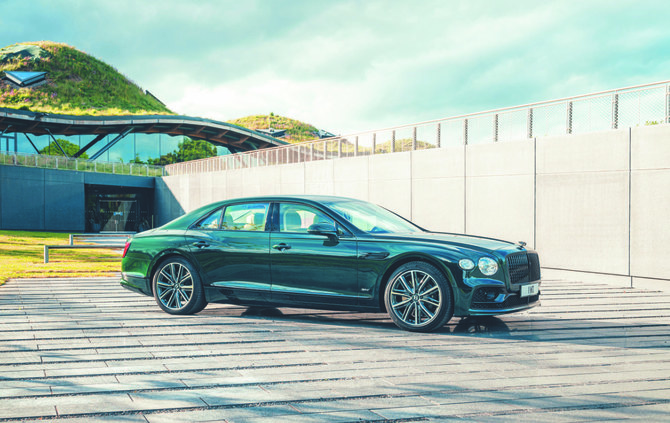
New, greener Flying Spur Hybrid to arrive in 2022

The new Flying Spur incorporates a class-leading portfolio of intelligent and intuitive equipment tailored to the driver and passengers.
Short Url
Updated 05 September 2021
Follow

New, greener Flying Spur Hybrid to arrive in 2022

Samaco Automotive, the certified dealer of Bentley Motors in Saudi Arabia, has announced details of the company’s latest luxury model on its journey to electrification — the new Flying Spur Hybrid, which arrives in the Kingdom in 2022.
The introduction of the new hybrid model builds on the success of the third-generation Flying Spur, using a highly innovative third powertrain delivering the most environmentally friendly Bentley to date. The Flying Spur Hybrid emphasizes Bentley’s commitment to its “Beyond100” strategy to become an end-to-end carbon neutral organization and the world’s leading sustainable luxury mobility company.
“The latest addition to Bentley’s new hybrid range demonstrates that hybridization does not compromise luxury or performance. With an unperceivable blend between the internal combustion engine and electric motor, refined serenity is on offer regardless of driving mode or style,” said Peter Smith, general manager at Bentley Motors in Saudi Arabia.
He added: “The new powertrain combines a 2.9-liter V6 petrol engine with an advanced electric motor, delivering a total of 536 bhp and 750 Nm of torque — an additional 95 bhp in comparison to the Bentayga Hybrid. The new Flying Spur is the most efficient Bentley ever having the capability to cover over 700 km when fully fueled.”
The new Flying Spur incorporates a class-leading portfolio of intelligent and intuitive equipment tailored to the driver and passengers. For the Flying Spur Hybrid, connected car services will now also include My Battery Charge, My Car Statistics, and My Cabin Comfort.

HIGHLIGHT

The Flying Spur Hybrid emphasizes Bentley’s commitment to its ‘Beyond100’ strategy to become an end-to-end carbon neutral organization and the world’s leading sustainable luxury mobility company.

Inside the cabin, the automatic start-stop switch has been replaced with a control for the three E modes — EV Drive, Hybrid Mode and Hold Mode, enabling the driver to manage the battery usage during a journey. EV Drive mode is engaged as soon as the car is switched on and maximizes the electric driving experience. This is ideal for city driving and for shorter journeys.
The flow of energy can also be displayed via the infotainment screen where statistics can be seen and the timers for charging the vehicle can be set. Additional e-motion information is available to the driver via the instrument panel, heads-up display and center screen, including range, battery level and charging information.
Exterior visual differences for the Flying Spur Hybrid include a “hybrid” front fender badge, quad oval tailpipes, and a covered universal charging point on the left-hand rear fender.
The advanced electronic motor is located between the transmission and the engine and provides up to 134 bhp and 400 Nm of torque.
The E-motor is powered by a 14.1 kWh lithium-ion battery and can be charged to 100 percent in as little as two and a half hours (region-specific). The power electronics convert the energy stored from the high voltage battery to supply the E-motor or supplement the existing 12v vehicle electrical infrastructure.
The combined powertrain propels the Flying Spur Hybrid from 0-60 mph in 4.1 seconds (Flying Spur V8: 4.0 secs) and on to a top speed of 177 mph. Reduced CO2 values and lower fuel consumption are pending certification and will deliver the most environmentally focused powertrain of the range.



RLC Global Forum places Kingdom at center of future of retail

Updated 16 January 2026
Follow

RLC Global Forum places Kingdom at center of future of retail

The RLC Global Forum will return to the Saudi capital on Feb. 3–4 to shape the future of retail and consumer-facing industries at a defining moment for growth against a backdrop of shifting cross-border commerce, evolving consumption patterns, and the global AI imperative.
As the world’s economic and cultural gravity continues to shift, Riyadh stands at the intersection of transformation by connecting East and West, tradition and innovation, and providing the ideal stage for this global dialogue.
The forum’s launch coincides with the announcement of two strategic partnerships with Cenomi Centers and Panda Retail Company, highlighting Saudi Arabia’s emergence as a driving force in the global growth narrative.
Speaking to Arab News ahead of the annual forum, Panos Linardos, chairman of RLC Global Forum, said the event enables decision-makers to create a sustainable growth and innovation strategy in retail by monitoring major transformative forces affecting worldwide leaders. 
“At the 2026 RLC Global Forum, the priority is not identifying trends — in fact most leaders already see the signals — but understanding how those forces collide and reshape decision-making. This year’s agenda reflects a world at a growth crossroads: capital is more disciplined, consumers are more selective, and traditional operating models are under strain,” said Linardos.
“This year we are focused on three interconnected questions. First, where does enduring growth come from when scale alone no longer guarantees resilience? Second, how are power and value shifting across the retail ecosystem? And third, how do markets like Saudi Arabia move from rapid expansion to sustainable, system-level value creation?” said the chairman.
“We believe that retail does not operate in isolation. That is why the forum is structured to examine these dynamics across retail, real estate, technology, and investment as a single interdependent system. This integrated view, rather than siloed thinking, is where meaningful strategy now takes shape,” he added.
The forum will convene more than 2,000 senior decision-makers in Riyadh, with participants spanning global retail groups, sovereign-linked investors, developers, technology platforms, policymakers, and academic institutions from more than 40 countries.
“What matters most, however, is not scale but composition. You must understand that this is an invitation-only audience shaped deliberately around decision-making authority. CEOs sit alongside ministers, investors alongside operators, and academics alongside practitioners, not to offer commentary, but to interrogate assumptions and test strategies against real-world constraints,” said Linardos.
What distinguishes the forum is its ability to bring global perspectives into direct conversation with regional realities.
“As Saudi Arabia’s role in global trade, tourism, and consumer markets accelerates, that intersection has become increasingly relevant for leaders reassessing how and where growth is built,” he said.
Reports indicate that retail sales in the Kingdom are forecast to reach $161.4 billion by 2028. “The scale of the opportunity is clear, but the more interesting question is how that growth is shaped,” Linardos told Arab News. “Demographics, digital adoption, tourism growth, and large-scale urban development are converging at once. That creates opportunity, but also raises the bar. The next phase of retail growth in the Kingdom will favor models that integrate physical space, digital infrastructure, cultural relevance, and operational discipline.”
At the 2026 RLC Global Forum, many of the discussions center on this transition, he said.
The Kingdom’s advantage lies in its ability to design ecosystems where retail, hospitality, culture, and experience reinforce one another. Creating this long-term, integrated value is a core focus of the discussions at the forum, he added.
Commenting on the forum’s role in the future of the Saudi retail landscape, Linardos said: “Saudi Arabia does not need another conference to showcase ambition. What it benefits from — and increasingly demands — is a platform for informed, global dialogue grounded in execution. The RLC Global Forum plays that role by positioning Saudi Arabia not as a case study, but as a strategic participant in shaping the future of retail and consumer economies.”
“By bringing global leaders into Riyadh, the forum allows for an exchange that is both outward-looking and locally anchored. As the Kingdom moves from rapid transformation to long-term institution building, these conversations become more consequential. The forum is thus a critical catalyst in translating Vision 2030’s ambitions into a resilient, global-market reality,” he added.
The RLC Global Forum is a leading platform that brings together the world’s most influential retail leaders, innovators, and policymakers to drive positive industry change. It marks the next phase of the Retail Leaders Circle’s 12-year mission to connect and empower decision-makers across the retail and consumer-facing sectors.
Through high-level dialogue and strategic cross-industry initiatives, the forum addresses the long-term forces defining the trajectory of retail and its interconnected ecosystems.
Alongside the annual retail forum in Riyadh, the RLC Global Forum curates a calendar of high-profile events around the world, including the CEO Summit in New York and the RLC Fashion Summit in Milan.