KARACHI: Afghanistan’s emerging situation and burgeoning import bills are keeping Pakistan’s currency under pressure which has depreciated by more than 10 percent in the last four months, said traders and analysts on Friday.
The Pak rupee did make some progress in the last two days and closed at Rs166.91 on Friday. Official data reveal the currency was hovering around the same level last year on July 29 when the country was witnessing the peak of the coronavirus pandemic.
“The situation in Afghanistan is keeping the national currency under tremendous pressure,” said Khurram Schehzad of Alpha Beta Core, a financial advisory platform. “Greenback is in a massive demand in Afghanistan since the withdrawal of the international forces.”
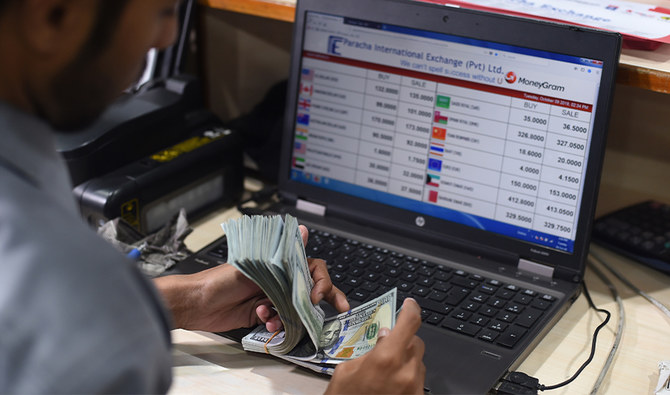
Local currency dealers agree with the assessment, saying about $2 million have been flowing out of the country to Afghanistan on a daily basis since the fall of Kabul.
“Afghans with dual nationality have been buying 1.5 to 2 million dollars on a daily basis from open market and taking it to their country since the American currency is now in a short supply over there,” Malik Bostan, Chairman Forex Association of Pakistan, told Arab News. “The inflow of dollars has stopped in the neighboring country, and Afghanistan's entire banking system has collapsed.”
“Previously, Pakistan received $5 million to $7 million from Afghanistan every day since currency was cheap over there and salary payments were mostly made in dollars,” he added.
Apart from the situation in Afghanistan, the Pakistani rupee is also weakening against greenback due to the country’s growing trade deficit.
Pakistan has recorded the highest trade deficit in August when its import bill stood at $6.3 billion and its export revenue was $2.25 billion, causing a trade deficit of $4.06 billion. Previously, the country had recorded its highest deficit of $3.77 billion in June 2018.
“The situation indicates that dollar is in a short supply to meet the demand of importers which is exerts a significant pressure on the national currency,” Samiullah Tariq, director research at the Pakistan-Kuwait Investment, told Arab News.
“In July, the current account deficit was $773 million, but it seems that it is going to be higher for August, though the remittance figures have yet not been released,” he added.
The State Bank of Pakistan reported on Thursday the country had $27.22 billion in foreign reserves. The country’s forex position was also strengthened since it received $2.75 billion from the International Monetary Fund (IMF) last week. However, this build-up has also failed to cool the currency market where the Pakistani rupee remains under pressure.
“The policy of the government or the central bank seems to be that it is not going to use its forex reserves to defend the rupee,” Tariq commented.


![]()

US withdrawal from Afghanistan, high import bill weaken Pakistan’s currency — traders
Short Url
https://arab.news/c6y5n
US withdrawal from Afghanistan, high import bill weaken Pakistan’s currency — traders
- Local currency dealers say nearly $2 million have been flowing to Afghanistan from Pakistan on a daily basis since the international military pullout
- The Pakistani currency has lost nearly 10 percent of its value against the US dollar in the last four months
Latest updates


© 2026 SAUDI RESEARCH & PUBLISHING COMPANY, All Rights Reserved And subject to Terms of Use Agreement.