

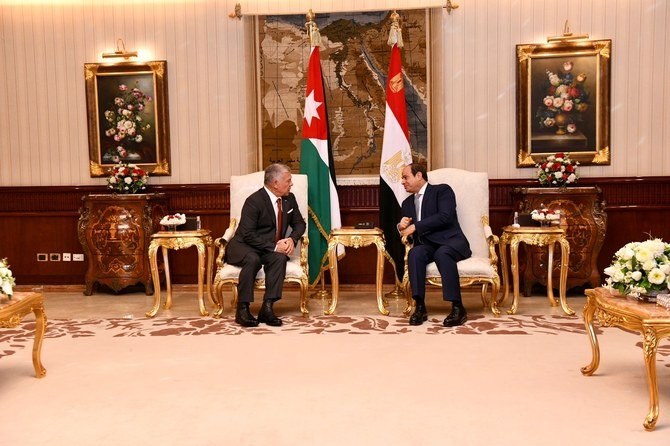
Leaders from Egypt, Jordan and Palestine attend trilateral summit, discuss Palestinian cause

A trilateral summit between the leaders of Egypt, Jordan and Palestine took place in Cairo on Thursday to discuss issues of mutual concern, including the Palestinian cause.
Short Url
Updated 03 September 2021
Follow

Leaders from Egypt, Jordan and Palestine attend trilateral summit, discuss Palestinian cause

  • The meeting discussed the latest developments regarding the Palestinian peace process
  • El-Sisi reaffirmed Cairo’s pledge to help the Palestinians restore their legitimate rights

CAIRO: A trilateral summit between the leaders of Egypt, Jordan and Palestine took place in Cairo on Thursday to discuss issues of mutual concern, including the Palestinian cause.

Egyptian President Abdel Fattah El-Sisi received Jordan’s King Abdullah and Palestinian President Mahmoud Abbas at the presidential palace.

Bassam Radi, spokesman for the presidency, said the meeting discussed the latest developments regarding the Palestinian peace process.

El-Sisi reaffirmed Cairo’s pledge to help the Palestinians restore their legitimate rights, push for the resumption of peace negotiations and consolidate the truce between the Palestinians and Israel, stressing the importance of unified efforts to achieve a political settlement.

He also stressed Egypt’s vision of how to revive the peace process, stabilize the truce in the Gaza Strip, and reconstruct the enclave, adding that achieving the aspirations of the Palestinian people for an independent state will only come by uniting the long-standing divisions between the West Bank and Gaza.

President Abbas and King Abdullah thanked El-Sisi for hosting the summit, emphasizing that the meeting represented an opportunity for discussion and exchange of views on how to put the Palestinian issue back on top of the international community’s priorities.

Abbas said he appreciated Egypt’s historic role in seeking a just and comprehensive solution to the Palestinian issue, which was recently manifested in Cairo’s efforts to broker a ceasefire between Hamas and Israel.

Abbas also underlined El-Sisi’s subsequent initiative for the reconstruction of Gaza.

The three agreed to continue intensive consultation and coordination for next steps regarding support for the Palestinian cause at various forums and at all levels.

Egypt and Jordan have been in talks with regional and international parties to revive the Israeli-Palestinian talks following the international resolutions, the Arab Peace Initiative and the two-state solution to establish an independent Palestinian state on the 1967 borders, with East Jerusalem as its capital.


UN rights chief Shocked by ‘unbearable’ Darfur atrocities

Updated 18 January 2026
Follow

UN rights chief Shocked by ‘unbearable’ Darfur atrocities

  • Mediation efforts have failed to produce a ceasefire, even after international outrage intensified last year with reports of mass killings, rape, and abductions during the RSF’s takeover of El-Fasher in Darfur

PORT SUDAN: Nearly three years of war have put the Sudanese people through “hell,” the UN’s rights chief said on Sunday, blasting the vast sums spent on advanced weaponry at the expense of humanitarian aid and the recruitment of child soldiers.
Since April 2023, Sudan has been gripped by a conflict between the army and the paramilitary Rapid Support Forces that has left tens of thousands of people dead and around 11 million displaced.
Speaking in Port Sudan during his first wartime visit, UN Human Rights commissioner Volker Turk said the population had endured “horror and hell,” calling it “despicable” that funds that “should be used to alleviate the suffering of the population” are instead spent on advanced weapons, particularly drones.
More than 21 million people are facing acute food insecurity, and two-thirds of Sudan’s population is in urgent need of humanitarian aid, according to the UN.
In addition to the world’s largest hunger and displacement crisis, Sudan is also facing “the increasing militarization of society by all parties to the conflict, including through the arming of civilians and recruitment and use of children,” Turk added.
He said he had heard testimony of “unbearable” atrocities from survivors of attacks in Darfur, and warned of similar crimes unfolding in the Kordofan region — the current epicenter of the fighting.
Testimony of these atrocities must be heard by “the commanders of this conflict and those who are arming, funding and profiting from this war,” he said.
Mediation efforts have failed to produce a ceasefire, even after international outrage intensified last year with reports of mass killings, rape, and abductions during the RSF’s takeover of El-Fasher in Darfur.
“We must ensure that the perpetrators of these horrific violations face justice regardless of the affiliation,” Turk said on Sunday, adding that repeated attacks on civilian infrastructure could constitute “war crimes.”
He called on both sides to “cease intolerable attacks against civilian objects that are indispensable to the civilian population, including markets, health facilities, schools and shelters.”
Turk again warned on Sunday that crimes similar to those seen in El-Fasher could recur in volatile Kordofan, where the RSF has advanced, besieging and attacking several key cities.
Hundreds of thousands face starvation across the region, where more than 65,000 people have been displaced since October, according to the latest UN figures.
