



LONDON: Hollywood actor-turned-producer Bo Svenson has had enough of the US entertainment industry’s one-dimensional depiction of characters from the Middle East. He is working on films he hopes will shake up the industry and position Arabs and Muslims to be the stars of their own stories.
Svenson, who was born in Sweden and is now an American citizen, has been appearing in blockbuster films for decades, including “Breaking Point,” “Heartbreak Ridge,” “Kill Bill 2” and “Inglourious Basterds.” With more than 120 film and TV acting credits to his name since his debut in the mid-1960s, the 80-year-old can justifiably claim to be one of Hollywood’s most prolific actors.
Now the CEO of production company MagicQuest Entertainment, he told Arab News that for his next venture he wants to use his position as a renowned filmmaker to “be of service to the Arab world.” He explained that he hopes to recruit Saudis to be part of his upcoming projects, and that one of his latest screenplays “is an opportunity to address the humanity within the Muslim world.”
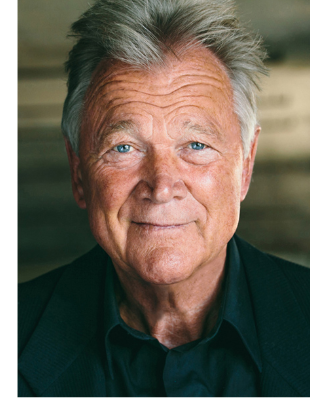
Bo Svenson
Set centuries ago, “The Red Cloth” features a Muslim character who flees religious persecution in Norway and becomes one of the first Europeans to set foot in what is now North America. Svenson described the story’s main character, Meshaal, as a “truly dignified human being” — a depiction he believes is sorely lacking in the modern US film industry.
“Many people in Hollywood take the easy way out,” he said. “They need a bad guy in a modern film? They use a Muslim, they use an Arab.
“I’m not into the easy way out. I want to do that which is nuanced, worthwhile, that which is dignified, and that which serves others.”
This would be a welcome change from the typical Hollywood portrayals of Arabs — and American Arabs in particular — according to Samer Khalaf, president of the American-Arab Anti-Discrimination Committee.
“Before the Sept. 11 attacks there was no nuance at all in how Hollywood portrayed Arabs and Muslims,” he said. “It was pure ‘Allahu Akbar’-screaming terrorists. That was the extent of the Arab character in just about any movie that touched upon it.
“Since then, the industry has moved forward slightly but there is still nobody writing from the Arab or Muslim perspective. They’re relying on centuries-old stereotypes when writing their characters. There is no nuance.
“There’s no normal, everyday, average Arab American being portrayed. In reality, there are Arab Americans and Muslim Americans from all walks of life, but in the films they are never being portrayed as normal people.”
This reflects ignorance about the role Arabs have played in American society for well over a century, Khalaf added.
“There’s no realization that Arab Americans have been part of the fabric of this country since the mid-to-late 1800s,” he said. “Those Arabs are silent in the movies. The character is always based on the Arab or Muslim that is a new immigrant, out of their depth in a new world and speaking with a heavy accent.”
Such depictions inevitably skew public perceptions of the millions of Arabs in America, Khalaf said.
 “If you go to Middle America, where maybe people have not had the opportunity to meet an Arab or a Muslim, they are going to rely on what they see on the news — where they’re exposed to the most horrible aspects of what’s happening in the Middle East — or what they see in Hollywood,” he added.
“Right now, the bottom line is that a lot of movies that depict Arabs are foreign-based; they’re stories that happen in the Middle East. I cannot think of any, off the top of my head, that actually depict an Arab American lead character.”
Even those that do feature Arabs or Muslims in prominent roles are often based on the “white savior message, the whole idea that we need Western heroes to save us either from ourselves or our evil governments,” Khalaf said.
Recent agreements between streaming service Netflix and Israeli studios compound this effect, he added. “They are bringing in Israeli shows that are extremely racist and stereotypical about Arabs, particularly Palestinians.”


