

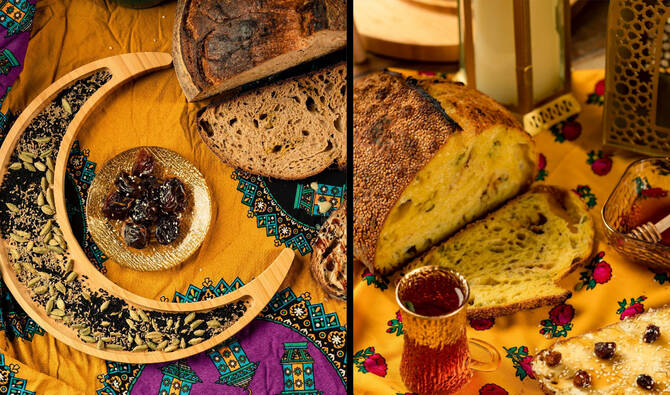
Where We Are Going Today: Ana Starter Sourdough Factory in Dammam

Short Url
Updated 25 February 2026
Follow

Where We Are Going Today: Ana Starter Sourdough Factory in Dammam

Since returning to live in the Kingdom after years abroad with the best bakeries at my fingertips, I have been on a mission to find suitable sourdough locally. I sampled many mediocre ones, but one would rise above the rest: Ana Starter Sourdough Factory.

I first met founder Aisha Al-Omair at the Juthoor Farmer’s Market and tried her bread then. I liked it immediately.

“Ana Starter Sourdough Factory started as a passion for creating and fermenting the healthiest bread and introducing it to the Saudi market,” she told me at the time.

It began as a personal mission then expanded — like the dough — to serve the community.

“For a long time, I’ve suffered feeding my kids proper bread. The breads that were available at the supermarkets or at local bakeries had instant yeast, that never really took time to ferment, and therefore, when you consume the average bread, you notice some stiffening, you notice indigestion, you notice bloating and heartburn.”

Indeed, I did not feel any bloating or heartburn after devouring a slice or a few so I recently went on a quest to find more.

I ventured to Dammam to find her factory shop. It is a tiny slither of a place — I almost missed it while driving past factories in the Industrial City.

The shop comes with a decadent whiff of delicious bread.

Upon entering, you will see fridges stocked with bread and goodies like jams and butters (from other brands) that complement the bread well.

The sourdough offerings include jalapeno cheddar, zataar, plain and about a dozen other flavors.

The hassawi sourdough, made with local dates from neighboring Al-Ahsa, quickly became my favorite. It has little bits of dates tucked inside like tiny treasures.

Each slice is separated with a sheet, making it easy to freeze and pull out what you need without slices sticking together.

Fluffy with a rustic crust, it is great for sandwiches, dipping in olive oil, or slathering with salted butter.

My freezer is now packed with loaves.

At around SR45 ($12) per loaf, the price is slightly steep for the local market, but the superior quality is worth the extra dough.

Each day, they post on Instagram Stories showing what is available for pickup — and the quantity of each item.

Ordering is easy: Send a DM to reserve a loaf, swing by the shop, or opt for delivery.

• For more details, check their Instagram @anaastarter.


Lebanese filmmaker turns archival footage into a love letter to Beirut

Updated 28 February 2026
Follow

Lebanese filmmaker turns archival footage into a love letter to Beirut

LONDON: Lebanese filmmaker Lana Daher’s debut feature “Do You Love Me” is a love letter of sorts to Beirut, composed entirely of archival material spanning seven decades across film, television, home videos and photography.

The film premiered at the 82nd Venice International Film Festival in September and has since traveled to several regional and international festivals.

Pink Smoke (2020) by Ben Hubbard. (Supplied)

With minimal dialogue, the film relies heavily on image and sound to reconstruct Lebanon’s fragmented history.

“By resisting voiceover and autobiography, I feel like I had to trust the image and the shared emotional landscape of these archives to carry the meaning,” Daher said.

A Suspended Life (Ghazal el-Banat) (1985) by Jocelyne Saab. (Supplied)

She explained that in a city like Beirut “where trauma is rarely private,” the socio-political context becomes the atmosphere of the film, with personal memory expanding into a collective experience — “a shared terrain of emotional history.”

Daher said: “By using the accumulated visual representations of Beirut, I was, in a way, rewriting my own representation of home through images that already existed."

Whispers (1980) by Maroun Bagdadi. (Supplied)

Daher, with editor Qutaiba Barhamji, steered clear of long sequences, preferring individual shots that allowed them to “reassemble meaning” while maintaining the integrity of their own work and respecting the original material, she explained.

The film does not feature a voice-over, an intentional decision that influenced the use of sound, music, and silence.

The Boombox (1995) by Fouad Elkoury. (Supplied)

“By resisting the urge to fill every space with dialogue or score, we created room for discomfort,” Daher said, adding that silence allows the audience to sit with the image and enter its emotional space rather than being guided too explicitly.

 The film was a labor of love, challenging Daher personally and professionally.

“When you draw from personal memory, you’re not just directing scenes, you’re revisiting parts of yourself and your childhood,” she said. “There’s vulnerability in that.”