

Israeli strikes target pro-Iran groups in Syria: monitor

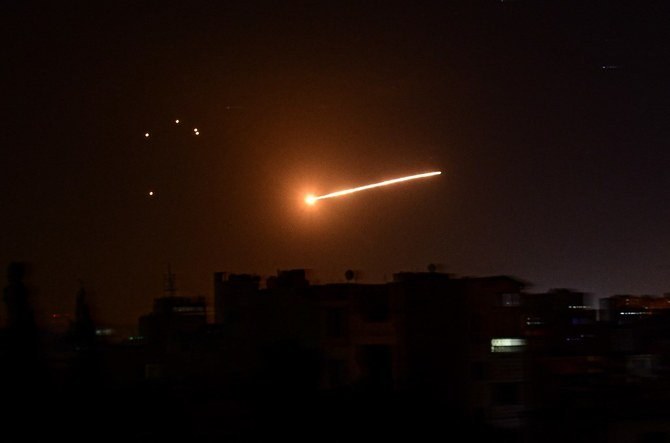
Syrian air defences intercept an Israeli missile in the sky over the Syrian capital Damascus. (File/AFP)
Short Url
Updated 03 September 2021
Follow

Israeli strikes target pro-Iran groups in Syria: monitor

BEIRUT: Israeli missile strikes hit military positions used by pro-Iran groups near the Syrian capital Damascus overnight, a war monitor said Friday.

The strikes on the suburbs of Barzeh and Jamraya “targeted Syrian regime military positions that are used by pro-Iran groups” to store and develop weapons, said the Syrian Observatory for Human Rights.

The Observatory, which is based in Britain and relies on a network of sources inside Syria for its reports, said it could not immediately confirm if there were any casualties.

The official SANA news agency said Syrian air defenses shot down most of the missiles.

“The Syrian army’s air defenses intercepted after midnight an Israeli missile attack in the vicinity of Damascus,” SANA said, adding the attack only caused material damage.

It published pictures and video footage appearing to show air defenses responding to the attack.

AFP reporters heard loud explosions in the Syrian capital.

Since the outbreak of the Syrian civil war in 2011, Israel has routinely carried out raids in Syria, mostly targeting Iranian and Lebanese Hezbollah forces as well as Syrian government troops.

The Israeli army rarely acknowledges its strikes but it often says it will not allow Syria to become a stronghold of its arch-foe Iran.

Late last month, Israeli strikes near Damascus killed four pro-Iran militia fighters.


UN, aid groups warn Gaza operations at risk from Israel impediments

Updated 18 December 2025
Follow

UN, aid groups warn Gaza operations at risk from Israel impediments

  • Dozens of international aid groups face de-registration by December 31, which then means they have to close operations within 60 days

UNITED NATIONS: The United Nations and aid groups warned on Wednesday that humanitarian operations in the Palestinian territories, particularly Gaza, were at risk of collapse if Israel does not lift impediments that include a “vague, arbitrary, and highly politicized” registration process.
Dozens of international aid groups face de-registration by December 31, which then means they have to close operations within 60 days, said the UN and more than 200 local and international aid groups in a joint statement.
“The deregistration of INGOs (international aid groups) in Gaza will have a catastrophic impact on access to essential and basic services,” the statement read.
“INGOs run or support the majority of field hospitals, primary health care centers, emergency shelter responses, water and sanitation services, nutrition stabilization centers for children with acute malnutrition, and critical mine action activities,” it said.

SUPPLIES LEFT OUT OF REACH: GROUPS
While some international aid groups have been registered under the system that was introduced in March, “the ongoing re-registration process and other arbitrary hindrances to humanitarian operations have left millions of dollars’ worth of essential supplies — including food, medical items, hygiene materials, and shelter assistance — stuck outside of Gaza and unable to reach people in need,” the statement read.
Israel’s mission to the United Nations in New York did not immediately respond to a request for comment on the statement. Under the first phase of US President Donald Trump’s Gaza plan, a fragile ceasefire in the two-year-old war between Israel and Palestinian militants Hamas began on October 10. Hamas released hostages, Israel freed detained Palestinians and more aid began flowing into the enclave where a global hunger monitor said in August famine had taken hold.
However, Hamas says fewer aid trucks are entering Gaza than was agreed. Aid agencies say there is far less aid than required, and that Israel is blocking many necessary items from coming in. Israel denies that and says it is abiding by its obligations under the truce.
“The UN will not be able to compensate for the collapse of INGOs’ operations if they are de-registered, and the humanitarian response cannot be replaced by alternative actors operating outside established humanitarian principles,” the statement by the UN and aid groups said.
The statement stressed “humanitarian access is not optional, conditional or political,” adding: “Lifesaving assistance must be allowed to reach Palestinians without further delay.”