Pakistan to register real estate companies to fulfill compliance conditions of FATF watchdog

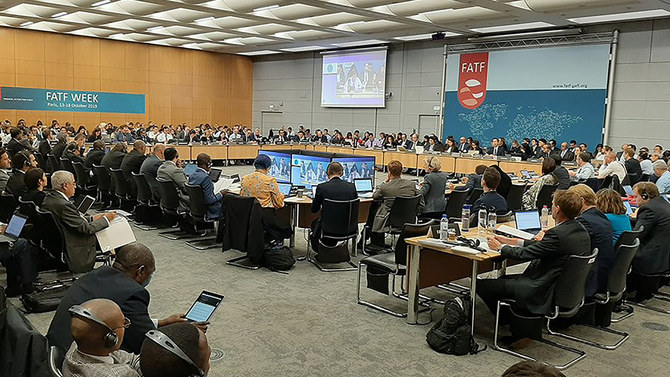
This undated file photo shows a FATF meeting in progress. (Photo courtesy: @FATFNews/Twitter)
Short Url
Updated 03 September 2021
Follow

Pakistan to register real estate companies to fulfill compliance conditions of FATF watchdog

  • The global financial watchdog wants the country to demonstrate it can monitor non-financial businesses that can be exploited for money laundering, terror financing
  • Analysts say Pakistan is now an over-regulated country after striving to meet different FATF conditions

KARACHI: Pakistan wants local real estate enterprises to voluntarily register themselves as designated non-financial businesses and professions (DNFBP) “within the next couple of days” to fulfil one of the key compliance conditions of the Financial Action Task Force (FATF), realtors and officials confirmed while talking to Arab News on Thursday.
The international financial watchdog asked Pakistan in June to continue its efforts to address the strategic deficiencies in its financial system that could be exploited by criminals who wanted to launder money or fund terrorist activities.
The international organization also wanted the country to demonstrate its ability to monitor the DNFBPs that do not belong to the financial sector of the country but can help individuals or entities conceal their criminal revenues.
According to the FATF, such businesses include casinos, trusts, individuals and companies dealing in precious metals and stones and real estate firms etc.
“Realtors are expected to start voluntarily registering themselves with the Designated Non-Financial Businesses and Professions Directorate at the Federal Board of Revenue [FBR] within the next couple of days,” Muhammad Ahsan Malik, general secretary of the Real Estate Consultants Association, told Arab News.
“Earlier, there was no clarity on what we were required to provide the authorities,” he continued. “Now the responsibilities of realtors have been defined and we know the record we need to maintain.”
Last month, Pakistan took measures to register property dealers, developers and builders to counter money laundering and terror financing that could take place through property transactions. These steps also included the establishment of a separate directorate at the FBR.
“The FBR has been made the regulatory authority for which a separate directorate general has been instituted,” Syed Nadeem Hussain Rizvi, an FBR spokesperson, told Arab News. “Its basic purpose is regulation, and it has nothing to do with tax issues.”
He informed that realtors were initially reluctant to register with the directorate since they feared the mechanism would deter buyers and sellers who might not want to share their details with the tax agency.
“The process has just begun and will be reviewed by the FATF,” he added.
The new mechanism is devised to help realtors identify the names of 4,500 proscribed individuals involved in money laundering and terror financing who are on a list prepared by the United Nations. The system will generate Suspicious Transaction Report (STR) if the names of these people emerged during a transaction.
Pakistan’s real estate developers said they understood that registration was now an international requirement.
“As developers, we don’t have any other choice but to follow the requirement,” Muhammad Hassan Bakshi, member of the prime minister’s taskforce on housing and former chairman of the Association of Builders and Developers of Pakistan, told Arab News.
Pakistan was placed on the FATF grey list of countries in 2018 due to its weak financial system.
Analysts say the country has technically completed most of the requirements imposed by the international financial watchdog, though they also believe any decision to remove its name from the grey list can be influenced by political considerations.
“Pakistan has completed its technical regulations and is now over-regulated,” Dr. Vaqar Ahmed, joint executive director at the Sustainable Development Policy Institute, told Arab News. “In the upcoming [FATF] meeting, the Afghan situation will surely come up for discussion and Pakistan will be viewed through the Afghan lens. Any decision regarding the grey list is therefore likely to be purely political.”


Separated twice: An Afghan man’s life in Pakistan and the fear of losing home again

Updated 27 January 2026
Follow

Separated twice: An Afghan man’s life in Pakistan and the fear of losing home again

  • Lost as a child in Peshawar, Mohammad Rahim Khan built a life in Pakistan but remains undocumented
  • Deportation drive of ‘illegal’ foreigners exposes legal gaps around adoption, marriage, refugee status

ISLAMABAD: Mohammad Rahim Khan was five years old when he last saw his mother.

It was at the Hajji Camp bus stop in Pakistan’s northwestern city of Peshawar, more than four decades ago. His mother, an Afghan refugee fleeing war, had brought him across the Tari Mangal border in Kurram district and into Pakistan. While waiting at the crowded terminal, Khan wandered to a nearby toy shop. When he returned, she was gone.

He searched for her for two days. She never came back.

A local shopkeeper, Ali Muhammad, took pity on the child and brought him home, promising to help find his family. The temporary shelter became permanent. Khan grew up in Pakistan, adopted informally into the household, and never returned to Afghanistan.

Now 45, he lives on the outskirts of Islamabad in a modest two-room house, working as a daily wage laborer. But a nationwide deportation drive launched by Pakistan in 2023 has placed his entire life under threat.

Since November 2023, authorities have deported nearly 2 million Afghan nationals, targeting those without legal documentation. Khan, who has remained undocumented throughout his adult life, fears he may soon be among them.

“I spoke to my lawyer that I am very worried,” Khan told Arab News. “I love Pakistan.”

A FAMILY WITHOUT PAPERS

Ali Muhammad later married Khan to his daughter, Gul Mina. Together, they have six children, four daughters and two sons. Yet despite decades in Pakistan, Khan’s Afghan nationality continues to shadow the family.

Khan never held an Afghan refugee card, Afghan Citizen Card (ACC), Proof of Registration (POR), or any other formal documentation. His family assumed for decades that his informal adoption, marriage to a Pakistani citizen, and long residence would provide sufficient legal standing. They only sought legal advice when the deportation drive began threatening separation.

Without a Pakistani national identity card, his children cannot obtain Form-B, the birth registration document required for school enrolment.

“They [children] are told to get a Form-B,” Gul Mina told Arab News. “Otherwise, they will not go to school.”

Three of their daughters were forced to leave school after eighth grade.

Healthcare has also been affected. When Khan’s 13-year-old son, Ehsanullah, fractured his arm, a public hospital refused to issue a registration card without identity documents.

“Then I went to a [private clinic] in Chak Shahzad and got my treatment there,” Khan said.

The family has petitioned the Islamabad High Court to block his deportation. Lawyers say the case highlights how thousands of long-term residents fall through legal cracks created by Pakistan’s citizenship, refugee and documentation framework.

LEGAL GREY ZONE

Pakistan does not legally recognize Western-style adoption. Instead, it uses a guardianship system under the 1890 Guardians and Wards Act, aligning with Islamic principles that preserve lineage, so adopted children don’t inherit or change their family name but receive care, education and welfare through court-appointed guardianship.

“Because we don’t have a legal pathway for adoption per se, the adopted child does not get citizenship of the adopting parents automatically,” said Advocate Umer Ijaz Gillani, a legal expert on citizenship.

Years earlier, Khan’s father-in-law had offered to register him as his biological son to obtain identity documents, but Khan refused, calling the move fraudulent. Because Khan later married his father-in-law’s daughter, both he and his wife cannot legally list the same person as their father on official records, leaving them without a lawful workaround.

Marriage offers no certainty either. Pakistan’s Citizenship Act of 1951 grants citizenship to foreign women married to Pakistani men, but is silent on foreign husbands married to Pakistani women.

While higher courts have, at times, ruled in favor of such men, implementation has been inconsistent. In October 2025, the Supreme Court struck down a high court order that had directed authorities to grant citizenship to an Afghan man married to a Pakistani woman.

Even the Pakistan Origin Card (POC), a long-term residency document, remains difficult to secure.

“We have experienced that in the case of especially Afghan men who marry Pakistani women, the government authorities are often reluctant to recognize this right,” Gillani said.

According to submissions made by government officials in court, authorities have received at least 117 applications for nationality from Afghan men married to Pakistani women following directives issued by the Peshawar High Court, reflecting a broader pattern rather than isolated cases.

‘NO RELAXATION’

Officials say the deportation policy allows no exceptions.

“No relaxation has been granted by the government, including for those who’ve married to Pakistani citizens,” said Asmatullah Shah, the chief commissionerate for Afghan refugees.

“If they want to live here, they should go back and apply for a visa and then they can come here with valid documentation.”

Legal experts note that deportation would send Khan to Afghanistan despite having no known relatives there, and that returning legally would require obtaining an Afghan passport and a Pakistani visa, costs far beyond the means of a daily wage laborer.

For Khan’s mother-in-law, Husn Pari, who raised him for decades as her own son, the prospect is devastating.

“When I am not able to meet [Khan] for one day, my day does not pass,” she said. “His own mother, how much pain must she be in?”

For Khan, the fear of deportation echoes the trauma of his childhood.

“Before I was separated from my first mother,” he said. “The second time I will be separated from my second mother. This is very difficult for me.”