


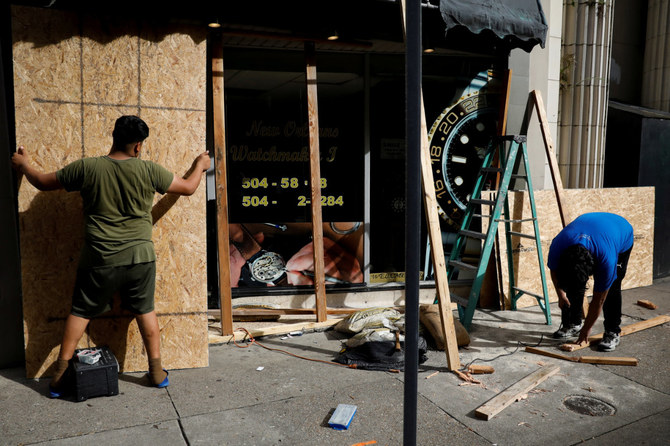


Hurricane Ida intensified over warm Gulf of Mexico waters on Saturday, prompting tens of thousands to flee coastal areas, while President Joe Biden pledged aid to help states quickly recover once the storm has passed.
Forecasters said Ida could make a US landfall on Sunday night as an “extremely dangerous” Category 4 storm on the five-step Saffir-Simpson scale, generating winds of 140 miles per hour (225 kph), heavy downpours and a tidal surge that could plunge much of the Louisiana shoreline under several feet of water.
On Saturday evening Ida was about 200 miles (320 km) southeast of the mouth of the Mississippi River, packing top winds of 105 miles per hour (169 kph) and aiming for the Louisiana coast, the National Hurricane Center said.
“We’re concerned about explosive development shortly before it makes landfall,” said Jim Foerster, chief meteorologist at DTN, which provides weather advice to oil and transportation companies.
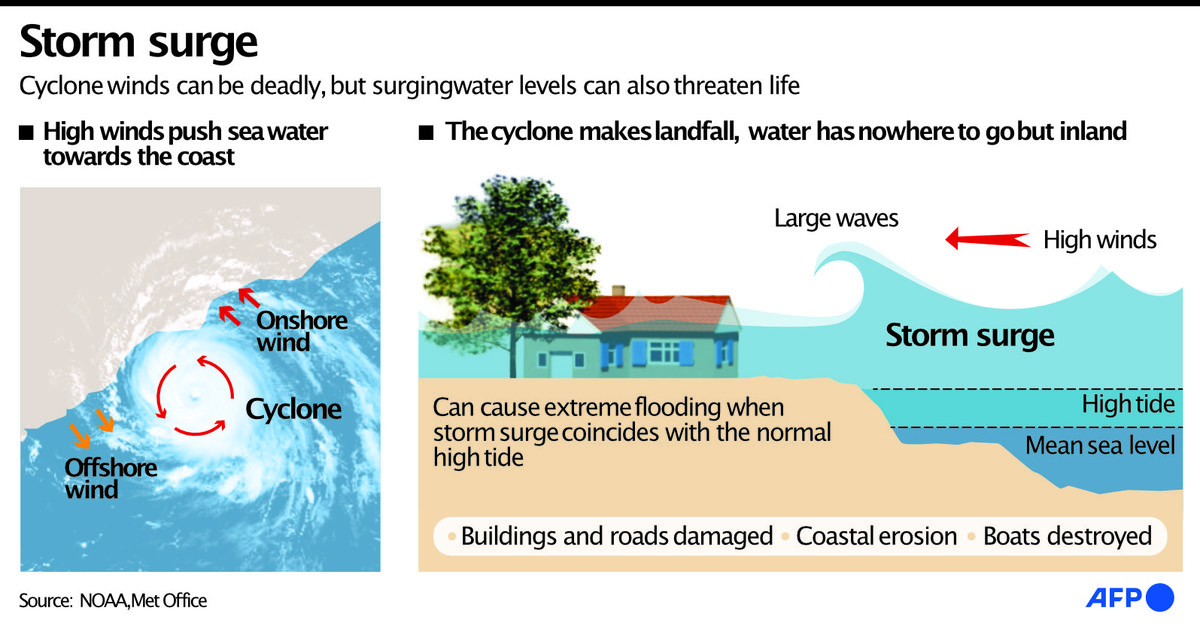
Flooding from Ida’s storm surge — high water driven by the hurricane’s winds — could reach between 10 and 15 feet (3 and 4.5 meters) around the mouth of the Mississippi River, with lower levels extending east along the adjacent coastlines of Mississippi and Alabama, the NHC said.
Officials ordered https://twitter.com/nolaready/status/1431297701535158279 widespread evacuations of low-lying and coastal areas, jamming highways and leading some gasoline stations to run dry as residents and vacationers fled the seashore.
“I left Fourchon last night at 8 o’clock and it’s a ghost town,” said Andre LeBlanc, a sportfishing captain speaking from his inland home in Lafayette, Louisiana. “We were some of the last to get out of there.”
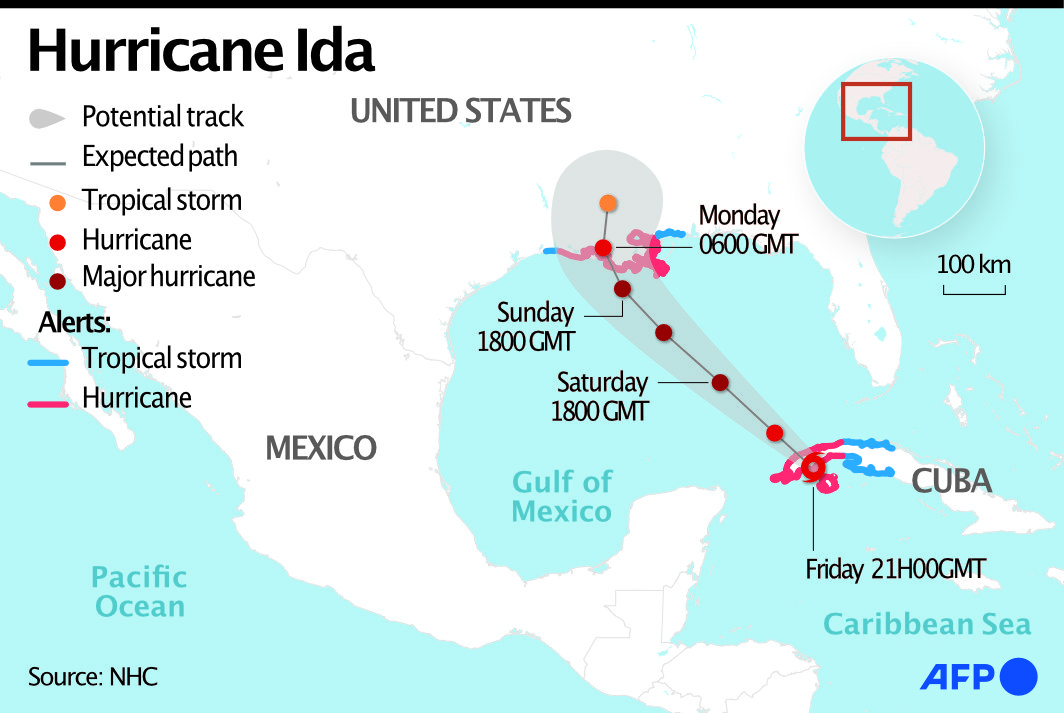
Utilities were bringing in extra crews and equipment to deal with expected power losses. Hundreds of thousands of homes could fall dark as Ida’s strong winds carry well into Louisiana and as far east at Mobile, Alabama, said DTN’s Foerster.
Biden on Saturday said 500 federal emergency response workers were in Texas and Louisiana to respond to the storm. Aid workers have “closely coordinated with the electric utilities to restore power as soon as possible,” Biden said at a briefing with Federal Emergency Management Agency officials.
Louisiana Governor John Bel Edwards, whose state is already reeling from a public health crisis stemming from a fourth wave of the COVID-19 pandemic, said Ida’s winds will be fierce and spread across a 300-mile area.
“We have a very serious situation on our hands,” Edwards said at a briefing. “This will be one of the strongest hurricanes to hit anywhere in the state of Louisiana since at least the 1850s.”
The state is not planning to evacuate hospitals now strained by an influx of COVID-19 patients, he said. There were more than 3,400 new infections reported on Friday, and about 2,700 people are hospitalized with the virus.
“We have been talking to hospitals to make sure that their generators are working, that they have way more water on hand than normal, that they have PPE on hand,” Edwards said.
US energy companies reduced offshore oil production by 91 percent and gasoline refiners cut operations at Louisiana plants in the path of the storm. Regional fuel prices rose in anticipation of production losses.
Phillips 66 completed the shutdown of its Alliance refinery on Louisiana’s coast, and PBF Energy Inc. reduced its Chalmette, Louisiana, processing, people familiar with the matter said.
Exxon Mobil Corp. is cutting production by 50 percent at its Baton Rouge, Louisiana, refinery said sources familiar with plant operations.
Gasoline demand in Louisiana was up 71 percent for the week ended Friday, said Patrick DeHaan, head of petroleum analysis at tracking firm GasBuddy.
Ida, the ninth named storm and fourth hurricane of the 2021 Atlantic hurricane season, may well exceed the strength of Hurricane Laura, the last Category 4 storm to strike Louisiana, by the time it makes landfall, forecasters said.
The region was devastated in August 2005 by Hurricane Katrina, which killed more than 1,800 people.
Scott Pierce, 32, evacuated to Florida to escape Idaho
“We’re terrified,” said Pierce, an engineer worried about his home on the shores of Lake Pontchartrain, the site of some of the worst flooding in Hurricane Katrina.


