‘High expectations’ from Baghdad summit to reduce regional tensions, analysts say

1 / 3
Iraq's President Salih and France's President Macron attend a news conference in Baghdad. (Reuters)
2 / 3
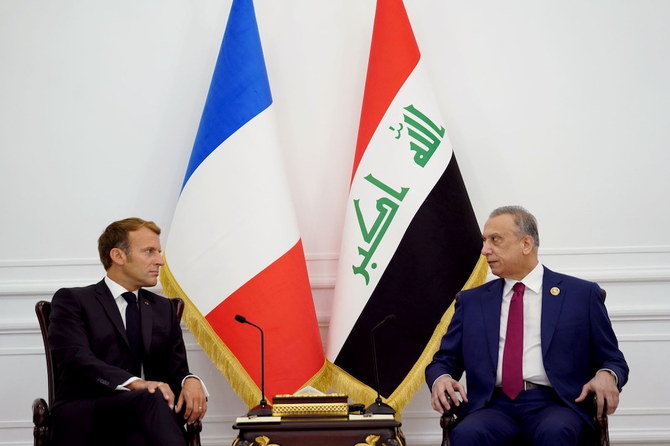
Iraqi Prime Minister Mustafa Al-Kadhimi, right, meets with French President Emmanuel Macron ahead of the Baghdad summit on Aug. 28, 2021. (Reuters)
3 / 3
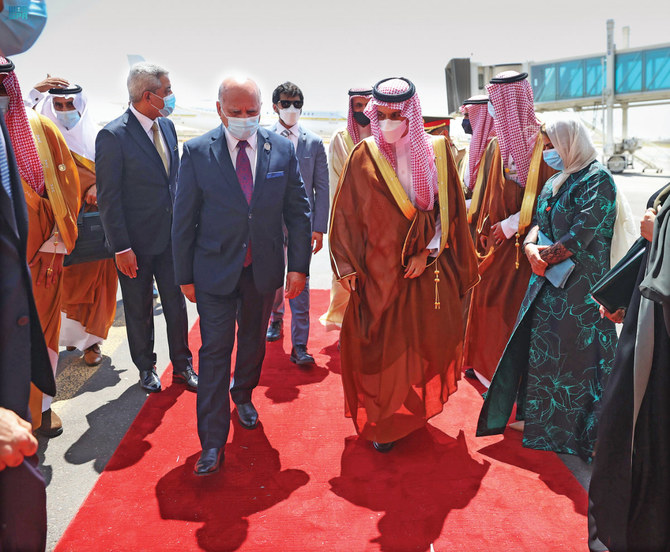
Saudi Foreign Minister Prince Faisal bin Farhan being received by his Iraqi counterpart Fuad Hussein in Baghdad on Saturday. (SPA)
Short Url
Updated 29 August 2021
Follow

‘High expectations’ from Baghdad summit to reduce regional tensions, analysts say

  • Iraq takes center stage for talks to boost regional security
  • Prince Faisal leads Saudi delegation at landmark summit in Baghdad

AMMAN: Arab leaders and senior officials held rare talks on Saturday at a conference hosted by Iraq aimed at easing Middle East security tensions.
The Saudi delegation was led by Foreign Minister Prince Faisal bin Farhan, who said the Kingdom would continue to work to enhance Iraq’s security and stability, and preserve its institutions.
Prince Faisal said Saudi Arabia continued to cooperate with Iraq and partner countries in the region to confront the threat of terrorism, and supported Baghdad’s efforts to cooperate with the international coalition to confront the remnants of Daesh.
The minister took part in talks with Egyptian President Abdel Fattah El-Sisi, King Abdullah of Jordan, and Sheikh Tamim bin Hamad Al-Thani, the emir of Qatar. 
The UAE and Kuwait were represented by their prime ministers, and Iran and Turkey by their foreign ministers.
The high-level meeting sent a message of Arab solidarity with Iraq. Macron, whose country is co-organizing the meeting, described Saturday’s meeting as “historic,” showcasing Iraq’s return to stability following the ruinous war against the Daesh group, which was defeated in 2017.
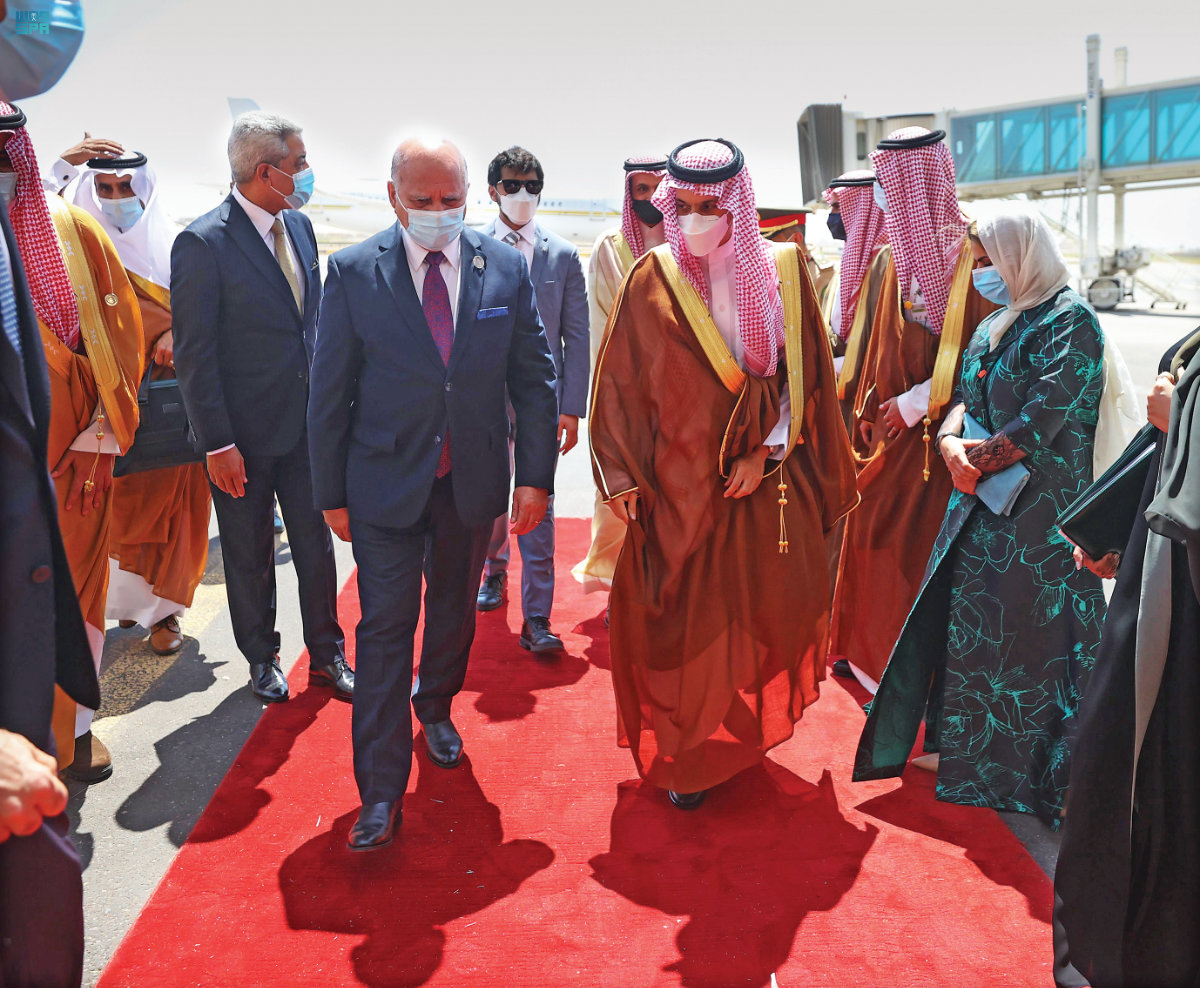


Saudi Foreign Minister Prince Faisal bin Farhan being received by his Iraqi counterpart Fuad Hussein in Baghdad on Saturday. (SPA)

“Iraq, which for years has been a headline for war and conflicts, is hosting leaders and representatives of the region today to affirm their support for Iraqi sovereignty and prosperity,” said President Barham Salih.
French President Emmanuel Macron also attended the Baghdad meeting, and said France would continue to deploy troops in Iraq to battle terrorism even if the US withdrew.
“We all know that we must not lower our guard, because Daesh remains a threat, and I know that the fight against these terrorist groups is a priority of your government,” Macron told Iraqi Prime Minister Mustafa Al-Kadhimi.

Participants in the summit also discussed the regional water crisis, the war in Yemen and the economic and political crisis that has brought Lebanon to the point of collapse. However, analysts said the meeting’s major significance was that it took place at all. 
“This summit marks the return of Iraq as a pivotal player in the region,” said Ihsan Al-Shammari, head of the Iraqi Political Thinking Center in Baghdad. “Having rival parties seated at the same table is a significant step in that direction.”
Mamdouh Al-Abadi, Jordan’s former deputy prime minister, told Arab News that “even the least important meetings” between leaders were “better than no meetings.” 
“One should not minimize the personal chemistry and relations that are developed in such meetings, and their effect on lowering tensions,” he said.
However, Al-Abadi warned against too much optimism. “If the Syrians are invited and attend the summit, then it would be a game changer,” he added.

Boost for Iraqi PM
He further said that the summit will be a boost to Iraqi PM Al-Kadhimi, who is facing a tough domestic political battle after a campaign announcement by firebrand populist Shiite leader Muqtada Sadr.
On Friday, Sadr reversed his decision to boycott the October elections and said that his movement would take part in order to “end corruption.”

This summit marks the return of Iraq as a pivotal player in the region.”

Ihsan Al-Shammari, head of the Iraqi Political Thinking Center in Baghdad


Adnan Abu Odeh, former adviser to Jordan’s King Hussein and King Abdullah, told Arab News that the regional meeting is largely about Iran. 
“When regional and world leaders meet, the main issue is usually a regional one, and in this case, Iran and its relations with other countries will most likely be the focus.”
Abu Odeh said that the foreign policy of US President Joe Biden “has made Arab leaders worried — if you can’t depend on the Americans, you start looking for regional solutions.”
Reem Badran, a former parliamentarian in Jordan, told Arab News that “any meeting of regional leaders gives us hope.
“We are always optimistic when leaders meet,” she said, adding: “The new situation is no different. On the economic level, we are hopeful that these summit meetings can be translated into economic stability, especially if major energy and transport projects can be carried out.”
Badran, who now runs a business, Al-Hurra Project Management, and is active in women’s microbusiness financing, said that an improvement of the economic situation would also have a direct effect on women “who are paying the highest price among all segments of our society.”
Tagreed Odeh, Middle Eastern Studies program coordinator at the Council on International Educational Exchange, said that the Baghdad summit is “a golden opportunity to widen space for dialogue with the aim of putting out the regional fires that have consumed the Middle East.”
Odeh said that the key to the success of the summit is “the fact that the host country, Iraq, has declared its willingness to prepare all that is required to have a welcoming atmosphere for all participants.”
Economic reporter Salameh Derrawi said that while the attendees are diverse, the key players are the Jordanians, Egyptians and Iraqis. “The leaders of those three countries have been working hard on finalizing regional projects in the areas of energy, oil pipelines and tax-free industrial zones.”


Gaza’s tiny Christian community tries to capture the holiday spirit during the ceasefire

Updated 9 sec ago
Follow

Gaza’s tiny Christian community tries to capture the holiday spirit during the ceasefire

  • Gaza’s tiny Palestinian Christian community is trying to capture some of the Christmas spirit under a fragile ceasefire in the Israel-Hamas war
  • One 76-year-old Christian finds hope in his faith while sheltering at Gaza’s Holy Family Church compound
GAZA: Attallah Tarazi recently received Christmas presents that included socks and a scarf to shield him against the Gaza winter, and he joined some fellow Palestinian Christians in a round of hymns.
“Christ is born,” the group sang in Arabic. “Hallelujah.”
The presents and hymns offered the 76-year-old a taste of the holiday in a devastated Gaza, where a fragile ceasefire has provided some relief, but the losses of the Israel-Hamas war and the ongoing struggles of displaced people are dampening many traditional festivities.
Tarazi and much of the rest of Gaza’s tiny Palestinian Christian community are trying to capture some of the season’s spirit despite the destruction and uncertainty that surround them. He clings to hope and the faith that he said has seen him through the war.
“I feel like our joy over Christ’s birth must surpass all the bitterness that we’ve been through,” he said. He’s been sheltering for more than two years at the Holy Family Church compound in Gaza, where a church group including choir members toured among displaced people this Christmas season, he said.
“In such a glorious moment, it’s our right to forget all that’s war, all that’s danger, all that’s bombardment.”
But for some, the toll is inescapable.
This will be the first Christmas for Shadi Abo Dowd since the death of his mother, who was among those killed in July when an Israeli attack hit the same Catholic church compound where Tarazi lives and which has been housing displaced people. Israel issued statements of regret and said it was an accident.
Abo Dowd said his son was wounded in the assault that also hurt the parish priest.
Ahead of Christmas, the Latin patriarch of Jerusalem, Cardinal Pierbattista Pizzaballa, paid a visit to the Holy Family Parish. A patriarchate statement said the visit marked the beginning of Christmas celebrations in “a community that has lived and continues to live through dark and challenging times.”
Suffering and a state of ‘no peace and no war’
Abo Dowd, an Orthodox Christian who observes Christmas on Jan. 7, said he does not plan to celebrate beyond religious rituals and prayers. “There’s no feast,” he said.
“Things are difficult. The wound is still there,” he said. “The suffering and pain are still there.”
He added: “We’re still living in a state of no peace and no war.”
Israeli strikes have decreased since the ceasefire agreement took effect in October, but deadly attackshave not entirely ended. Israel and Hamas have traded accusations of breaking the truce and the more challenging second phase has yet to be implemented.
The war began when Hamas-led militants stormed into Israel on Oct. 7, 2023, killing some 1,200 people and taking about 250 hostages.
Israel’s ensuing offensive has killed nearly 71,000 Palestinians in Gaza, according to Gaza’s Health Ministry, which does not differentiate between civilians and combatants but says around half the deaths were women and children.
The ministry, which operates under the Hamas-run government, is staffed by medical professionals and maintains detailed records viewed as generally reliable by the international community.
Israel’s offensive in Gaza has also caused widespread destruction and displaced the vast majority of the territory’s some 2 million residents. Highlighting some of the many struggles and needs of the enclave and its people was torrential rain that recently flooded displacement camps and collapsed already badly damaged buildings.
“I always tell my children, ‘God only gives the toughest battles to his strongest soldiers,’” Abo Dowd said. “We’re holding onto our Christian faith and onto our country, and we love our country.”
He and others know of many Christians among those who fled Gaza during the war and more who hope to leave if given the opportunity. He worries about the effect on the Christian presence and on Gaza’s social fabric. “It’s a tragedy,” he said.
His children would like to study abroad. “They’re young. What will they stay to do? There’s no future.”
A Christmas without many familiar faces
The departure of many relatives and friends means Christmas doesn’t feel the same for 23-year-old Wafa Emad ElSayegh.
He and family members gathered with others at Gaza’s Greek Orthodox church compound to put up decorations. But the absence of friends who escaped Gaza fueled his nostalgia.
“We used to be together in everything,” said ElSayegh, who’s now staying with his family at the home of an aunt who left Gaza during the war.
His favorite part of Christmas was the togetherness — the family gatherings, the celebratory events that he said drew Christians and some Muslims, and the excitement of children receiving gifts.
“There would be celebrations, songs and an indescribable joy that we, unfortunately, haven’t felt in a long time,” he said. And with many relatives away, he said the usual Christmas atmosphere cannot be recreated.
Joy amid the pain
Elynour Amash, 35, is trying to bring some of that cheer to her children “through decorating and lighting the tree so they can feel that joy is possible despite all pain.”
“My children feel a little bit of joy, like breathing after a long period of suffocation,” she said in written responses to The Associated Press. “They’re happy they’re celebrating without fear of a nearby explosion and because some chocolates and sweets have returned to their lives, in addition to foods that they had long been deprived of.”
She’s thankful her home is still standing, but the scenes of displaced people in tents that cannot shield them from the cold and rain often drive her to tears.
She doesn’t feel like the war has truly ended.
“The sounds of explosions and gunfire can still be heard, and the fear hasn’t left the hearts. There’s continuous worry that the ceasefire won’t last.” She sees the toll in her youngest, who trembles when he hears loud noises.
“It’s as if the war lives inside of him,” she said. “As a mother, that pain is indescribable.”
She also worries that someday Christians could disappear from Gaza. But, for now, “our presence, no matter how small, is a testimony of love, steadfastness and faith in this land,” she said.
Tarazi is determined to stay.
Early in the war, he lost a sister, who was among those killed when an Israeli airstrike hit the Orthodox church compound housing displaced people. The Israeli military said it had targeted a nearby Hamas command center. Tarazi said a brother also died after he could not get needed medical care due to the war.
He prays for peace and freedom for the Palestinian people. “Our faith and our joy over Christ’s birth are stronger than all circumstances,” he said.