

Israeli PM aims to push Biden away from Iran nuclear deal

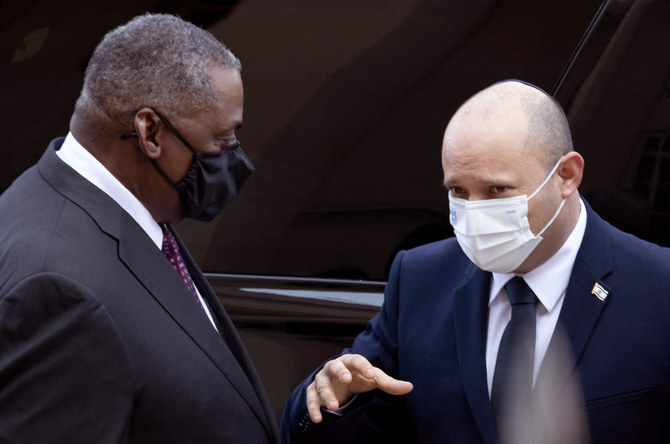
Israeli Prime Minister Naftali Bennett (R) is greeted by US Secretary of Defense Gen. Lloyd Austin during an honor cordon at the Pentagon on Aug. 25, 2021 in Arlington, Virginia. (File/AFP)
Short Url
Updated 27 August 2021
Follow

Israeli PM aims to push Biden away from Iran nuclear deal

  • Bennett made clear that he would push against the Iran deal, arguing Tehran has already advanced in its uranium enrichment
  • Bennett’s Washington visit comes weeks after Ebrahim Raisi was sworn in as Iran’s new president

WASHINGTON: Israeli Prime Minister Naftali Bennett is aiming to dissuade President Joe Biden from returning to the Iran nuclear deal when the two leaders meet at the White House Friday.

The meeting, originally scheduled for Thursday, was postponed for one day as Biden focused his attention on dealing with the aftermath of a suicide bomb attack at the Kabul airport that killed at least 13 US troops.

“On behalf of the people of Israel, I share our deep sadness over the loss of American lives in Kabul,” Bennett said in a statement posted on social media. “Israel stands with the United States in these difficult times, just as America has always stood with us. Our thoughts and prayers are with the people of the United States.”

Before arriving in Washington, Bennett made clear that he would push against the Iran deal, arguing Tehran has already advanced in its uranium enrichment, and sanctions relief would give Iran more resources to back Israel’s enemies in the region.

The Israeli leader met separately Wednesday with Secretary of State Antony Blinken and Defense Secretary Lloyd Austin to discuss Iran and other issues. The visit is his first to the US as prime minister.

Bennett told his Cabinet before the trip that he would tell the American president “that now is the time to halt the Iranians, to stop this thing” and not to reenter “a nuclear deal that has already expired and is not relevant, even to those who thought it was once relevant.”

Biden has made clear his desire to find a path to salvage the 2015 landmark pact cultivated by Barack Obama’s administration but scuttled in 2018 by Donald Trump’s. But US indirect talks with Iran have stalled and Washington continues to maintain crippling sanctions on the country as regional hostilities simmer.

Trump’s decision to withdraw from Iran’s nuclear deal led Tehran to abandon over time every limitation the accord imposed on its nuclear enrichment. The country now enriches a small amount of uranium up to 63 percent, a short step from weapons-grade levels, compared with 3.67 percent under the deal. It also spins far more advanced centrifuges and more of them than were allowed under the accord, worrying nuclear nonproliferation experts even though Tehran insists its program is peaceful.

Bennett’s Washington visit comes weeks after Ebrahim Raisi was sworn in as Iran’s new president.

Raisi, 60, a conservative cleric with close ties to Supreme Leader Ayatollah Ali Khamenei, has suggested he’ll engage with the US But he also has struck a hard-line stance, ruling out negotiations aimed at limiting Iranian missile development and support for regional militias — something the Biden administration wants to address in a new accord.

Administration officials acknowledged that Iran’s potential “breakout” — the time needed to amass enough fissile material for a single nuclear weapon — is now down to a matter of months or less.

But a senior administration official, who spoke on condition of anonymity to preview the scheduled talks, said the administration sees the maximum pressure campaign employed by the Trump administration as having emboldened Iran to push ahead with its nuclear program.

Bennett is also looking to turn the page from his predecessor, Benjamin Netanyahu.

Netanyahu had a close relationship with Trump after frequently clashing with Obama. Biden, who has met with every Israeli prime minister since Golda Meir, had his own tensions with Netanyahu over the years.

During his latest White House campaign, Biden called Netanyahu “counterproductive” and an “extreme right” leader.


Egyptian woman faces death threats for filming alleged harasser

Updated 47 min 48 sec ago
Follow

Egyptian woman faces death threats for filming alleged harasser

  • Case revives longstanding national debate in Egypt over harassment and violence against women
  • A 2013 UN study found that 99.3 percent of Egyptian women reported experiencing harassment

CAIRO: A young Egyptian woman is facing death threats after posting a video showing the face of a man she says repeatedly harassed her, reviving debate over how victims are treated in the country.
Mariam Shawky, an actress in her twenties, filmed the man aboard a crowded Cairo bus earlier this week, accusing him of stalking and harassing her near her workplace on multiple occasions.
“This time, he followed me on the bus,” Shawky, who has been dubbed “the bus girl” by local media, said in a clip posted on TikTok.
“He kept harassing me,” added the woman, who did not respond to an AFP request for comment.
Hoping other passengers would intervene, Shawky instead found herself isolated. The video shows several men at the back of the bus staring at her coldly as she confronts her alleged harasser.
The man mocks her appearance, calls her “trash,” questions her clothing and moves toward her in what appears to be a threatening manner.
No one steps in to help. One male passenger, holding prayer beads, orders her to sit down and be quiet, while another gently restrains the man but does not defend Shawky.
Death threats
As the video spread across social media, the woman received a brief flurry of support, but it was quickly overwhelmed by a torrent of abuse.
Some high-profile public figures fueled the backlash.
Singer Hassan Shakosh suggested she had provoked the situation by wearing a piercing, saying it was “obvious what she was looking for.”
Online, the comments were more extreme. “I’ll be the first to kill you,” one user wrote. “If you were killed, no one would mourn you,” said another.
The case has revived a longstanding national debate in Egypt over harassment and violence against women.
A 2013 UN study found that 99.3 percent of Egyptian women reported experiencing harassment, with more than 80 percent saying they faced it regularly on public transport.
That same year, widespread protests against sexual violence rocked the Egyptian capital.
In 2014, a law criminalizing street harassment was passed. However, progress since then has been limited. Enforcement remains inconsistent and authorities have never released figures on the number of convictions.
Public concern spiked after previous high-profile incidents, including the 2022 killing of university student Nayera Ashraf, stabbed to death by a man whose advances she had rejected.
The perpetrator was executed, yet at the time “some asked for his release,” said prominent Egyptian feminist activist Nadeen Ashraf, whose social-media campaigning helped spark Egypt’s MeToo movement in 2020.
Denials
In the latest case, the authorities moved to act even though the bus company denied any incident had taken place in a statement later reissued by the Ministry of Transport.
The Interior Ministry said that the man seen in the video had been “identified and arrested” the day after the clip went viral.
Confronted with the footage, he denied both the harassment and ever having met the woman before, according to the ministry.
Local media reported he was later released on bail of 1,000 Egyptian pounds (around $20), before being detained again over a pre-existing loan case.
His lawyer has called for a psychiatric evaluation of Shawky, accusing her of damaging Egypt’s reputation.
These images tell “the whole world that there are harassers in Egypt and that Egyptian men encourage harassment, defend it and remain silent,” said lawyer Ali Fayez on Facebook.
Ashraf told AFP that the case revealed above all “a systemic and structural problem.”
She said such incidents were “never taken seriously” and that blame was almost always shifted onto women’s appearance.
“If the woman is veiled, they’ll say her clothes are tight. And if her hair is uncovered, they’ll look at her hair. And even if she wears a niqab, they’ll say she’s wearing makeup.”
“There will always be something.”