LONDON: A British Muslim of Iraqi-Kurdish origin is walking from the UK to Saudi Arabia to arrive in time for next year’s Hajj pilgrimage.
Adam Mohamed, 52, set off from Wolverhampton, where he lives, on Aug. 1 and aims to reach Makkah before the pilgrimage starts in July.
He has already reached the Netherlands and will pass through Germany, the Czech Republic, Bulgaria, Turkey, Syria and Jordan. The journey is around 6,500 km and he is walking on average 17.8 km each day.
“One day I just woke up and I said I am going to walk toward Hajj, toward Makkah, which is what I did, and to pray on the way and beg for Allah to give us mercy and forgive us as a humankind, all of us, not just one race, or one identity, or one faith, everyone,” Mohamed told Arab News.
Hajj is one of the five pillars of Islam and must be performed at least once in a lifetime. The annual pilgrimage to Islam’s holiest city is one of the world’s largest gatherings with more than 2 million people taking part each year. This year however, Saudi authorities did not permit foreign pilgrims and restricted the ritual to 60,000 people already living inside the Kingdom in a bid to stop the spread of the coronavirus disease.
Pushing a cart weighing up to 250 kg and outfitted with speakers playing Islamic recitations, Mohamed said he is spreading messages of love, peace and equality.
“I came out from my home, and my journey is turning up to be Ummah’s (the community’s) journey,” he said. “Now, it’s not not my journey anymore, it’s for every different race, religion, faith and ethnicity.”
The self-employed electrical engineer is meeting dozens of people along the way.
“So many people are coming forward just to pay their respects from everywhere, they are bringing me food every single day, most of them pay me money as well and a lot of them leave everything behind and they come and stay with me and push the trolley with me,” he said.
A GoFundMe page was set up on Aug. 1 to raise money for his “Peace Journey from UK to Makkah” initiative and has raised nearly £30,000 ($41,240), well over his target of just £1,000.
Mohamed built the trolley, the size of a coffin, in two months with the help of a local welding company, and fitted it with electricity to help him sleep and cook. It bears the name of his mission in English and Arabic and at the back it reads “All Lives Matter.”
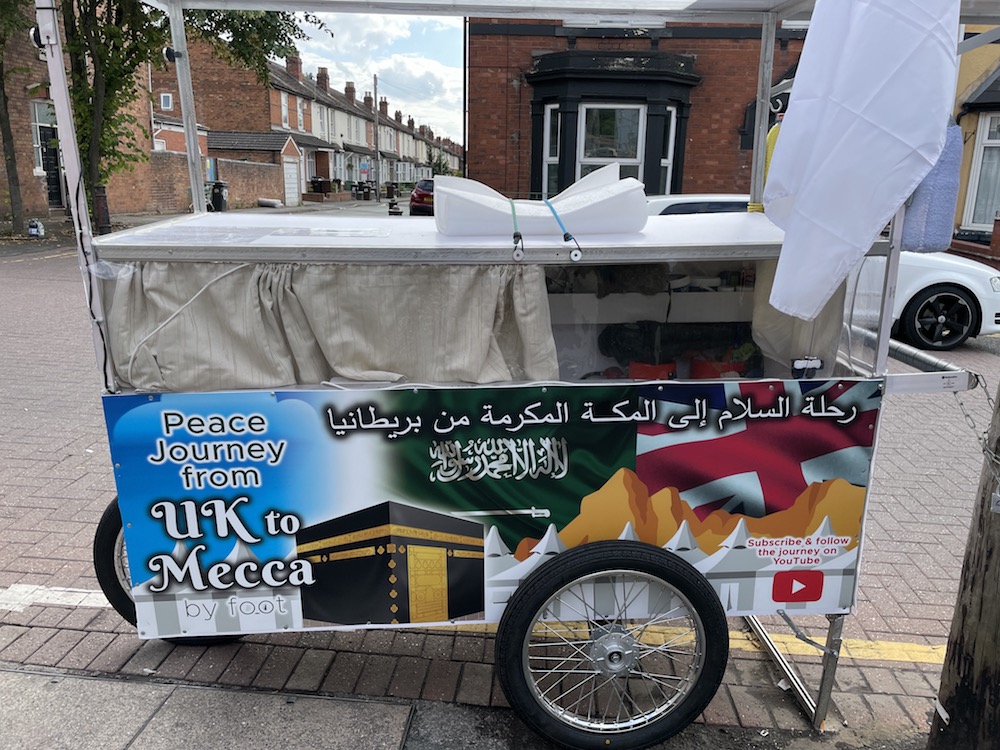
Adam Mohamed is walking from Wolverhampton in the UK to Makkah in Saudi Arabia while spreading messages of peace, love and equality. (Supplied)
After the pandemic hit, the father-of-two began questioning many things, dived deep into the Qur’an and began to examine life and human behavior. He said he wanted to remind people along the way that life is short and imagine if something else comes along “a little bit bigger or a little bit stronger, what could happen?” h
He said: “My message is to all humanity: Please stop hatred, stop judging people, we are human, we are brothers. Plus, we as Muslim communities in the EU — around 30 or 40 million Muslims — have been forced to leave our lands. We came here and we came as refugees, we came seeking peace. The people of Europe provide that for us, so we should respect them.”
Within 25 days he has gained half a million followers on TikTok as he documents his journey daily on social media. People driving past in their cars are beginning to recognize him with children running up to him and telling him that they are listening to his advice.
“You cannot imagine how happy and proud I feel when I see the kids running toward me and say ‘Uncle Adam, my hero’ and hug me. I’m inspiring them as well as women and men,” he said. In one of his videos, he also wears a hijab for a day as a tribute and to encourage Muslim women to wear it with pride.
The humble humanitarian said he is not bothered about fame and money, but wants to help people and be “a servant for humanity from the biggest head of the government, to the smallest member in the community.”
Mohamed, who speaks four languages, including Arabic and Farsi, has already received many requests for assistance when he returns, among which is a request to help fight against a ban on halal meats in European countries like France, Poland and the Netherlands.
Mohamed moved to the UK in the late 1990s after serving in the Iraqi army as a soldier and being captured as a prisoner of war. He expressed his pride in Queen Elizabeth II and the British government for removing difficulties faced by Muslims in other countries and the principle of basic human rights they adhere to.
“I feel honored to be his daughter because I never thought he would do something so amazing and bring so many people together,” his eldest daughter Dalya told Arab News.
“He brought peace, love and humanity and restored all of that back into us as humans, and I think a lot of us we’re forgetting that at the end of the day we are all brothers and sisters, and he is bringing so much positive in so much negative that there is at the moment in the world,” Dalya, 21, said. “It’s nice to see one person be able to bring all of this together.”