


RIYADH: With just nine days before schools start, the Ministry of Education’s most prominent transport provider has sought to ease parents’ concerns over domestic drivers being stuck abroad.
After 18 months of online learning, vaccinated students older than 12 are heading back to school on Aug. 29 for the new academic year. But many expats remain stuck abroad due to a ban on travel from several countries, with many of them working as family drivers, an integral part of a household for many Saudi families.
Last September, Saudi Arabia suspended flights arriving from India due to a surge in coronavirus disease (COVID-19) cases. Other countries were later added to the suspension list, including Pakistan, Indonesia, and Afghanistan.
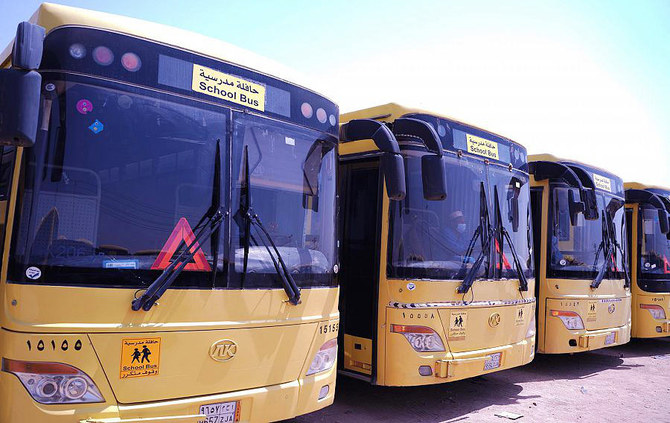
With schools reopening, Tatweer Educational Transportation Services Company, the MoE’s school transport provider, has completed preparations for the new academic year, ready to provide services with the highest precautionary standards to serve 1.2 million students across the Kingdom.
With a dearth of domestic drivers, companies such as the TTC and other MoE transportation initiatives are helping teachers and students get to schools and back home safely.
The TTC has taken measures to increase efficiency and ensure the optimal use of seats. Amid the increasing demand on services, the company is preventing seats being reserved by groups that do not use them and instead providing spaces for the neediest.
Khalida Al-Khaldi, a private school teacher in Jeddah who recently moved her twin daughters to a public school, will be using TTC this year as both she, her husband, and their daughters will be heading in opposite directions.
BACKGROUND
The TTC has taken measures to increase efficiency and ensure the optimal use of seats. Amid the increasing demand on services, the company is preventing seats being reserved by groups that do not use them and instead providing spaces for the neediest.
“The service came recommended by several colleagues who have used it before. Given our situation, this will be our best option, and the girls are old enough to know by now how to keep safe, clean, and take their precautionary measures while on the bus.”
But some parents are wary and are opting not to use buses to transport their kids to school.
Maha Salama Albalawi from Riyadh told Arab News: “We chose the school carefully; our kids need to be social and have a chance to experience a stable school environment. Each classroom has a specific number of kids, and they make sure to sanitize. As moms, we need a break from our kids, and it is healthier for them because they have a full productive day. They’ll even eat better now and sleep earlier, just like how it was before.”
Given that her family driver is also unable to return to the Kingdom, she said that she would prefer to transport her children herself as “buses do not seem like a healthy option for us at the moment. I need to make them wash their hands all the time and are careful,” she added.
Sharing his experience, Akhtarul Islam Siddiqui, an Indian expat whose four children are studying at Indian schools in Riyadh, said: “Most parents had been using school transport before the pandemic as they cannot drop and pick up their wards due to their job schedules, so they will continue with precautions assured by the transport providers.”
Siddiqui has had to rely on school transportation at one of Riyadh’s more expensive Indian international schools given his commute to work and Riyadh traffic. He told Arab News that some corrupt activities and mishandling of funds have put parents in a difficult financial position, questioning the ethics of the school’s transport system.
He said that the situation is out of his hands and that he is going to use a private bus company instead of the one the school is using.
With the growing demand for drivers, recruitment agencies are prepared to cover the high cost because the hiring group bears the travel ban.
Saquib Hamza, manager at Dynamic Staffing Services for Saudi Arabia, told Arab News: “During these difficult times, many people who went from Saudi Arabia to India and Pakistan are willing to come back to resume their employment.
“Currently, we have flight options to Saudi Arabia following the guidelines by the General Authority of Civil Aviation, which requires a 14-day quarantine from the Maldives, Armenia and Tanzania.
“The bookings are very popular, and the package comes between SR8,000 to 10,000 ($2,133 to 2,666) depending on the quarantine package and flight availability.”
He added: “If recruiters are willing to recover drivers from countries facing travel bans, we are ready to provide our service if they take responsibility for high travel costs.
“As a recruitment company, we are getting regular calls and follow-ups from thousands of job seekers, including drivers working in Saudi Arabia. People are desperate to return to Saudi Arabia as their families depend on them for livelihood.”
Hamza said: “I still believe Saudi Arabia can partially start direct flights from India, Pakistan for fully vaccinated people with mandatory quarantine periods in the Kingdom.”


