

Report: Taliban killed minorities, fueling Afghans’ fears

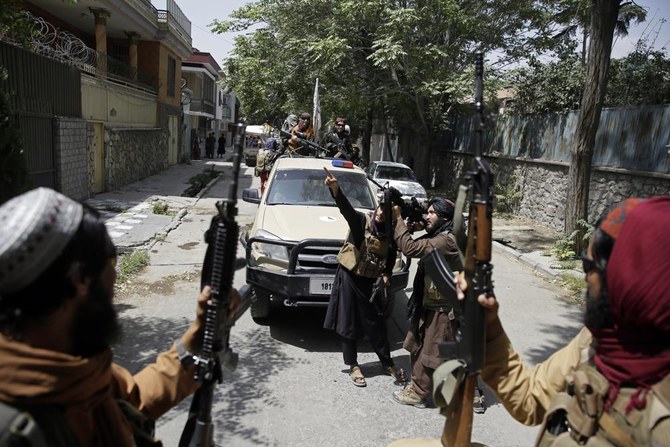
Taliban fighters patrol in Kabul, Afghanistan, Thursday, Aug. 19, 2021. (File/AP)
Short Url
Updated 20 August 2021
Follow

Report: Taliban killed minorities, fueling Afghans’ fears

  • The Taliban sought to project moderation and pledged to restore security and forgive those who fought them
  • Many Afghans are skeptical, and an Amnesty report provided evidence that undercut the Taliban’s claims

KABUL: Taliban fighters tortured and killed members of an ethnic minority in Afghanistan after recently overrunning their village, Amnesty International said, fueling fears that they will again impose a brutal rule, even as they urged imams to push a message of unity at the first gathering for Friday prayers since the capital was seized.

Terrified that the new de facto rulers would commit such abuses, thousands have raced to Kabul’s airport desperate to flee following the Taliban’s stunning blitz through the country. Others have taken to the streets to protest the takeover — acts of defiance that Taliban fighters have violently suppressed.

The Taliban have sought to project moderation and have pledged to restore security and forgive those who fought them in the 20 years since a US-led invasion. Ahead of Friday prayers, leaders urged to imams to use sermons to appeal for unity, urge people not to flee the country, and to counter “negative propaganda” about them.

But many Afghans are skeptical, and the Amnesty report provided more evidence that undercut the Taliban’s claims they have changed.

The rights group said that its researchers spoke to eyewitnesses in Ghazni province who recounted how the Taliban killed nine Hazara men in the village of Mundarakht on July 4-6. It said six of the men were shot, and three were tortured to death.

The brutality of the killings was “a reminder of the Taliban’s past record, and a horrifying indicator of what Taliban rule may bring,” said Agnes Callamard, the head of Amnesty International.

The group warned that many more killings may gone unreported because the Taliban have cut cellphone services in many areas they’ve captured to prevent images from there from being published.

Separately, Reporters without Borders expressed alarm at the news that Taliban fighters killed the family member of an Afghan journalist working for German broadcaster Deutsche Welle on Wednesday.

“Sadly, this confirms our worst fears,” said Katja Gloger of the press freedom group’s German section. “The brutal action of the Taliban show that the lives of independent media workers in Afghanistan are in acute danger.”

Many Afghans fear a return to the Taliban’s harsh rule in the late 1990s, when the group largely confined women to their homes, banned television and music, chopped off the hands of suspected thieves and held public executions.

Thousands continue to flock to Kabul’s airport, braving checkpoints manned by Taliban fighters as they seek desperately to get on evacuation flights out.

Mohammad Naim, who has been among the crowd at the airport for four days trying to escape the country, said he had to put his children on the roof of a car on the first day to save them from being crushed by the mass of people.

He saw other children killed after they were unable to get out of the way.

Naim, who said he had been an interpreter for US forces, said he had urged others not to the come to airport.

“It is a very, very crazy situation right now and I hope the situation gets better because I saw kids dying, it is very terrible,” he said.

The Pentagon said Thursday that about 2,000 people were brought out on American flights on each of the previous two days, and the State Department said 6,000 more were expected to leave that day. But thousands of Americans and their Afghan allies may be in need of escape.

Dozens of other flights have already brought hundreds more Western nationals and Afghan workers to Europe and elsewhere.

Chaos at the airport itself has sometimes hindered flights, but getting to the facility is the major challenge. Germany was sending two helicopters to Kabul to help bring small numbers of people from elsewhere in the city to the airport, officials said.

Australian Prime Minister Scott Morrison noted that Australian citizens have not been able to be evacuated from outside Kabul, and even in the capital the situation is difficult.

“The situation in Kabul does remain chaotic,” he said.

In recent days, some Afghans have protested the Taliban in several cities — a remarkable show of defiance that fighters often met with violence. At least one person was killed Wednesday at a rally in the eastern city of Jalalabad, after demonstrators lowered the Taliban’s flag and replaced it with the Afghan tricolor. Another person was seriously wounded at a protest a day later in Nangarhar province.

The demonstrations have come to the capital as well. On Thursday, a procession of cars and people near Kabul’s airport carried long black, red and green banners in honor of the Afghan flag — a banner that is becoming a symbol of defiance.

Meanwhile, opposition figures gathering in the last area of the country not under Taliban rule talked of launching an armed resistance. It was not clear how serious a threat they posed given that Taliban fighters overran nearly the entire country in a matter of days with little resistance from Afghan forces.

In addition to concerns about Taliban abuses, officials have warned that Afghanistan’s already weakened economy could crumble further without the massive international aid that sustained the toppled Western-backed government. The UN says there are dire food shortages and experts said the country was severely in need of cash with much of the government’s funds abroad frozen.

After the Taliban overran Kabul the market used by many in the capital to exchange money was closed down.

Underscoring the difficulties the Taliban will face in returning the country to normal life, trader Aminullah Amin said Friday that it would stay closed for the time being. There was just too much uncertainty surrounding exchange rates, how the Taliban might regulate the market, and the possibility of looting.

“We have not decided to reopen the markets yet,” he said.


Thailand heads to polls with voters demanding ‘real change’

Updated 4 sec ago
Follow

Thailand heads to polls with voters demanding ‘real change’

  • Millennials, Generation Z make up around 46.5 percent of Thailand’s eligible voters
  • Voters will also decide on whether to rewrite current military-backed constitution

BANGKOK: Thai voters will head to the polls on Sunday after cycling through three prime ministers in less than three years, with the three-way contest of major parties set to decide the leader of the Southeast Asian nation over the next four years.

For the first time in the country’s history, nearly 53 million eligible voters in the kingdom of 71 million people will choose 500 lawmakers and also decide whether to rewrite the constitution.

The snap election was called in December by Anutin Charnvirakul, Thailand’s third premier since the 2023 election, who dissolved the House of Representatives to preempt a looming no-confidence vote.

More than 5,000 candidates from 57 parties are registered to take part in the polls, which will directly elect 400 lawmakers based on constituencies, while 100 others will be chosen from “party list” nominees, who gain seats according to each party’s proportional share of the vote.

Together, they will constitute the 500 members of the House of Representatives who will select the prime minister.

“This election is a gamble on the future of Thailand. Over the past decade, I have never seen the country move backward as much as it has,” Lawan Sarovat, a 60-year-old resident of Bangkok, told Arab News.

Thailand has been struggling with prolonged political uncertainty and a series of challenges, including an economy stuck at about 2 percent growth for the past five years and a border conflict with Cambodia last year that killed more than 100 people and cost at least $436 million.

“We want to see change. We had hoped that the previous election would bring about real change, but that did not happen. This time, people must try to make their voices heard in every possible way,” Sarovat said.

Main contenders

Sunday’s vote pits incumbent Prime Minister Charnvirakul’s Bhumjaithai party, which is backed by Thailand’s royalist conservative establishment, with the progressive youth-led People’s Party and Pheu Thai, a once-dominant party associated with now-jailed former premier Thaksin Shinawatra.

A nationwide survey by the National Institute of Development Administration put People’s Party leader Natthaphong Ruengpanyawut in first place for prime minister at over 29 percent, followed by Anutin at more than 22 percent.

The People’s Party was also a leading choice in terms of party preference, chosen by more than 33.5 percent of the January survey’s 2,500 respondents, while Bhumjaithai and Pheu Thai came second and third with about 22.7 percent and 16.9 percent, respectively.

The People’s Party is the successor to the group that won the last election — Move Forward — but was blocked from power, despite winning the greatest number of seats in the House of Representatives with the support of 14 million Thais.

It was eventually dissolved by the Constitutional Court over its proposals to revise the country’s strict royal insult laws.

“Elections in Thailand are not simply about citizens voting to choose a government. They are surrounded by multiple factors,” Thai senator Tewarit Maneechai told Arab News.

Even after securing popular support, Thai political parties must gain acceptance from a network of independent bodies established under the current constitution, including the Senate, the Constitutional Court, and the National Anti-Corruption Commission.

These institutions, Maneechai said, continue to function as mechanisms of the old power structure that has dominated Thailand’s political direction since the 2014 military coup.

Under this system, even an elected government can be removed from office at any time. Maneechai pointed to the case of Paetongtarn Shinawatra, ex-premier from the Pheu Thai Party, who was removed from office in August 2025 following a ruling by the Constitutional Court — a decision that raised public concerns over the expanding authority of independent agencies.

“There are surrounding factors that determine whether a government can actually be formed. Political parties that are able to govern are those that operate within the rules designed by the group that came to power through the coup,” Maneechai said.

Constitutional referendum

On Sunday, voters will also decide if a new constitution should replace a military-backed 2017 charter.

The ballot will simply ask voters if they “approve that there should be a new constitution,” with options of “Yes,” “No,” or “No opinion.”

The referendum needs more than 17 million votes in favor to become “a mandate that the entire country must heed,” Maneechai said.

“The referendum matters because even if a party wins the election, its ability to remain in power ultimately depends on independent mechanisms under the current constitution, which have the authority to remove a prime minister and destabilize a government.”

Though a majority “Yes” would kickstart a multi-stage drafting process, it will require two more referendums before a new charter could be adopted.

Change vs. status quo

Jamza Jongkham is among many Thai voters hoping that the election will lead to a constitutional reform.

“Right now, Thai politics is operating under rules controlled by an authoritarian camp that dominates the entire system, overriding political parties elected by the people,” he told Arab News.

The 27-year-old said what happened to the Move Forward party in 2023 was “fundamentally unfair,” and despite anger at how powerful politicians misuse power, he still has hopes in the younger generation.

Together, millennials and Generation Z make up around 46.5 percent of Thailand’s eligible voters.

“I still believe that people’s voices matter. If we choose to remain silent and do not exercise our right to vote, I believe Thailand will only become worse. There are still many people who want to see this country move in a better direction,” he said.

“If we can change the system so that everyone can participate in politics on an equal footing, I believe Thailand would become a far more just society.”

Puangthong Pawakapan, a political scientist at Chulalongkorn University, said Sunday’s vote is unlikely to serve as a decisive turning point in Thai politics, but rather reflect “an increasingly intense political struggle” between the public and entrenched power structures.

“This election has divided both those in power and the public into two clear sides — those who want change and those who want to preserve the status quo,” she told Arab News.

“Today, the public clearly sees that Thailand’s political and economic problems are rooted in an old power structure that is extremely difficult to change.”