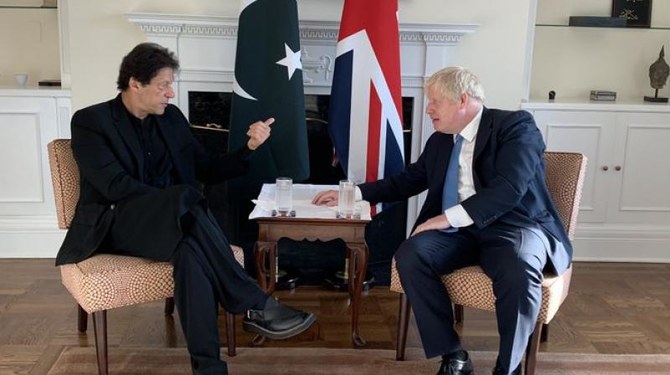
ISLAMABAD: British Prime Minister Boris Johnson told Pakistan on Tuesday any recognition of the new government in Afghanistan should happen on an international, not unilateral basis.
He made the statement during a phone call with Prime Minister Imran Khan wherein the two leaders also agreed to remain in touch to discuss the changing situation in Afghanistan.
The Taliban captured Kabul on Sunday without a fight, after taking over Afghanistan city by city in the last two weeks.
Pakistan’s information minister Chaudhry Fawad Hussain already announced earlier in the day that his country would consult regional and international powers before making a decision on recognizing Taliban rule in Afghanistan.
“It has to be a regional decision, it has to be with consultation of regional and international powers,” Hussain said at a press conference in Islamabad. “We don’t want to take a unilateral decision on that, we are in touch with our regional and international friends and we will decide accordingly.”
Hussain’s statement came a day after Pakistan’s National Security Committee met to discuss the evolving situation in Afghanistan.
The insurgent group has since announced an “amnesty” across the country and urged women to join its government, trying to calm nerves across the country.
On Tuesday, a senior official of the group ordered fighters to maintain discipline and not enter any diplomatic buildings or interfere with embassy vehicles, and allow ordinary people to go about their business as usual.
In separate comments, Pakistani interior minister Sheikh Rashid said Islamabad had also raised concerns with the Afghan Taliban over the release of members of the outlawed Tehreek-e-Taliban Pakistan.
The TTP, or Pakistani Taliban, is separate but allied to the Afghan Taliban. As the Afghan Taliban overran cities last week, reports surfaced that many TTP prisoners had also been released from Afghan prisons, including former TTP deputy chief Maulana Faqir Mohammad.
“The outlawed TTP and Daesh militants are present in the mountainous ranges of Nooristan and Nighar,” Rashid had told the Afghan Taliban, as quoted by Geo. “We have taken the Taliban on-board over the TTP issue and told them that Pakistan will not allow its soil to be used against Afghanistan and hope Afghanistan won’t allow its soil to be used against Pakistan.”


![]()

Britain urges Pakistan not to unilaterally decide on recognizing Taliban rule in Afghanistan
Short Url
https://arab.news/cz367
Britain urges Pakistan not to unilaterally decide on recognizing Taliban rule in Afghanistan
- Prime Minister Boris Johnson made the statement during a phone call with his Pakistani counterpart
- Pakistan’s information minister had already said recognizing the Taliban would be a regional, international decision
Latest updates


Recommended


© 2026 SAUDI RESEARCH & PUBLISHING COMPANY, All Rights Reserved And subject to Terms of Use Agreement.